On eBird ↗
Wattled Crane
Live sightings near you, the range map, bar charts of when it is seen, and Macaulay Library photos and recordings.
Wattled Crane
Grus carunculatus
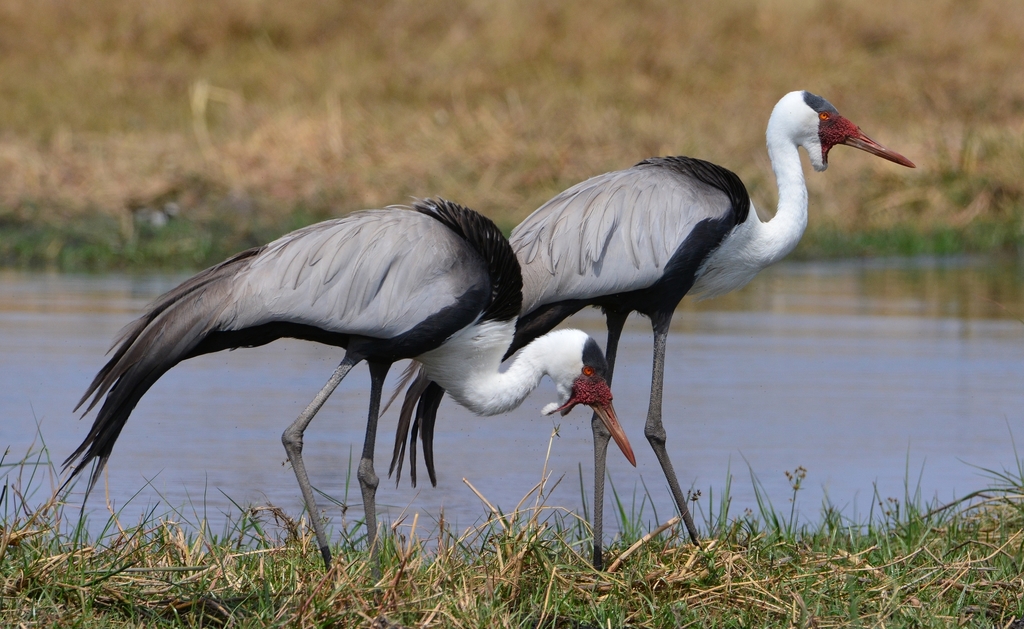
The wattled crane (Grus carunculata) is a large, threatened species of crane found in wetlands and grasslands of eastern and southern Africa, ranging from Ethiopia to South Africa. Some authorities consider it the sole member of the genus Bugeranus.
From the article Wattled crane on Wikipedia (CC BY-SA), quoted section by section
Description
At a height known to range from 150 to 175 cm (4 ft 11 in to 5 ft 9 in), it is the largest crane in Africa and is the second tallest species of crane in the world, after the sarus crane. It is also the tallest flying bird native to Africa third only among all birds to the two species of ostrich. The wattled crane is taller and, despite the appearance of gracility imparted by its sharp but slim beak and slender neck and legs, is the heaviest on average of several very large, long-legged waders in Africa (i.e. the 2 largest African storks, shoebill, greater flamingo, goliath heron). It is also roughly the fourth heaviest African flying bird after the great white pelican, the much more sexually dimorphic kori bustard and cape vulture. The wingspan is 230–260 cm (7 ft 7 in – 8 ft 6 in), the length is typically 110 to 140 cm (3 ft 7 in to 4 ft 7 in) and weight is 6.4–8.28 kg (14.1–18.3 lb) in females and 7.5–9 kg (17–20 lb) in males. Among standard measurements, the wing chord length is 61.3–71.7 cm (24.1–28.2 in), the exposed culmen is 12.4–18.5 cm (4.9–7.3 in) and the tarsus is 23.2–34.2 cm (9.1–13.5 in). Going on standard measurements, it is the second largest proportioned crane after the sarus species, outsizing in these respects even the ostentatiously heavier red-crowned crane. Three adult wattled cranes averaged 8.15 kg (18.0 lb). The back and wings are ashy gray. …
Range & habitat
The wattled crane occurs in eleven countries in eastern and southern Africa, including an isolated population in the Ethiopia Highlands. More than half of the world's wattled cranes occur in Zambia, but the single largest concentration occurs in the Okavango Delta of Botswana.
The wattled crane has been spotted in Uganda for the first time in 2011, seen in the Kibimba Rice region in the eastern side of the country. This sighting brings the total number of bird species in Uganda to 1040. In April 2018, a new population of Wattled Cranes was discovered in Angola.
Wikipedia: “Range”
What it does
Wattled cranes inhabit fairly inaccessible wetlands under most conditions. It requires shallow marsh-like habitats with a good deal of sedge-based vegetation. All cranes are omnivorous. The principal food of the wattled crane is mainly aquatic eating the tubers and rhizomes of submerged sedges and water lilies. It is one of the more herbivorous of extant cranes. The other primary portion of the diet consists of aquatic insects. They will supplement the diet with snails, amphibians and snakes when the opportunity arises. Roughly 90% of foraging done by this species occurs in shallow waters. They typically forage by digging vigorously with their bill into the muddy soil. On occasion, it will eat grain and grass seed as well, but does so much less often than the other three African crane species.
Wikipedia: “Habitat and diet”
Listen
Looking for field recordings…
Where it lives
Recorded sightings
—
geo-referenced records in GBIF, from museums, herbaria and field observers.
Drag the globe to turn it. Dots are where records exist, not a range map; darker means more records.
In the stacks
Searching the stacks…
Every page naming Grus carunculatus in the Biodiversity Heritage Library →
This page is assembled live from iNaturalist, GBIF, Wikipedia, the Source Library and the Internet Archive. It is not yet part of the hand-edited codex. iNaturalist taxon 57.