On eBird ↗
Koepcke's Hermit
Live sightings near you, the range map, bar charts of when it is seen, and Macaulay Library photos and recordings.
Koepcke's Hermit
Phaethornis koepckeae
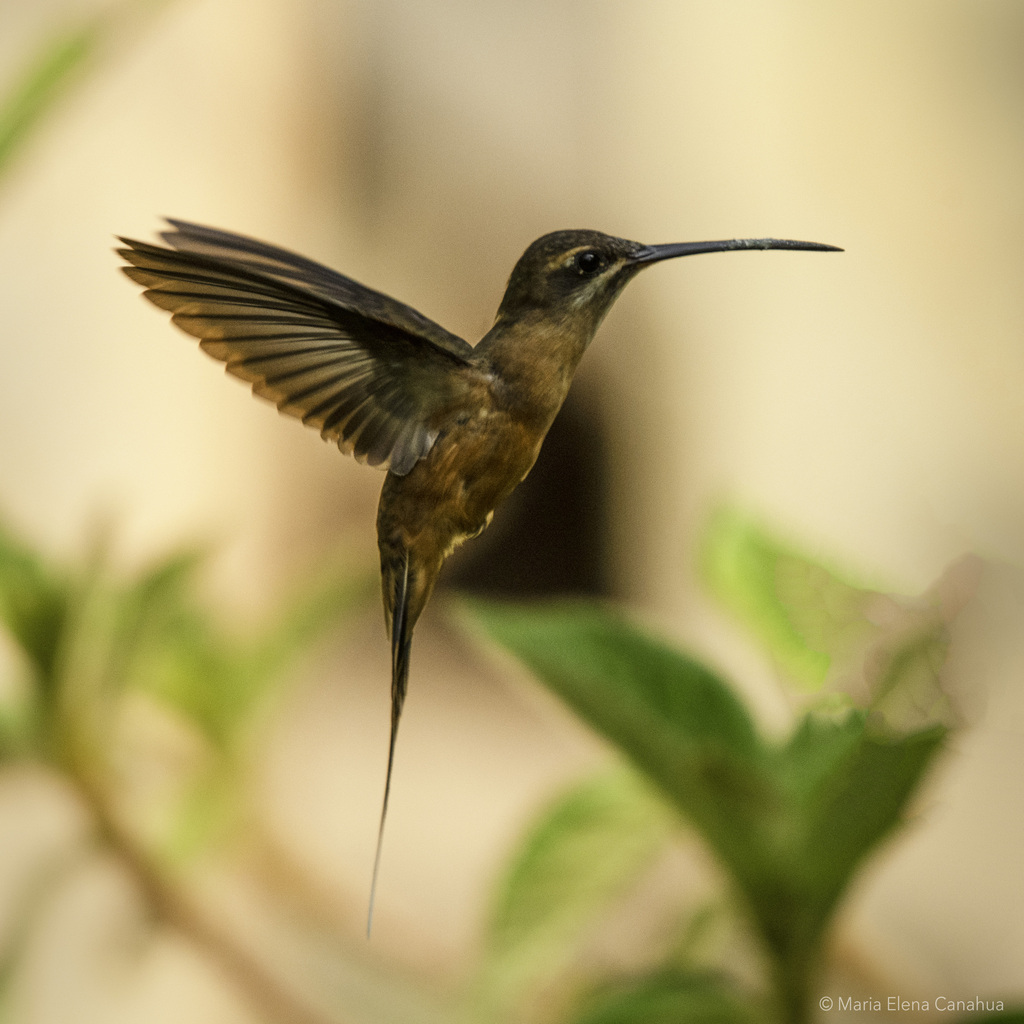
The Koepcke's hermit, ermite de Koepcke, or ermitaño de Koepcke (Phaethornis koepckeae) is a species of hummingbird in the family Trochilidae. It is found only in Peru. Its natural habitats are subtropical or tropical moist lowland forest and subtropical or tropical moist montane forest. It is threatened by habitat loss.
From the article Koepcke's hermit on Wikipedia (CC BY-SA), quoted section by section
Description
Koepcke's hermit is 14 to 15 cm (5.5 to 5.9 in) long. Males weigh 4.7 to 5.8 g (0.17 to 0.20 oz) and females 4.5 to 4.9 g (0.16 to 0.17 oz). It is one of the few hermit hummingbirds with a nearly straight bill. It has a blackish crown glossed with greenish, a glossy greenish bronze nape, a glossy bronze back, and a rufous rump. The tail is mostly dark glossy green. The innermost pair of tail feathers are longer than the others and have white tips; the others have broad buffy rufous tips. The face has a black "mask" bordered with narrow white streaks. The chin and throat are white, the center of the breast pale reddish buff with grayer sides, and the belly and flanks a rich reddish buff.
Range & habitat
Koepcke's hermit is found on the eastern foothills of the Peruvian Andes from just south of the Marañón River in Amazonas south to central Madre de Dios. In elevation it ranges between 450 and 1,300 m (1,500 and 4,300 ft), and the distribution is patchy. It inhabits the understory of tall evergreen forest and humid montane forest. It generally shuns secondary forest.
Wikipedia: “Distribution and habitat”
What it does
Koepcke's hermit is assumed to be a "trap-line" feeder like other hermit hummingbirds, visiting a circuit of a wide variety of flowering plants for nectar. It also consumes small arthropods.
Wikipedia: “Feeding”
Listen
Looking for field recordings…
Where it lives
Recorded sightings
—
geo-referenced records in GBIF, from museums, herbaria and field observers.
Drag the globe to turn it. Dots are where records exist, not a range map; darker means more records.
In the stacks
Searching the stacks…
Every page naming Phaethornis koepckeae in the Biodiversity Heritage Library →
This page is assembled live from iNaturalist, GBIF, Wikipedia, the Source Library and the Internet Archive. It is not yet part of the hand-edited codex. iNaturalist taxon 5654.