- Plants
- ›liverworts
- ›complex thalloid liverworts
- ›Marchantiidae
- ›Complex thallose liverworts
- ›Marchantiaceae
- ›Marchantia
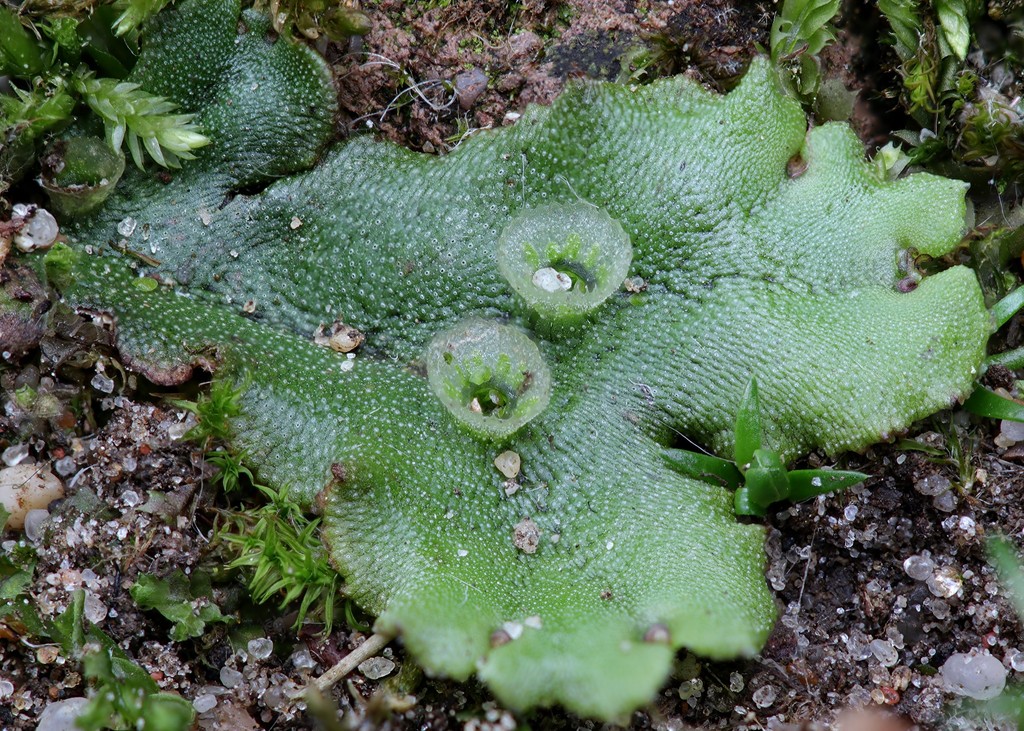
Common Liverwort
Marchantia polymorpha
Marchantia polymorpha is a species of large thalloid liverwort in the class Marchantiopsida. M. polymorpha is highly variable in appearance and contains several subspecies. This species is dioicous, having separate male and female plants. M. polymorpha has a wide distribution and is found worldwide. Common names include common liverwort or umbrella liverwort.
From the article Marchantia polymorpha on Wikipedia (CC BY-SA), quoted section by section
Description
It is a thallose liverwort which forms a rosette of flattened thalli with forked branches. The thalli grow up to 10cm long with a width of up to 2cm. It is usually green in colour but older plants can become brown or purplish. The upper surface has a pattern of polygonal markings. The underside is covered by many root-like rhizoids which attach the plant to the soil. The complex oil bodies in Marchantia polymorpha, as in all Marchantiopsida species, are restricted to specialized cells where they occupy nearly the entire intracellular space.
Wikipedia: “Morphology”
Range & habitat
Marchantia polymorpha subsp. ruderalis has a circumpolar boreo-arctic cosmopolitan distribution, found worldwide on all continents except Antarctica.
Wikipedia: “Distribution”
What it does
An important benefit of M. polymorpha is that it is frequently the first vegetation to appear after a large wildfire. Exposed mineral soil and high lime concentrations present after a severe fire provide favorable conditions for gametophyte establishment. After invading the burned area, M. polymorpha grows rapidly, sometimes covering the entire site. This is important to the prevention of soil erosion that frequently occurs after severe fires, causing significant, long-term, environmental damage. In addition, M. polymorpha renews the humus in the burned soil, and over time raises the quality of the soil to a point where other vegetation can be established. Not only does common liverwort secure burned soil and improve its quality, but after a certain point, when the soil health is restored, it can no longer compete with the vegetation that originally inhabited the area. In a USDA study in northeastern Minnesota, M. polymorpha dominated the landscape for 3 years after a severe fire, but after 5 years was replaced by lichen. After a similar fire in New Jersey M. polymorpha covered the ground for 2–3 years, but was then replaced with local shrubs and forbs. In Alaska the following vegetative successions were observed after a fire, again indicating that after soil rehabilitation has occurred the original flora returns and outcompetes M. polymorpha.
Wikipedia: “Ecology”
Where it lives
Recorded sightings
—
geo-referenced records in GBIF, from museums, herbaria and field observers.
Drag the globe to turn it. Dots are where records exist, not a range map; darker means more records.
In the old herbals & bestiaries


In the stacks
Searching the stacks…
Every page naming Marchantia polymorpha in the Biodiversity Heritage Library →
This page is assembled live from iNaturalist, GBIF, Wikipedia, the Source Library and the Internet Archive. It is not yet part of the hand-edited codex. iNaturalist taxon 56406.