- Animals
- ›Chordates
- ›Vertebrates
- ›Reptiles
- ›Snakes and Lizards
- ›Lizards
- ›Wall lizards, amphisbaenians, and allies
- ›Wall Lizards
- ›Lacertinae
- ›Podarcis
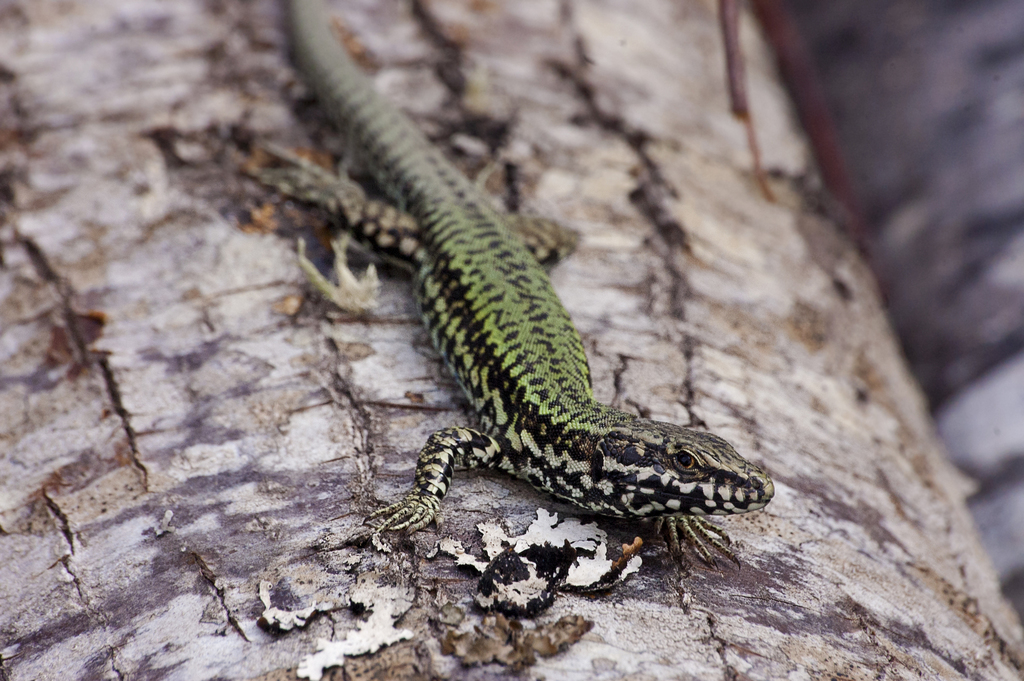
Common Wall Lizard
Podarcis muralis
The common wall lizard (Podarcis muralis) is a species of lizard with a large distribution in Europe and well-established introduced populations in North America, where it is also called the European wall lizard. It can grow to about 20 cm (7.9 in) in total length. The animal has shown variation in the places it has been introduced to. Fossils have been found in a cave in Greece dating to the early part of the Holocene.
From the article Podarcis muralis on Wikipedia (CC BY-SA), quoted section by section
Description
The common wall lizard is a small, thin lizard whose small scales are highly variable in colour and pattern. Its coloration is generally brownish or greyish, and may occasionally be tinged with green. In some individuals, the row of spots along their backs may form a line, while others may have a reticulated pattern with dark spots on the side and scattered white spots that can be blue in the shoulder region. The tail is brown, grey or rust in colour, and may also have light bars on the sides. The belly region has six rows of larger rectangular scales that are generally reddish, pink, or orangish. Common wall lizards may also have dark markings on the throat. This lizard has six distinct morphological forms which are identified by the colouration of its throat and underbelly. Three of these are pure morphs consisting only of solid colours on their scales: white, red (orange) or yellow, and three other morphs are distinguished by a combination of colours: white-yellow, white-red and yellow-red. On average, eggs are about 11 x 7 mm and weight 0,29 g at deposition, and absorb water up to 16 x 10 mm and 1 g.
Range & habitat
The natural range spans much of the mainland Europe except from the north and very south and extends to Turkey. It occurs as introduced populations in southern Britain, where one such population in the seaside town of Ventnor on the Isle of Wight has become somewhat famous, and also in North America. There has been some scientific debate as to whether the populations in Southern England represent the northern edge of their native range. The population of common wall lizards in the Mediterranean may have been caused by the hand of human activities such as pet releases and trade.
North America. Podarcis muralis has been introduced in the United States and is spreading throughout the Cincinnati metropolitan area. It is commonly observed living in limestone outcrops, rock walls, and rubble along the Ohio River basin.
It is referred to locally in the Cincinnati/Northern Kentucky area as the "Lazarus lizard", as it was introduced to the area around 1950 by George Rau, a boy whose family owned the Lazarus department store chain (Lazarus has since been absorbed into Macy's). After he returned from a family vacation to northern Italy, he released about 10 of the reptiles near his Cincinnati home. Genetic testing has revealed that as few as only three of these lizards survived long enough to reproduce, meaning they were subject to an extreme genetic bottleneck. …
Wikipedia: “Distribution and status”
What it does
The common wall lizard prefers rocky environments, including urban settings, where it can scurry between rock, rubble, debris and buildings. In the southern part of its range it tends to occur in humid or semi-humid habitats, compared to drier habitats in the north.
Wikipedia: “Ecology”
Where it lives
Recorded sightings
—
geo-referenced records in GBIF, from museums, herbaria and field observers.
Drag the globe to turn it. Dots are where records exist, not a range map; darker means more records.
In the stacks
Searching the stacks…
Every page naming Podarcis muralis in the Biodiversity Heritage Library →
This page is assembled live from iNaturalist, GBIF, Wikipedia, the Source Library and the Internet Archive. It is not yet part of the hand-edited codex. iNaturalist taxon 55990.