- Animals
- ›Chordates
- ›Vertebrates
- ›Reptiles
- ›Snakes and Lizards
- ›Lizards
- ›Iguanas and Allies
- ›Iguanas, Anoles, and Allies
- ›Phrynosomatid Lizards
- ›Sceloporine Lizards
- ›Sceloporus
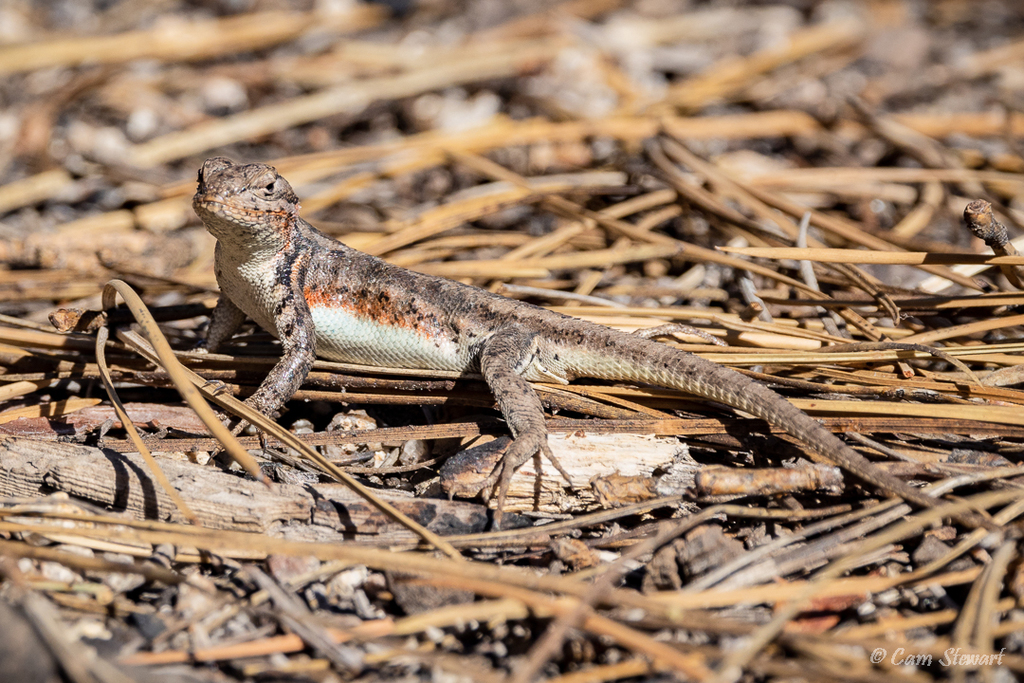
Common Sagebrush Lizard
Sceloporus graciosus
The sagebrush lizard or sagebrush swift (Sceloporus graciosus) is a common species of phrynosomatid lizard found at mid to high altitudes in the western United States. It belongs to the genus Sceloporus (spiny lizards) in the Phrynosomatidae family of reptiles. Named after the sagebrush plants near which it is commonly found, the sagebrush lizard has keeled and spiny scales running along its dorsal surface.
The sagebrush lizard is similar to the western fence lizard, another Sceloporus species found in the western US. The sagebrush lizard can be distinguished from the western fence lizard in that the former is on average smaller and has finer scales. The keeled dorsal scales are typically gray or tan, but can be a variety of colors. The main (ground) color is broken by a lighter gray or tan stripe running down the center of the back (vertebral stripe) and two light stripes, one on either side of the lizard (dorsolateral stripes). S. graciosus will sometimes have orange markings on its sides.
From the article Sagebrush lizard on Wikipedia (CC BY-SA), quoted section by section
Range & habitat
The geographic range of S. graciosus includes much of the western United States. It can be found throughout Utah, Nevada, southern Idaho, northern Arizona, northwestern New Mexico, Texas, and western Colorado. It is also widely distributed throughout areas of Wyoming, Oregon, California, Washington, western North Dakota, South Dakota, and Nebraska. The sagebrush lizard has been found to live at elevations ranging from 500 to 10,500 ft (150 to 3,200 m).
Geographic variation based on thermal constraints. Within the sagebrush lizard population, there is a pattern of geographic variation within body size and it is thought that thermal constraints may be an influencing factor. Generally speaking, longer seasonal activity is associated with large adult body size and this translates into increased lizard growth because they spend more time foraging. These growth differences can also be explained through biophysical constraints on foraging activity, food availability, or thermal constraints that cause variation in net energy assimilation. Through the study done by Michael Sears in the paper "Geographic variation in the life history of the sagebrush lizard: the role of thermal constraints on activity", it can be seen that patterns of growth of sagebrush lizards are not solely dependent on thermal constraints. …
Wikipedia: “Geographic distribution”
What it does
The sagebrush lizard is easily frightened and will immediately seek refuge in crevices, brush, rodent burrows, rocks, or trees when alarmed. One investigator observed that, under conditions where a lizard might be at threat of predation, the lizard would sometimes stay still and play dead. Individuals bask on the ground, on low branches of bushes, and on low boulders. Mammal burrows and rock crevices may serve as hibernation sites during cold periods. Activity is almost exclusively diurnal. The length of the warm-season activity varies geographically and from year to year, but at most localities, individuals are active from March or April to late September or early October. Juveniles appear to be active later in the autumn than adults. Significant seasonal movement or migration has not been reported for this species. Lizards may occasionally move outside the normal area of activity to find suitable nest sites for egg-laying, or to find hibernation sites. Males are more active, especially in the spring, and have larger home ranges than females, although home range size is small. The sagebrush lizard brumates during winter weather. The duration of the inactive period varies with local climate (in Idaho, adults are active from mid-April to September, while activity of juveniles peaks in August). It is the most common lizard on Idaho sagebrush plains. …
Wikipedia: “Behavior”
In human culture
The subspecific name, vandenburgianus, is in honor of American herpetologist John Van Denburgh.
Wikipedia: “Etymology”
Where it lives
Recorded sightings
—
geo-referenced records in GBIF, from museums, herbaria and field observers.
Drag the globe to turn it. Dots are where records exist, not a range map; darker means more records.
In the stacks
Searching the stacks…
Every page naming Sceloporus graciosus in the Biodiversity Heritage Library →
This page is assembled live from iNaturalist, GBIF, Wikipedia, the Source Library and the Internet Archive. It is not yet part of the hand-edited codex. iNaturalist taxon 55960.