- Animals
- ›Chordates
- ›Vertebrates
- ›Birds
- ›Hawks, Eagles, Kites, and Allies
- ›Hawks, Eagles, and Kites
- ›Typical Hawks and Harriers
- ›Circus
On eBird ↗
Hen Harrier
Live sightings near you, the range map, bar charts of when it is seen, and Macaulay Library photos and recordings.
Hen Harrier
Circus cyaneus
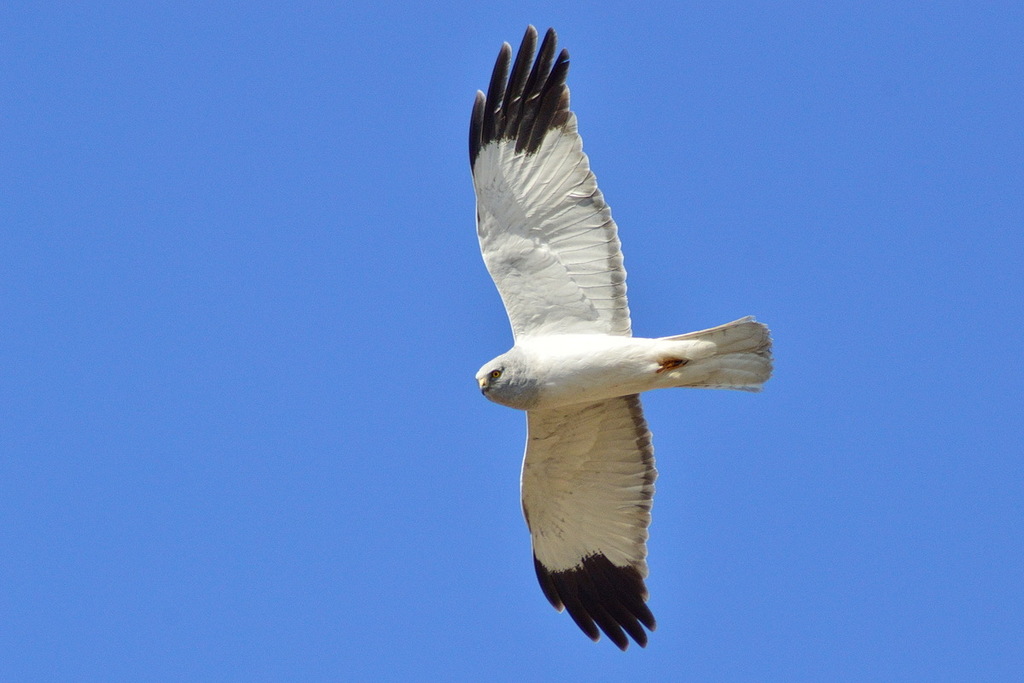
The hen harrier (Circus cyaneus) is a bird of prey. It breeds in open areas such as marshes and grasslands in Eurasia and is migratory, moving further south outside of the breeding season. Birds in milder regions, such as France and Great Britain, may be resident year-round, but the higher altitudes are largely deserted in winter. The species is sexually dimorphic; males are smaller and mostly grey and white with black wingtips, whereas females average larger and are predominantly brown and have buff underparts with brown barring. Both sexes have a white rump patch, although it is more noticeable on females and juveniles.
The term "hen harrier" refers to its former habit of preying on free-ranging fowl. The northern harrier (Circus hudsonius) was formerly considered to be a subspecies of the hen harrier.
From the article Hen harrier on Wikipedia (CC BY-SA), quoted section by section
Description
The hen harrier is 41–52 cm (16–20 in) long with a 97–122 cm (38–48 in) wingspan. It resembles other harriers in having distinct male and female plumages. The sexes also differ in weight, with males weighing 290 to 400 g (10 to 14 oz), with an average of 350 g (12 oz), and females weighing 390 to 750 g (14 to 26 oz), with an average of 530 g (19 oz). Among standard measurements, the wing chord is 32.8 to 40.6 cm (12.9 to 16.0 in), the tail is 19.3 to 25.8 cm (7.6 to 10.2 in) and the tarsus is 7.1 to 8.9 cm (2.8 to 3.5 in). It is relatively long winged and long tailed. The male is mainly grey above and white below except for the upper breast, which is grey like the upperparts, and the rump, which is white; the wings are grey with black wingtips. The female is brown above with white upper tail coverts, hence females, and the similar juveniles, are often called "ringtails". Their underparts are buff with brown barring. Juveniles resemble females but with less distinct barring, dark brown secondaries dark brown and less-barred belly. The female gives a whistled piih-eh when receiving food from the male, and her alarm call is chit-it-it-it-it-et-it. The male calls chek-chek-chek, with a more bouncing chuk-uk-uk-uk during his display flight.
What it does
This medium-sized raptor breeds on moorland, bogs, farmland, marshes, grasslands, swamps and other assorted open areas. A male will maintain a territory averaging 2.6 km2 (1.0 sq mi), though male territories have ranged from 1.7 to 150 km2 (0.66 to 57.92 sq mi). These are one of the few raptorial birds known to practice polygyny – one male mates with several females. Up to five females have been known to mate with one male in a season. A supplementary feeding experiment on the Orkney islands showed that rates of polygyny were influenced by food levels; males provided with extra food had more breeding females than 'control' males that received no extra food. The nest is constructed on the ground or on a mound of dirt or vegetation. Nests are made of sticks and are lined inside with grass and leaves. Four to eight (exceptionally 2 to 10) whitish eggs are laid. The eggs measure approximately 47 mm × 36 mm (1.9 in × 1.4 in). The eggs are incubated mostly by the female for 31 to 32 days. When incubating eggs, the female sits on the nest while the male hunts and brings food to her and the chicks. The male will help feed chicks after they hatch, but does not usually watch them for a greater period of time than around 5 minutes. …
Wikipedia: “Behaviour”
Listen
Looking for field recordings…
Where it lives
Recorded sightings
—
geo-referenced records in GBIF, from museums, herbaria and field observers.
Drag the globe to turn it. Dots are where records exist, not a range map; darker means more records.
In the old herbals & bestiaries

In the stacks
Searching the stacks…
Every page naming Circus cyaneus in the Biodiversity Heritage Library →
This page is assembled live from iNaturalist, GBIF, Wikipedia, the Source Library and the Internet Archive. It is not yet part of the hand-edited codex. iNaturalist taxon 559064.