- Animals
- ›Chordates
- ›Vertebrates
- ›Reptiles
- ›Snakes and Lizards
- ›Snakes
- ›Colubrid Snakes
- ›Colubrine Snakes
- ›Elaphe
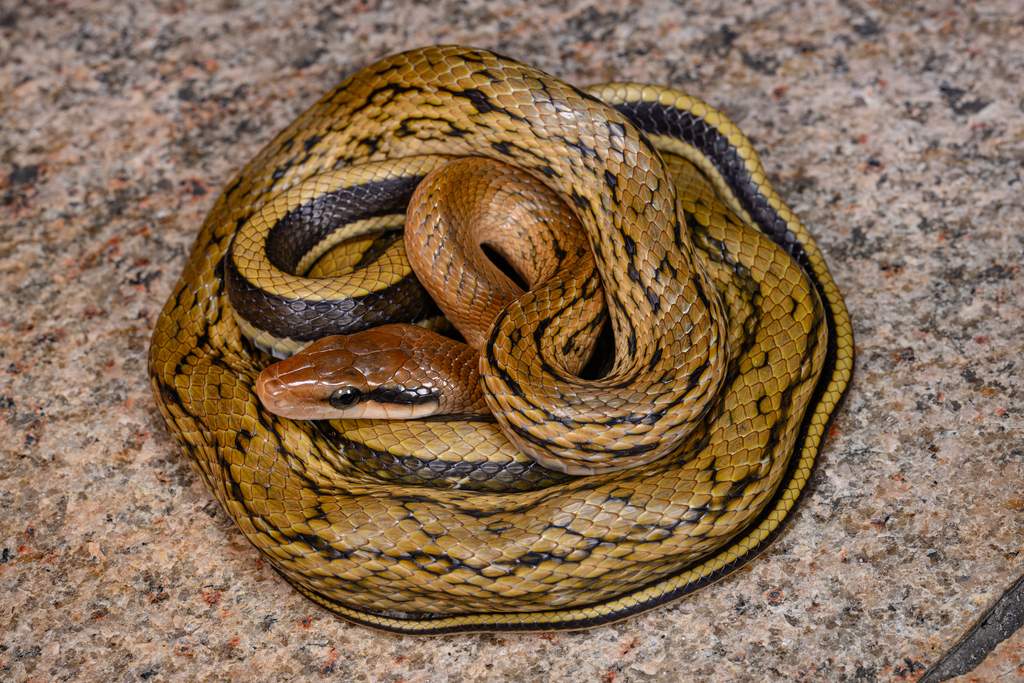
Beauty Ratsnake
Elaphe taeniura
The beauty rat snake (Elaphe taeniura), also called the beauty ratsnake, the beauty snake, or the cave racer, is a species of snake in the family Colubridae. The species is native to the eastern and southeastern regions of Asia. It is a long, thin, semi-arboreal species of snake with several recognized subspecies. This constrictor feeds on rodents, and though it is favored in some locations as a natural pest control or pet, it is also considered an invasive species in other locations.
From the article Beauty rat snake on Wikipedia (CC BY-SA), quoted section by section
Description
Living about 15–25 years, the average length of the beauty rat snake (including the tail) is about 4–6 feet (1.2–1.8 m).
Coloration. The overall ground color is yellowish-brown to olive, becoming darker at the end of the tail. The skin on the back of the neck and head are uniform in color and the back is typically marked with two pairs of round black spots that meld together. Starting at the back corner of each eye, a black stripe reaches back to each corner of the mouth which is pale cream around the upper labial area.
Range & habitat
The range of the species covers much of southern and southeastern Asia, excluding western and northeastern China. Within these countries, these snakes can be typically found in rain forests as well as within caves. Outside of Asia, the Chinese beauty snake has established a population in the Belgian city of Hasselt and surrounding municipalities. Around 2005, several snakes escaped from a Hasselt pet shop, establishing a colony within a nearby railroad bedding. The snakes use the railway system's cable trays to survive cold winters, procreate, migrate and feed of rodents which use the same trays to migrate as well. Neighbors of railroad beddings in Hasselt And surrounding municipalities regularly find snakes indoors in places ranging from toilets to attics.
Wikipedia: “Geographic range and habitat”
What it does
Due to their preference for caves, beauty snakes have become able climbers and are known to move along cave walls. This ability becomes a strong asset for them when it comes to hunting. In addition, likely due to its cave-dwelling habits, beauty rat snakes are cathemeral, meaning that they are active at random times during the 24-hour day regardless of whether it is day or night outside. When upset the beauty rat snakes will "waggle" its tail in an attempt to make noises that may scare the source of its fear. Another defensive behavior it exhibits when frightened is to flatten its body vertically in an attempt to look larger or more intimidating.
Feeding. The beauty rat snake typically feeds on ground rodents such as mice and, due to the snake's climbing abilities, even bats that are roosting within the caves they share. In addition to small mammals, beauty rat snakes have also been known to eat birds and bird eggs occasionally.
Breeding. The beauty rat snake species is oviparous, and mating usually results about a month after the hibernation period which is during times when the temperature is around 18–20 °C (64–68 °F). After laying 4-12 eggs, the female will incubate and defend them for about 70 days, only taking occasional breaks to hunt. Recently hatched young range about 30–45 cm (11+3⁄4–17+3⁄4 in) in length. …
Wikipedia: “Behavior”
In human culture
The subspecific name, grabowskyi, is in honor of biologist Friedrich J. Grabowsky. The subspecific name, mocquardi, is in honor of French herpetologist François Mocquard.
Wikipedia: “Etymology”
Where it lives
Recorded sightings
—
geo-referenced records in GBIF, from museums, herbaria and field observers.
Drag the globe to turn it. Dots are where records exist, not a range map; darker means more records.
In the stacks
Searching the stacks…
Every page naming Elaphe taeniura in the Biodiversity Heritage Library →
This page is assembled live from iNaturalist, GBIF, Wikipedia, the Source Library and the Internet Archive. It is not yet part of the hand-edited codex. iNaturalist taxon 558884.