- Animals
- ›Chordates
- ›Vertebrates
- ›Birds
- ›Swifts and Hummingbirds
- ›Hummingbirds
- ›Brilliants, Coquettes, and Allies
- ›Coquettes and Allies
- ›Metallura
On eBird ↗
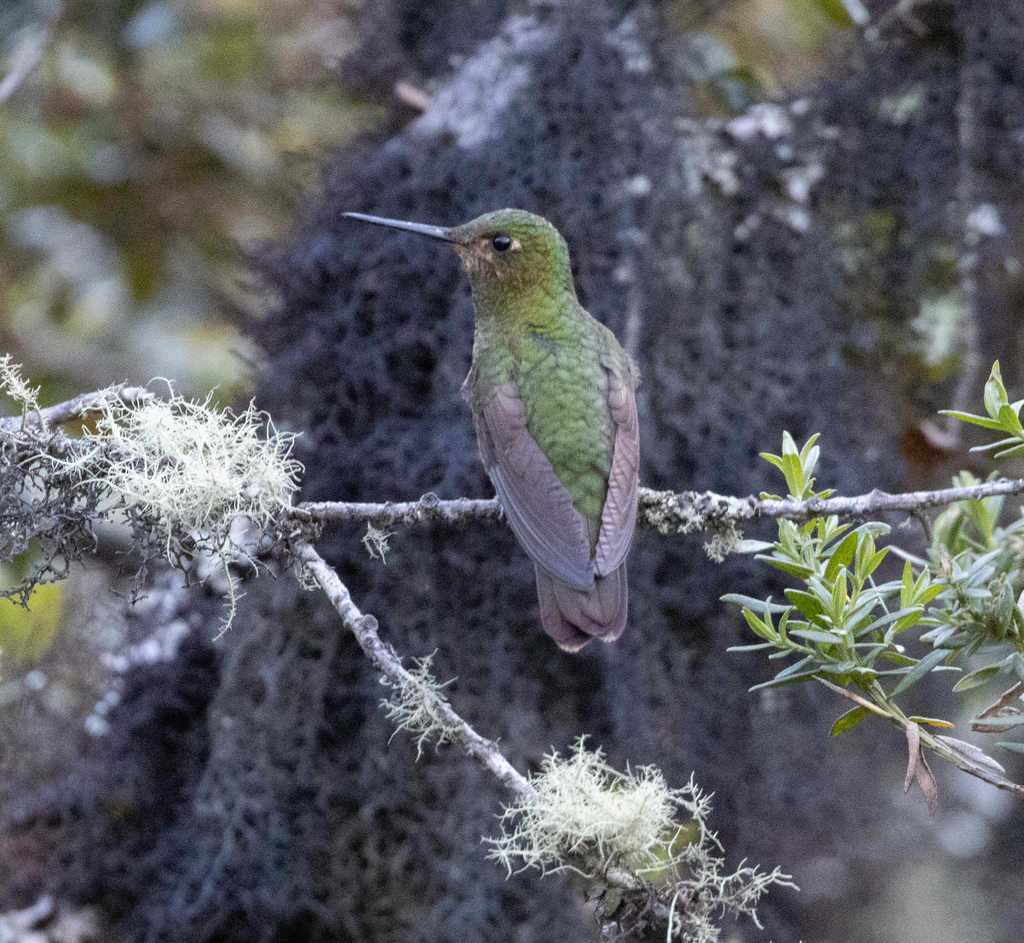
Scaled Metaltail
Live sightings near you, the range map, bar charts of when it is seen, and Macaulay Library photos and recordings.
Scaled Metaltail
Metallura aeneocauda
The scaled metaltail (Metallura aeneocauda) is a species of hummingbird in the Trochilidae family. It is found in Bolivia and Peru. Its natural habitat is subtropical or tropical moist montane forests.
From the article Scaled metaltail on Wikipedia (CC BY-SA), quoted section by section
Description
The scaled metaltail is 12 to 13 cm (4.7 to 5.1 in) long and weighs 5.2 to 5.4 g (0.18 to 0.19 oz). It has a medium length, straight, black bill. The adult male of the nominate subspecies has bottle green upperparts. Its slightly forked tail is iridescent sky blue with bronzy green tones on its upper side and glittering green on its underside. Its gorget is iridescent bright green. The rest of its underparts are green with a scaly appearance from tan feather margins. The adult female is similar to the male. Its gorget is smaller and its undersides are more mottled. Juveniles are similar to the female. Subspecies M. a. malagae is similar to the nominate but the upper side of its tail is bronzy red and the underside red. It also has a longer bill.
Range & habitat
The nominate subspecies of scaled metaltail is found on the eastern slope of the Andes from the Cordillera Vilcabamba of southeastern Peru south into northwestern Bolivia's La Paz Department. M. a. malagae is found in the vicinity of Inkachaka in central Bolivia's Cochabamba Department. The species inhabits glades and edges of cloudforest and elfin forest and also rocky slopes with herbs and shrubs. In elevation it ranges between 2,500 and 3,600 m (8,200 and 11,800 ft) and is most common above 3,000 m (9,800 ft).
Wikipedia: “Distribution and habitat”
What it does
The scaled metaltail feeds on nectar from a variety of flowering plants and shrubs, often by clinging to the flower. Males defend feeding territories. In addition to nectar, it feeds extensively on insects.
Wikipedia: “Feeding”
Listen
Looking for field recordings…
Where it lives
Recorded sightings
—
geo-referenced records in GBIF, from museums, herbaria and field observers.
Drag the globe to turn it. Dots are where records exist, not a range map; darker means more records.
In the stacks
Searching the stacks…
Every page naming Metallura aeneocauda in the Biodiversity Heritage Library →
This page is assembled live from iNaturalist, GBIF, Wikipedia, the Source Library and the Internet Archive. It is not yet part of the hand-edited codex. iNaturalist taxon 5565.