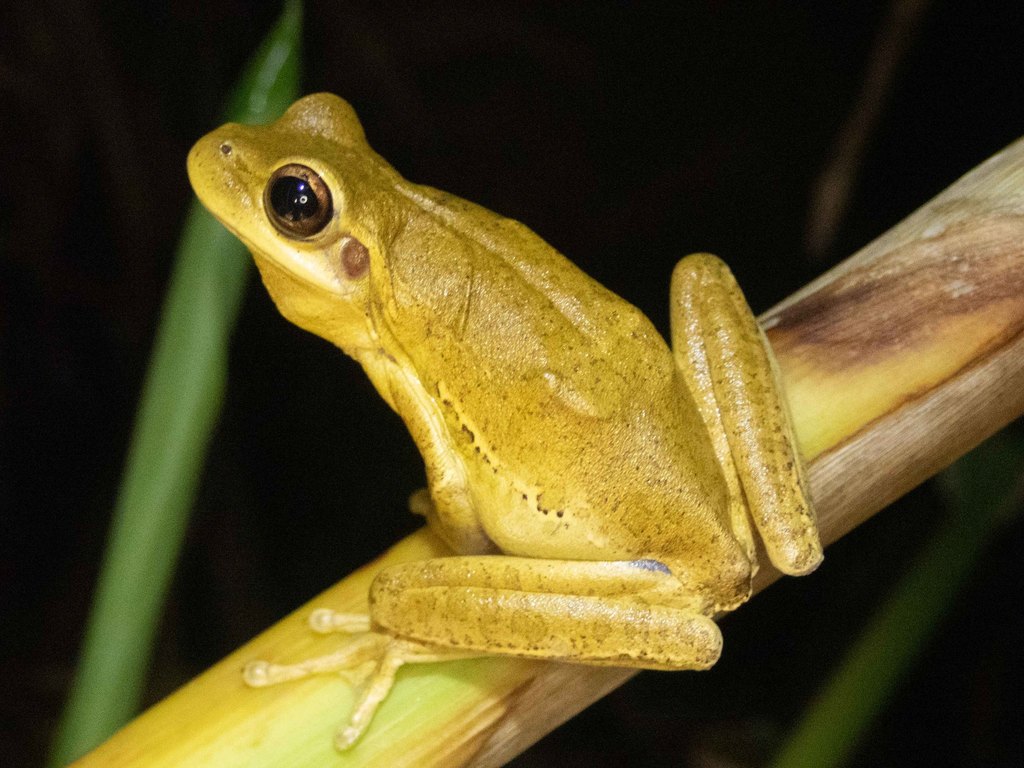
Burmeister's Tree Frog
Boana prasina
Boana prasina is a species of frog in the family Hylidae. It is endemic to southeastern Brazil and is observed in many Brazilian states: Minas Gerais, Rio de Janeiro, and São Paulo, and possibly further south. The common name of Boana prasina is Burmeister's treefrog.
Boana prasina occurs in forested habitats, grasslands, and pastureland at elevations of 800–1,400 m (2,600–4,600 ft) above sea level. These frogs are usually found on vegetation near ponds, pools, and lakes. B. prasina breeding takes place in permanent pools and small streams. The egg clutches of B. prasina are attached to vegetation in the water.
From the article Boana prasina on Wikipedia (CC BY-SA), quoted section by section
Description
B. prasina is a medium sized frog measuring 4 to 5 cm long. It is usually light brown with dark scattered spots across its back, but can also be brown, yellow or green. The belly of B. prasina is a lighter shade than the back. B. prasina has also been referred to as the rattle-voiced tree frog because of its call, which follows a rattle-like beat. The frogs typically croak when in low vegetation at the edge of water, although now appear in artificial garden lakes and lawns. The frog is generally nocturnal, sometimes appearing at dusk.
Range & habitat
B. prasina is limited to the elevated regions of southeastern Brazil. However, it does live in a wide variety of habitats including lakes/ponds, fields, pastures, muddy soils, and forests. They can be found both on the ground or in trees. In forests, it usually inhabits open areas or the edges. The forests are always very close to water, and are either riparian or gallery forests.
Wikipedia: “Habitat”
What it does
Tadpoles of B. prasina have fewer labial tooth rows than other tree frog species. Having fewer labial tooth rows may make feeding from three-dimensionally irregularly shaped surfaces, like algae, more efficient. Adult B. prasina feed on small insects and other arthropods. It has been suggested that the differences in secretions between male and female B. prasina are due to differences in their diet or how they spend their time. However, this explanation seems unlikely as differences in diet occur during early infancy.
Wikipedia: “Diet”
Listen
Looking for field recordings…
Where it lives
Recorded sightings
—
geo-referenced records in GBIF, from museums, herbaria and field observers.
Drag the globe to turn it. Dots are where records exist, not a range map; darker means more records.
In the stacks
Searching the stacks…
Every page naming Boana prasina in the Biodiversity Heritage Library →
This page is assembled live from iNaturalist, GBIF, Wikipedia, the Source Library and the Internet Archive. It is not yet part of the hand-edited codex. iNaturalist taxon 555141.