California torreya
Torreya californica
Torreya californica is a species of conifer endemic to California, occurring in the Pacific Coast Ranges and the foothills of the Sierra Nevada. It is commonly known as California torreya or California nutmeg tree (although not closely related to true nutmeg). It is one of only two species of genus Torreya that are native to North America. A slow-growing (but long-lived) subcanopy tree, it is listed as "vulnerable" in the IUCN Red List.
From the article Torreya californica on Wikipedia (CC BY-SA), quoted section by section
Description
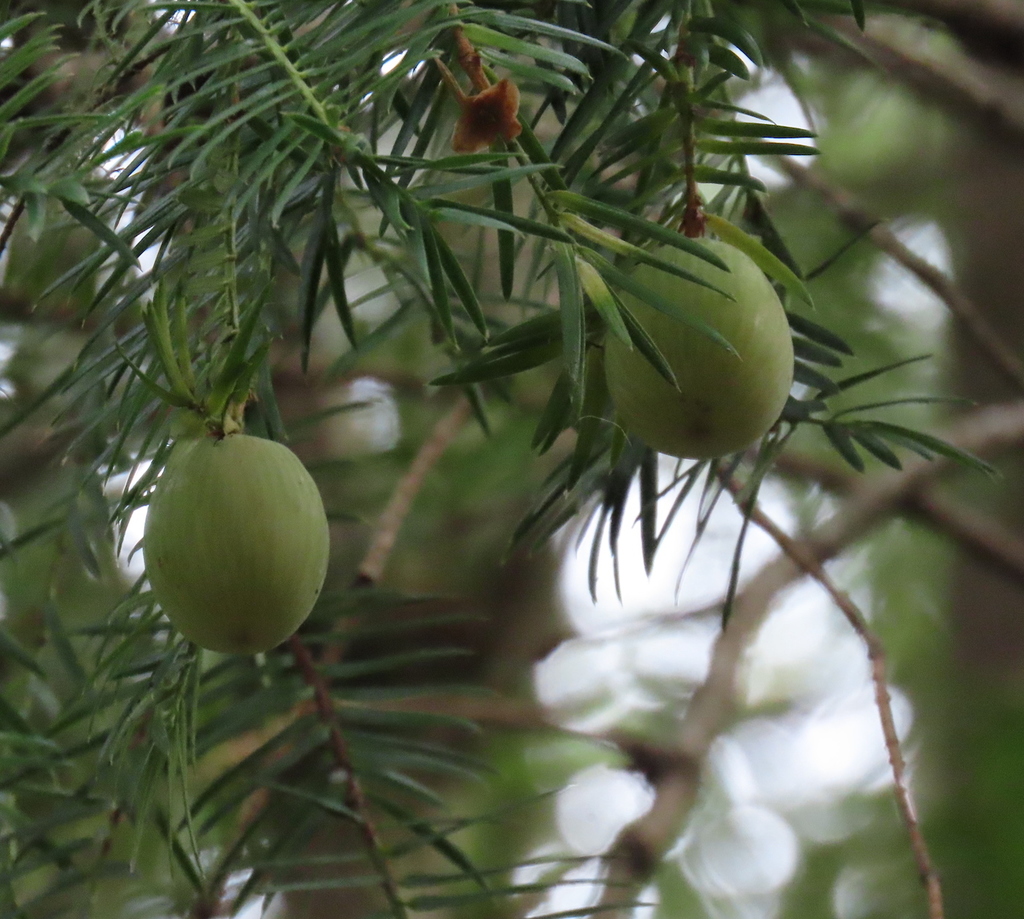
California torreya is an evergreen tree growing to 15–27 metres (49–89 ft) tall, with a trunk diameter of 0.5–1 m (1+1⁄2–3+1⁄2 ft), exceptionally 2 m. In full sun, the crown is conical in overall shape, with whorled branches. But in subcanopy shade, the tree may grow leaning and sometimes multi-stem. The species has a taproot. The bark is thin, from 0.8–1.3 cm on mature trees. The leaves are needle-like, stiff, sharp-pointed, 3–8 cm (1–3 in) long and persisting for many years. They are arranged spirally, but twisted at the base to lie flat either side of the shoots. As with all species of Torreya, the male (pollen) cones are 5–7 mm long, grouped in lines along the underside of a shoot. The female (seed) cones are single or grouped two to five together near the end of a short stem and require about 18 months to mature into a drupe-like structure with the single large nut-like seed 2.5–4 cm long. The seed is surrounded by a fleshy covering that becomes dark green to purple at full maturity in late autumn. On serpentine rock, California torreya becomes a stunted tree or shrub and occurs only on north-facing slopes in coastal chaparral. It is capable of resprouting following disturbance such as fire, although regrowth is slow.
Range & habitat
The altitudinal range of T. californica is from near sea level (but usually above 200 m) in the Coast Ranges to 2,500 m (8,200 ft) in the Sierra Nevada. This shade-adapted, subcanopy tree is native to mountainous habitats in either the California Coast Ranges or the west slopes of the Cascade and Sierra Nevada mountain ranges in California, which are distant from the coast. In the Coast Ranges, it is distributed from southwest Trinity County south to Monterey County. In the interior mountain ranges, it is distributed from Shasta County south to Tulare County. Mountainous terrain affords this narrowly dispersed ancient conifer opportunities to track suitable microclimates by shifting altitude and local topography, along with shifts between northerly (cool) and southerly (warm) slope aspects or deep ravines and canyons, while remaining on the same mountain. Short distance adjustments are crucial for this genus, as squirrels and humans seem to be the most active agents for seed dispersal. The patchiness of its geographic range is a form of disjunct distribution. The species is considered to be rare, but wherever it is found in the wild it may be locally abundant. This pattern of distribution is suggestive of a relict taxon that has had difficulties navigating episodes of climate change in which range shifts had to occur in topographically complex landscapes. …
Wikipedia: “Distribution and habitat”
What it does
Torreya species are all adapted to establish and grow slowly as subcanopy woody plants in forest habitats of moderate to dense shade. In this way, their leaf structure and growth habit resemble species of yew, genus Taxus, which is a close relative. Torreya species are found in late seral and climax communities. Owing to their ability to resprout from the root crown after logging or mild fire, the species will experience growth opportunities in the early stages of regrowth forest habitats. When a tree-fall opens the forest canopy (or if nearby roadbuilding occurs), then upward growth will be stimulated. Stems will lean in very shady conditions, in quest of patches of sunlight. Extremely leaning stems within a shady subcanopy gather moss as they age. An old leaning stem that fails to access sunlight will perish, but not before the long-lived root crown has given rise to one or more younger stems searching for sunlight in different directions. Seed production occurs on female branches (and trees) only in the presence of direct sunlight. Because the Torreya genus has very long-lived roots, it can continue slow growth, while replenishing basal stems, for many decades without seed production becoming crucial for the persistence of a local population.
Threats. …
Wikipedia: “Ecology”
At the table
Commercial harvesting of California nutmeg is almost nonexistent due to scant availability. It was logged on a limited basis in the past, especially where growing in association with coast redwood, but was never an important timber species. The fine-grained, yellow-brown wood is highly durable. It is strong and elastic, smooth in texture, polishes well, and emits a fragrance similar to that of sandalwood. The wood is sometimes used in making Go game boards, as a cheaper substitute for the prized kaya (Torreya nucifera) of Japan and Southeast Asia. The seeds were once mentioned in pharmacognostic literature under the Latin name nux moschata Californica. The seeds were reportedly a highly valued food of Indigenous peoples in California, though they are inedible raw. Additionally, the roots were used for making baskets and the wood for making bows.
Wikipedia: “Uses”
In human culture
Torreya is named for Dr. John Torrey (1796–1873), an American botanist who contributed to the Flora of North America. Californica means 'from California'.
Wikipedia: “Etymology”
Where it lives
Recorded sightings
—
geo-referenced records in GBIF, from museums, herbaria and field observers.
Drag the globe to turn it. Dots are where records exist, not a range map; darker means more records.
In the stacks
Searching the stacks…
Every page naming Torreya californica in the Biodiversity Heritage Library →
This page is assembled live from iNaturalist, GBIF, Wikipedia, the Source Library and the Internet Archive. It is not yet part of the hand-edited codex. iNaturalist taxon 55193.