- Fungi Including Lichens
- ›Basidiomycete Fungi
- ›Higher Basidiomycetes
- ›Mushrooms, Bracket Fungi, Puffballs, and Allies
- ›Agaricomycetidae
- ›Common Gilled Mushrooms and Allies
- ›Agaricineae
- ›Hydnangiaceae
- ›Laccaria
- ›Amethystinae
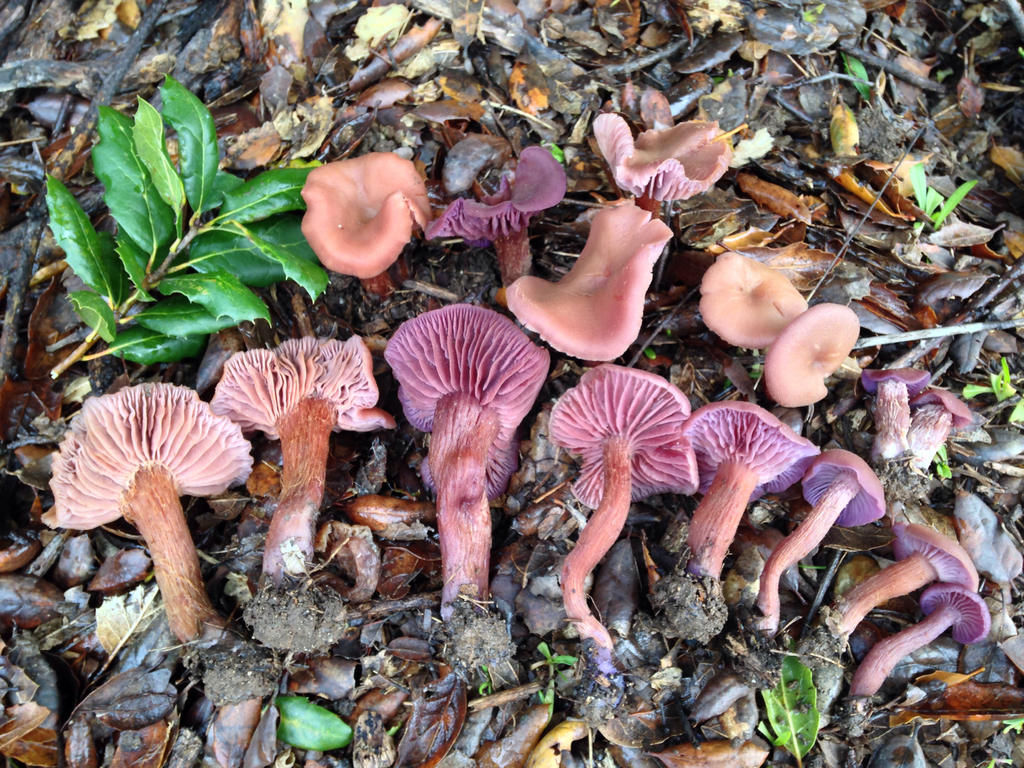
Western Amethyst Laccaria
Laccaria amethysteo-occidentalis
Laccaria amethysteo-occidentalis is a mushroom found under conifers, usually pine, growing alone, scattered or gregariously in western North America.
From the article Laccaria amethysteo-occidentalis on Wikipedia (CC BY-SA), quoted section by section
Description
The mushroom is entirely purple. The cap is 1–7 centimetres (1⁄2–2+3⁄4 in) in width; broad, convex to flat, often depressed, occasionally becoming slightly translucent-striated when fading, finely fibrillose, hygrophanous, fading to violet; margin rolled inward, later becoming flat; context thin and lighter grayish purple in color. The gills are purple, thick and distant. The stem is up to 14 cm (5+1⁄2 in) long, fibrous, with a whitish mycelium near the base. The spores are 7.5–10.5 x 7–16 μm, subglobose or broadly elliptical. The spore print is white. Basidia are 34–56.5 × 9.7–14.7 μm, clavate, elongate, hyaline. Pleurocystidia absent. Cheilocystidia are 36.5–66.5 × 12–18.4 μm, subclavate to clavate, thin-walled, hyaline, often very abundant, extending well beyond basidia.
Similar species. This species is similar to L. amethystina but differs by occurring in hardwood forest in eastern North America, rather than coniferous forest; having a smaller sporocarp; and being a lighter purple color. L. bicolor is smaller and less purplish; L. laccata has whitish mycelium at its base. Cortinarius violaceus is darker and has a less fibrillose stipe. Pseudoomphalina cokeri is also similar.
Range & habitat
It can be found on the ground near the North American West Coast from October to February.
Wikipedia: “Distribution and habitat”
Where it lives
Recorded sightings
—
geo-referenced records in GBIF, from museums, herbaria and field observers.
Drag the globe to turn it. Dots are where records exist, not a range map; darker means more records.
In the stacks
This page is assembled live from iNaturalist, GBIF, Wikipedia, the Source Library and the Internet Archive. It is not yet part of the hand-edited codex. iNaturalist taxon 54893.