 NL·0520
Herbarium of the Nature Library
- Name
- Nycticebus bengalensis
- Family
- Lorisidae
- Native to
- Northeast India, Bangladesh, Myanmar, southern China, Thailand, Laos, Cambodia and Vietnam
- Habitat
- Tropical evergreen forest, Semi-evergreen forest, Bamboo forest
Bengal slow loris
Nycticebus bengalensis
Also calledLajjābatī bānor (Bengali, 'shy monkey') · Northern slow loris · Lori perezoso de Bengala (Spanish)
The largest slow loris and one of the world's few venomous primates. When threatened it raises its arms over its head, licks a gland on the inner elbow, and mixes the secretion with saliva to deliver a painful, sometimes dangerous bite. It is the only slow loris in India and is heavily hunted for the pet and traditional-medicine trades.
The Bengal slow loris or northern slow loris is a strepsirrhine primate and a species of slow loris native to the Bangladesh, Northeast India, Cambodia, Laos, Burma, Vietnam, southern China, and Thailand. Its geographic range is larger than that of any other slow loris species. Considered a subspecies of the Sunda slow loris (N. coucang) until 2001, phylogenetic analysis suggests that the Bengal slow loris is most closely related to the Sunda slow loris. However, some individuals in both species have mitochondrial DNA sequences that resemble those of the other species, due to introgressive hybridization. It is the largest species of slow loris, measuring 26 to 38 cm from head to tail and weighing between 1 and 2.1 kg. Like other slow lorises, it has a wet nose (rhinarium), a round head, flat face, large eyes, small ears, a vestigial tail, and dense, woolly fur. The toxin it secretes from its brachial gland differs chemically from that of other slow loris species and may be used to communicate information about sex, age, health, and social status. Wikipedia
What it can do
- iBrachial (elbow) gland secretion combined with saliva makes a toxic bite that can cause severe swelling and anaphylactic shock in people
- iiIts grip can hold for hours, aided by networks of blood vessels in the limbs
- iiiFeeds on tree gum by gouging bark with its tooth-comb, an important dry-season food
In the field
Field marks
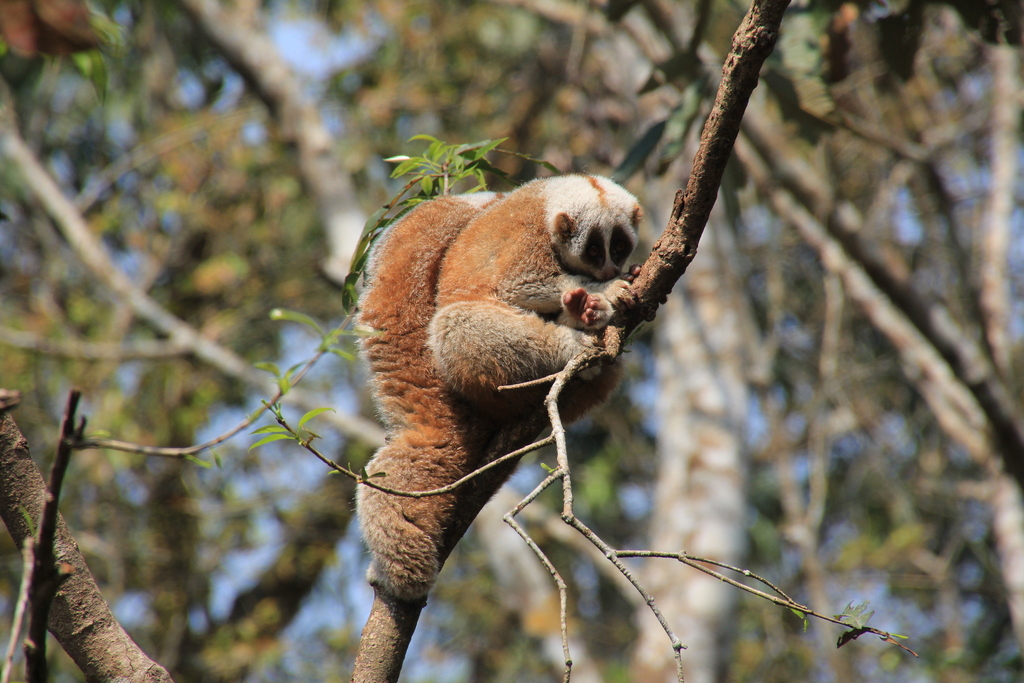
- aStocky, woolly primate with a round head and almost no tail
- bDark brown stripe along the spine reaching the crown
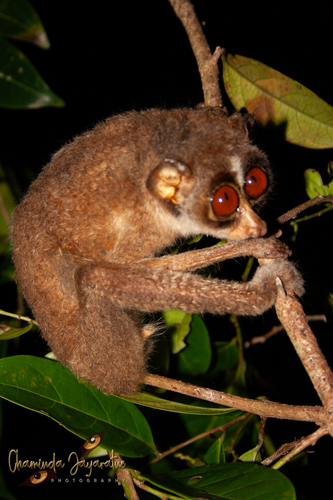
- cLarge eyes encircled by dark rings with a white stripe between
- dBright orange eyeshine in torchlight at night; slow, deliberate climbing
- Not to be confused with
- Pygmy slow loris (Indochina) is much smaller and redder. Slender lorises are thin-limbed and live only in southern India and Sri Lanka.
- Where to see it
- Hollongapar Gibbon Sanctuary (Assam); Lawachara National Park (Bangladesh); Dampa Tiger Reserve (Mizoram); Khao Yai National Park (Thailand); night walks with guides
- When
- Resident year-round
Listen
Looking for field recordings…
Life & habits
- Diet
- Plant gum and sap, nectar, fruit, insects, snails, birds' eggs
- Habitat
- Evergreen and semi-evergreen forest and bamboo groves with continuous canopy
- Size
- Body 26–38 cm; 1–2.1 kg; tail vestigial
- Lifespan
- About 20 years in captivity
Nocturnal and slow-moving, but capable of quick lunges. Sleeps curled in a ball in dense foliage by day.
Where it lives
Recorded sightings
—
geo-referenced records in GBIF, from museums, herbaria and field observers.
Native range
Northeast India, Bangladesh, Myanmar, southern China, Thailand, Laos, Cambodia and Vietnam
Drag the globe to turn it. Dots are where records exist, not a range map; darker means more records.
In the old herbals & bestiaries
No plate in the Source Library names this exact species, so these show its closest relatives as the old naturalists drew them: same genus, or the same kind of animal. Click a plate to read the page it came from, with translation.


In the stacks
Searching the stacks…
Every page naming Nycticebus bengalensis in the Biodiversity Heritage Library →
Marginalia
In Bengali it is called the 'shy monkey' (lajjabati banor) because it covers its face with its hands when caught in light. Its body parts have been sold in markets in Southeast Asia and China for traditional remedies.
Curiosity
Slow lorises are the only primates confirmed to produce venom.
Kinship




Photographs: iNaturalist contributors under the licences shown. Records: GBIF.org. Historical plates: Source Library (CC BY-SA 4.0; originals public domain). Summary text: Nature Library editors and Wikipedia (CC BY-SA). Medicinal and edibility notes are historical and educational, not advice. iNaturalist taxon 54863.