- Animals
- ›Molluscs
- ›Gastropods
- ›Heterobranchs
- ›Euthyneura
- ›Ringipleura
- ›Nudipleura
- ›Nudibranchs
- ›Doridina
- ›Doridoidei
- ›Sea Lemons and Allies
- ›Discodorididae
- ›Jorunna
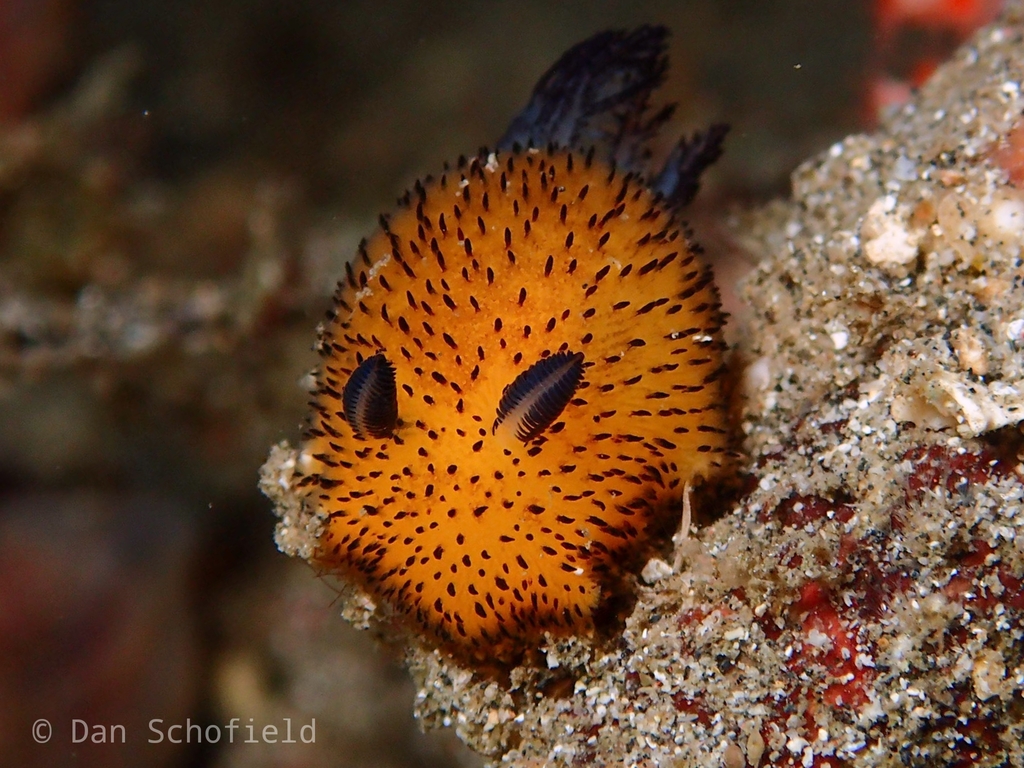
Sea Bunny
Jorunna parva
Jorunna parva is a species of sea slug, a dorid nudibranch, a shell-less marine gastropod mollusc in the family Discodorididae. The species was first described by Kikutaro Baba. The resemblance of Jorunna parva's rhinophores to bunny ears and its other features facilitated a surge in popularity on Twitter throughout Japan in 2015. The rhinophores are classified as sensory organs for the act of chemoreception. Sea slugs eat sponges, which contain toxins. Those toxins are used for...
From the article Jorunna parva on Wikipedia (CC BY-SA), quoted section by section
Description
The species is up to 2.5 cm long. Its black-and-white rhinophores somewhat resemble a rabbit's ears. Its external gills are located near its rear. Its body is covered in papillae, fleshy protuberances used for sensory functions, giving it the appearance of a furry animal. There are multiple colorations of Jorunna parva, including yellow, white, and green, though the latter is rarely photographed. All of these variants have black papillae interspersed among papillae of their main color. There is controversy over whether or not the different colorations are divergent species.
Like most other members of its genus, Jorunna parva's diet consists of toxic sponges in the family Chalinidae. However, they are also known to eat algae, seagrass, and other small creatures, such as sea slugs or sea snails. As the sea bunny feeds on sea sponges, they process the toxins and store them as a defense mechanism. Jorunna parva are hermaphrodites, meaning they produce both sperm and egg cells. They cannot fertilize the eggs themselves.
Range & habitat
This species was described from Kii Province, Japan. Jorunna parva has subsequently been reported from the Philippines, Tanzania, Papua New Guinea, Seychelles and Réunion but there are some doubts as to whether it is really a species complex. The Jorunna parva are concentrated in areas where there is an abundance of food and where resources are easily acquired. They often cling to submerged vegetation and spend the majority of the time at the bottom of tropical waters.
Wikipedia: “Distribution”
Where it lives
Recorded sightings
—
geo-referenced records in GBIF, from museums, herbaria and field observers.
Drag the globe to turn it. Dots are where records exist, not a range map; darker means more records.
In the stacks
Searching the stacks…
Every page naming Jorunna parva in the Biodiversity Heritage Library →
This page is assembled live from iNaturalist, GBIF, Wikipedia, the Source Library and the Internet Archive. It is not yet part of the hand-edited codex. iNaturalist taxon 548348.