- Fungi Including Lichens
- ›Ascomycete Fungi
- ›Sac Fungi and Lichens
- ›Common Lichens
- ›Shield Lichens, Sunburst Lichens, Rosette Lichens, and Allies
- ›shield lichens, rim lichens, and allies
- ›shield lichens and allies
- ›typical shield lichens
- ›Parmelia
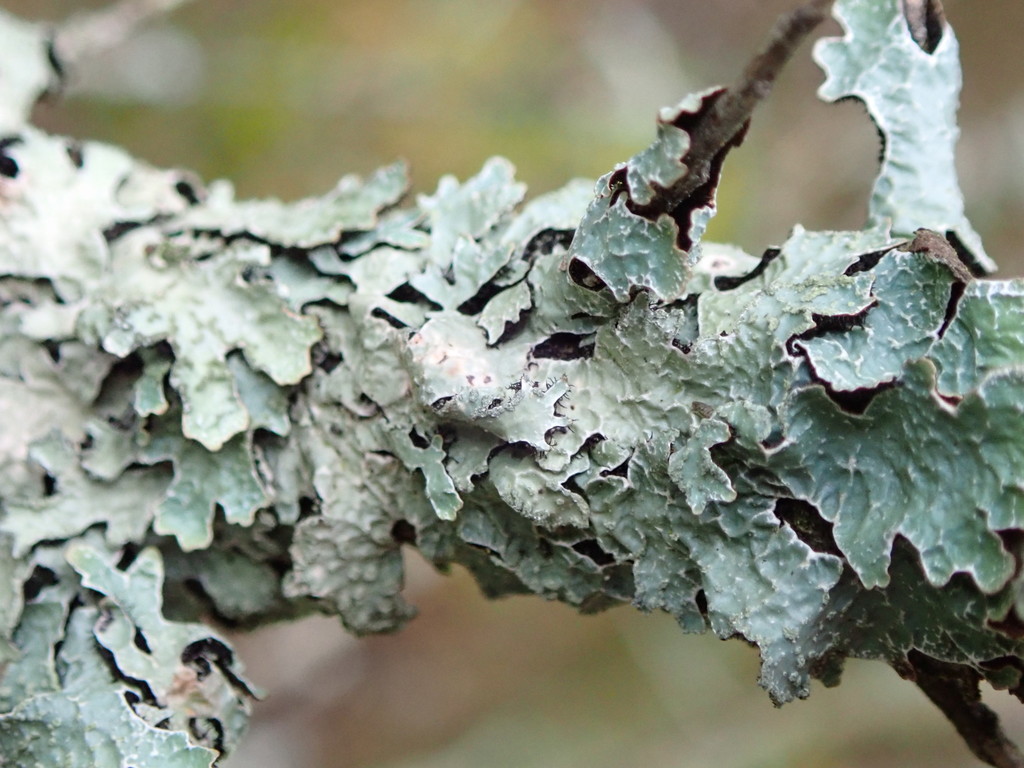
Netted shield lichen
Parmelia sulcata
Parmelia sulcata, commonly known as the hammered shield lichen or cracked-shield lichen, is a foliose lichen in the family Parmeliaceae. First described by Thomas Taylor in 1836, it is one of the most prevalent lichen species globally, known for its resilience to pollution and cosmopolitan distribution across temperate and cold regions of both hemispheres. P. sulcata forms a circular thallus up to 10 cm (4 in) in diameter, with a glaucous white to grey upper surface and a black lower surface, featuring broadly lobed structures with both marginal and laminal soralia and a distinctive reticulate pattern of pseudocyphellae.
Taxonomically, Parmelia sulcata has a complex history. Molecular phylogenetics studies have revealed significant genetic variability within what was traditionally considered a single species, identifying a complex of cryptic species, including Parmelia encryptata and P. barrenoae, and demonstrate the necessity of molecular data for accurate species identification. P. sulcata maintains a highly specific symbiotic relationship with green algae of the genus Trebouxia, particularly species within Trebouxia clade I, as its photobiont partner.
From the article Parmelia sulcata on Wikipedia (CC BY-SA), quoted section by section
Description
Parmelia sulcata is a foliose lichen with a generally circular thallus that can range in color from glaucous white to gray on the upper cortex; the lower surface is black. The thallus is broadly lobed. The thallus, loosely attached to its substrate, is typically up to 6 cm (2+3⁄8 in), although diameters up to 10 cm (4 in) have been recorded. Each lobe measures between 2–5 mm (1⁄16–3⁄16 in) in width, and lobes are overlapping. The lobes, which are more or less linear, have both marginal and laminal soralia. Also present on both laminal and marginal regions of the lobes are elongated pseudocyphellae—small pores in the cortex—that form a reticulate pattern. Rhizines on the thallus underside are simple (unbranched) to squarrose (brush-like). Apothecia (fruiting bodies) are rare in this species. If present, they are up to 8 mm (5⁄16 in) in diameter and lecanorine in form, with a red-brown disc; they often have a sorediate margin. Reproduction in P. sulcata occurs predominantly asexually through soredia, although apothecia are not exceptionally rare in rural areas. Ascospores measure 8–14 μm. In terms of standard spot tests, the upper surface of Parmelia sulcata reacts K+ (yellow), KC−, C−, and P−, indicating the presence of the secondary metabolites (lichen products) atranorin and chloroatranorin. The lichen's medulla and soredia are K+ (red-orange) and Pd+ (orange). …
Range & habitat
Parmelia sulcata is a common species throughout much of the world, found from temperate to cold regions of both the Northern and Southern Hemispheres. Its northern North American distribution has been described as "extremely widespread, even weedy", and includes Mexico's Baja California. It is one of the most common parmelioid lichens in Europe, having been recorded in 43 countries there. It has been found to reappear in urban areas after sulphur dioxide levels have decreased. Although common in the Northern Hemisphere, Parmelia sulcata is rare in South America. A 2023 study provided molecular evidence for its presence in Chile, and showed that DNA sequences from Chile belong to the most common haplotype found in Europe, Asia, and North America, indicating a widespread distribution of this haplotype. In Nepal, Parmelia sulcata has been reported from 3,000 to 3,366 m elevation in a compilation of published records. In Africa, Parmelia sulcata has been documented from the low alpine zone in Ethiopia and Kenya, at elevations ranging from 3,500 to 4,200 m (11,500 to 13,800 ft), but it is otherwise rare. Although most common on bark and on wood, Parmelia sulcata also grows on rocks or mossy rocks. …
Wikipedia: “Distribution and habitat”
What it does
The vertical zonality of Parmelia sulcata along tree trunks is influenced by various microclimatic conditions such as humidity, light conditions, and the chemical and physical properties of the bark. Parmelia sulcata, along with other lichen species, contributes to the high diversity of lichen biota in the lower and upper parts of tree trunks. The species composition of lichens, including Parmelia sulcata, changes from the base to the crown of the trees, indicating the importance of light conditions in their distribution. For instance, in a Russian study, Parmelia sulcata was commonly found at heights of 10–20 m (33–66 ft) on birch trees and around 15 m (49 ft) and in the crown on spruce trees, reflecting its preference for higher insolation levels (i.e., areas that receive more sunlight or solar radiation) in these zones. A study conducted in a temperate deciduous forest of Central Italy monitored carbon dioxide (CO2) gas exchange, radial growth, chlorophyll content, and photobiont density of Parmelia sulcata over a year. The results showed significant seasonal variations, with CO2 gas exchange and radial growth peaking in December, and photoinhibition occurring in early spring before tree leaves sprouted. Photobiont density was highest in June and December and lowest in April. …
Wikipedia: “Ecology”
In medicine
In Canada, the Métis peoples rubbed it on the gums of teething babies, while the Saanich peoples used it as a folk medicine.
Wikipedia: “Traditional medicine”
Where it lives
Recorded sightings
—
geo-referenced records in GBIF, from museums, herbaria and field observers.
Drag the globe to turn it. Dots are where records exist, not a range map; darker means more records.
In the stacks
Searching the stacks…
Every page naming Parmelia sulcata in the Biodiversity Heritage Library →
This page is assembled live from iNaturalist, GBIF, Wikipedia, the Source Library and the Internet Archive. It is not yet part of the hand-edited codex. iNaturalist taxon 54734.