- Animals
- ›Arthropods
- ›Chelicerates
- ›Arachnids
- ›Mites and Ticks
- ›Acariformes
- ›Sarcoptiformes
- ›Endeostigmatan Mites
- ›Eriophyoidea
- ›Gall and Rust Mites
- ›Phyllocoptinae
- ›Phyllocoptini
- ›Phyllocoptes
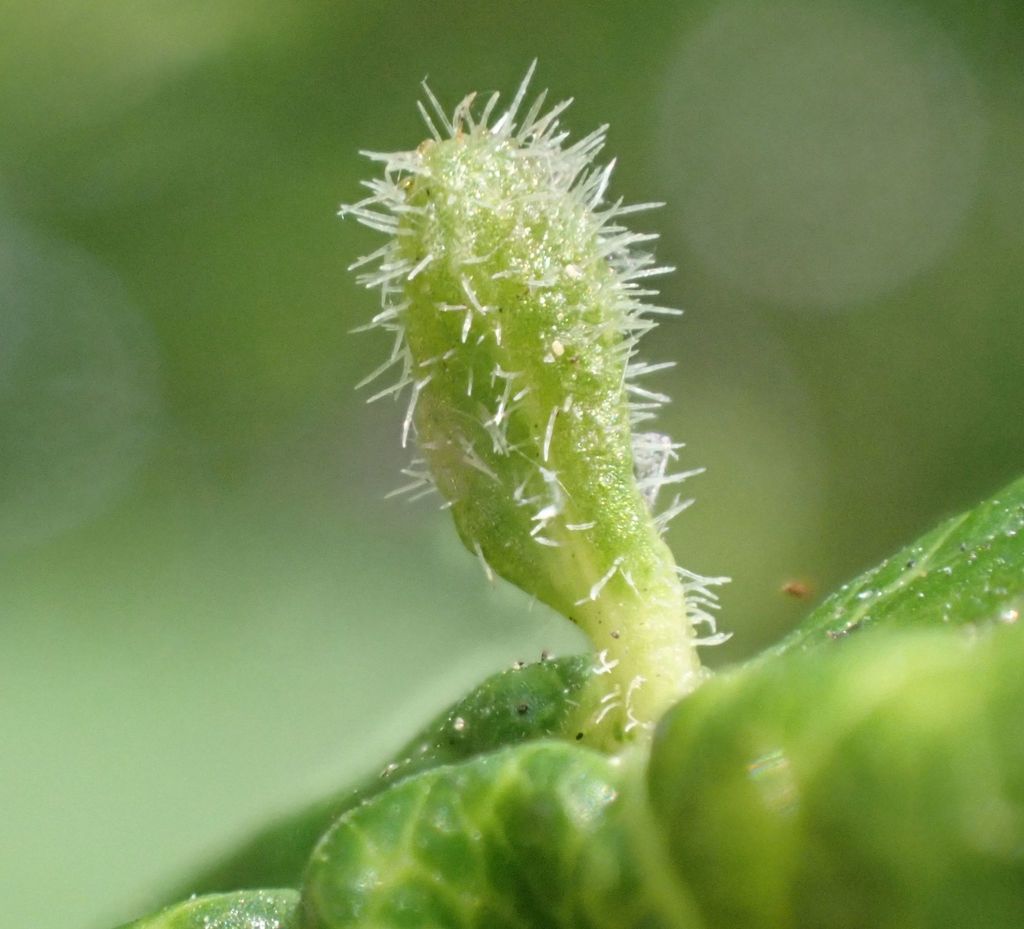
Phyllocoptes eupadi
Phyllocoptes eupadi (Newkirk, 1984) is a mite that chemically induces a pouch gall to develop as a sub-spherical distortion rising up from the upper surface of the lamina of leaves of blackthorn shrubs Prunus padus, Prunus spinosa and other Prunus species. Synonyms are Phytoptus padi Nalepa, 1890 and "Eriophyes padi (Nalepa, 1890)", non Eriophyes padi Domes, 2000.
From the article Phyllocoptes eupadi on Wikipedia (CC BY-SA), quoted section by section
Description
The gall's appearance on the upper surface is sub-spherical pustules, hairy and opening below, often clustering along the midrib, but also found over the whole leaf lamina surface and may vary in colour from pale yellow-green to deep red. The adult mite lives on sap, sucked from the cell tissues. The leaf surface can be so densely covered with galls that it becomes deformed and wrinkled.
Range & habitat
The species is found across Northern and Central Europe, as well as in England and Scotland.
Wikipedia: “Distribution”
Where it lives
Recorded sightings
—
geo-referenced records in GBIF, from museums, herbaria and field observers.
Drag the globe to turn it. Dots are where records exist, not a range map; darker means more records.
In the stacks
Searching the stacks…
Every page naming Phyllocoptes eupadi in the Biodiversity Heritage Library →
This page is assembled live from iNaturalist, GBIF, Wikipedia, the Source Library and the Internet Archive. It is not yet part of the hand-edited codex. iNaturalist taxon 547280.