- Animals
- ›Arthropods
- ›Chelicerates
- ›Arachnids
- ›Spiders
- ›Typical Spiders
- ›Entelegyne Spiders
- ›Salticoid Spiders
- ›Jumping Spiders
- ›Asemoneinae
- ›Asemonea
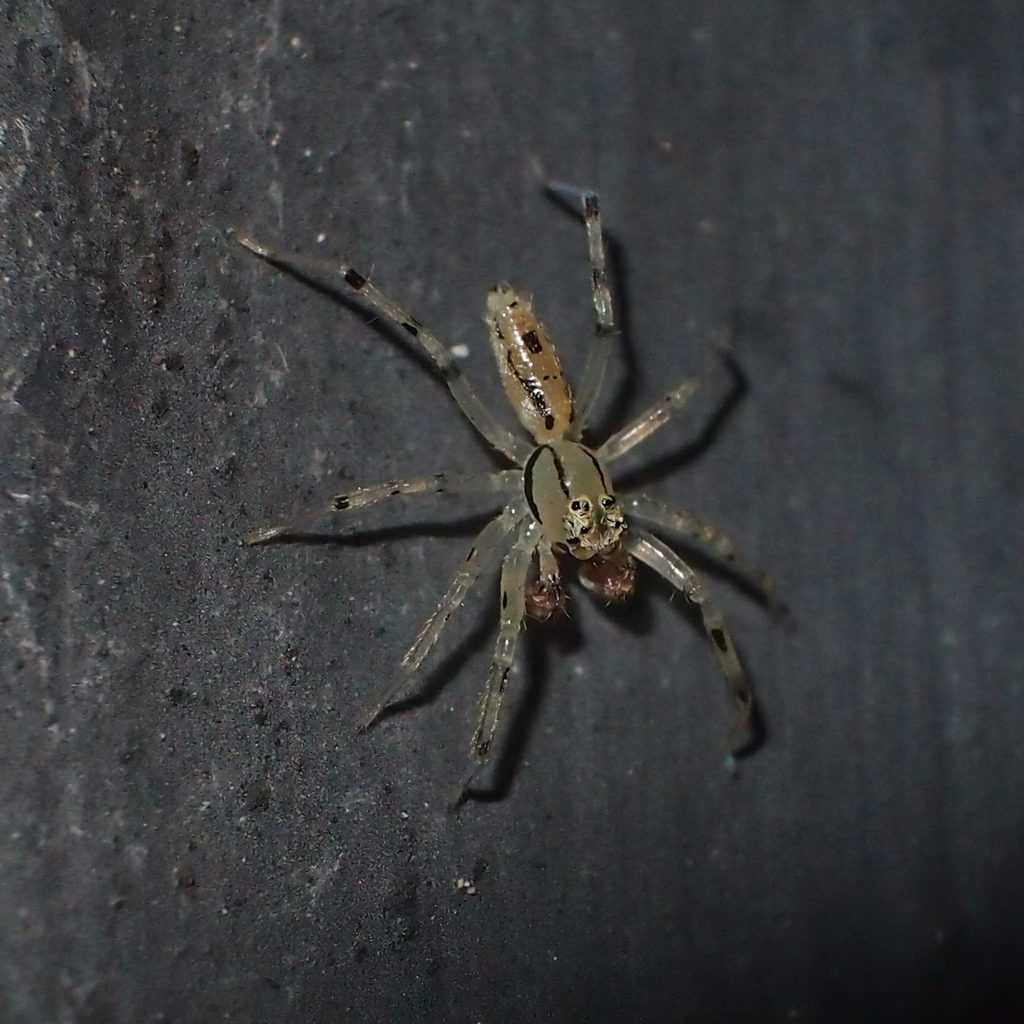
Asemonea tanikawai
Asemonea tanikawai is a species of jumping spider in the genus Asemonea that is endemic to Japan. It lives in trees in mountain ranges. The spider was first described in 1996 by Hiroyoshi Ikeda. The spider is small, with a carapace [prosoma that between 1.31 and 1.60 mm (0.052 and 0.063 in) long and an abdomen is between 1.84 and 2.24 mm (0.072 and 0.088 in) long. It is whitish-yellow with a pattern of two brown stripes down the back
From the article Asemonea tanikawai on Wikipedia (CC BY-SA), quoted section by section
Description
The spider is small, with a body length that can vary between 2.8 and 4.8 mm (0.11 and 0.19 in). It has a [prosoma that varies in length between 1.31 and 1.60 mm (0.052 and 0.063 in) and in width between 0.99 and 1.28 mm (0.039 and 0.050 in). The abdomen is between 1.84 and 2.24 mm (0.072 and 0.088 in) long and between 0.80 and 1.12 mm (0.031 and 0.044 in) wide. The spider is generally whitish-yellow. The carapace is covered in white hairs and marked with two brown stripes that stretch from the front to back. The sternum is similarly covered with white hairs. The eye field is black with an edge of white hairs. The clypeus is marked with black spots. The chelicerae, maxillae and remaining mouthparts are white. The male has a distinctive pedipalp with a complex tibial apophysis and a furrow alongside the femoral apophysis, which distinguishes it from the otherwise similar Asemonea maculata and Asemonea pinangensis. The female is also similar, with its copulatory openings hidden in its epigyne. The top of the male's abdomen has nine black spots and a covering of brown hairs, the underside a layer of white hairs. The male has whitish-yellow legs with black spots. It has a pedipalp with a complex apophysis, or appendage, on the tibia and a furrow alongside the apophysis on the femur. …
Range & habitat
Asemonea tanikawai is endemic to Japan. The holotype was discovered in the south of Iriomote Island in 1986. The spider has been also seen on Okinawa Island. It has a range that extends across the entire Ryukyu Islands.
Wikipedia: “Distribution”
What it does
Asemonea spiders rarely jump. Instead, they generally walk and run. They spin sheet webs on the underside of leaves, where they also lay their eggs. Although predominantly a diurnal hunter, the spider is also likely to eat nectar if it is available.
Wikipedia: “Behaviour”
Where it lives
Recorded sightings
—
geo-referenced records in GBIF, from museums, herbaria and field observers.
Drag the globe to turn it. Dots are where records exist, not a range map; darker means more records.
In the stacks
Searching the stacks…
Every page naming Asemonea tanikawai in the Biodiversity Heritage Library →
This page is assembled live from iNaturalist, GBIF, Wikipedia, the Source Library and the Internet Archive. It is not yet part of the hand-edited codex. iNaturalist taxon 547266.