- Animals
- ›Arthropods
- ›Chelicerates
- ›Arachnids
- ›Spiders
- ›Typical Spiders
- ›Entelegyne Spiders
- ›Salticoid Spiders
- ›Jumping Spiders
- ›Typical Jumping Spiders
- ›Plexippini
- ›Plexippina
- ›Plexippoides
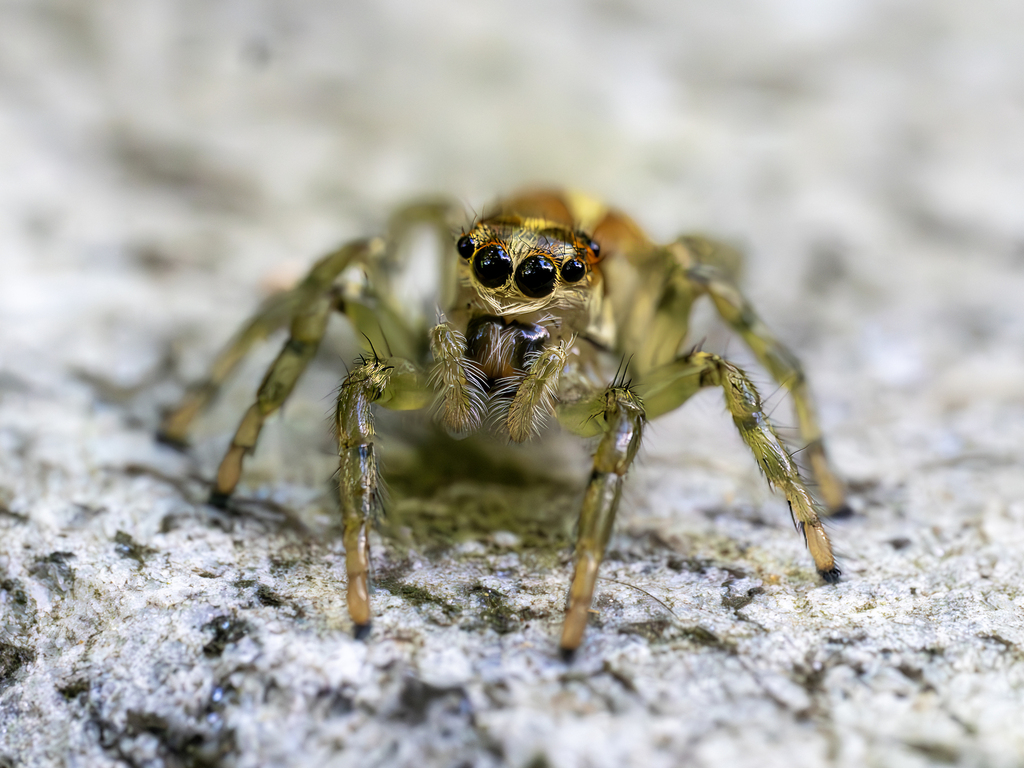
Plexippoides regius
Plexippoides regius (Korean: 왕어리두줄깡충거미; RR: Wangeoridujulkkangchunggeomi) is a species of jumping spider in the genus Plexippoides. The species was first described by Wanda Wesołowska in 1981 based on specimens from North Korea but its distribution has been extended to include China, Russia and South Korea, with examples found as far as Sichuan. The spider is small, with a body length between 6.9 and 8.65 mm (0.27 and 0.34 in), the female being generally larger than the male. It is distinguished by the two brown lines that stretch across the back of its carapace and abdomen that is recalled in its Korean name. Otherwise, the spider varies in coloration, with some examples having an orange or yellow-brown carapace and others dark brown. The male has a long embolus that encircles the palpal bulb. The female has complex seminal ducts that lead to heavily sclerotised and many-chambered spermathecae.
From the article Plexippoides regius on Wikipedia (CC BY-SA), quoted section by section
Description
Plexippoides regius is a small jumping spider. The male has a body length between 6.9 and 8.55 mm (0.27 and 0.34 in). The spider's body is divided into two main parts: an elongated cephalothorax and an oval abdomen that is narrower to the rear. The cephalothorax measures between 3.3 and 3.91 mm (0.13 and 0.15 in) in length and typically 2.8 and 2.5 mm (0.11 and 0.10 in) in width. The carapace, the hard upper part of the cephalothorax, varies between individual examples, with some being orange or yellow-brown and others dark brown. All have a very dark brown or black eye field. There are two brown bands that mark the carapace from behind the eyes to the rear. The underside, or sternum, is yellow to brown. The chelicerae are reddish-brown and the remainder of the mouthparts brown. The spider has two front teeth and one back tooth. The abdomen is a yellow-brown oval, measuring between 3.59 and 4.07 mm (0.14 and 0.16 in) in length and typically 2.2 mm (0.09 in) wide. The topside is yellow and has a marking of two brown stripes stretching down from front to back and a zigzag pattern on the edges. The underside is yellowish-brown and has a dense covering of dark hairs. The legs and spinnerets are also yellowish-brown, although the legs have a dense covering of thornlike bristles. The pedipalps are yellow with a broad cymbium that protrudes to the end of the tibial spike, or apophysis. …
Range & habitat
Plexippoides regius is found in China, Korea and Russia. The holotype was collected in North Hamgyong Province in North Korea in 1970. Examples were also identified in other areas of the country, including South Hamgyong Province. The spider was observed living in the cities of Chongjin in 1987 and Pyongyang in 1990, the latter near the Tomb of King Tongmyong. It has been subsequently seen living in four forest sites in South Korea. The first example of Plexippoides regius to be found in Russia was discovered in Primorsky Krai in 1979 but was not identified as being of this species until 1984. Other examples have been seen in Khabarovsk Krai. It was subsequently found in China. In 2002, specimens were collected in Henan, being discovered in Baligou, Huaiheyuan National Forest Park and the regions around Mount Song. In 2006, further discoveries were made, including in the rural areas of Tongbai. It has also been found in Dengfeng, Huixian, Xinyang, Linzhou, Luanchuan, Lushi, Neixiang, Songxian Jiyuan and Yiyang. Outside Henan, the spider has been spotted in Beijing and the Chinese provinces of Anhui, Hebei, Hubei, Jilin, Shanxi, Sichuan and Zhejiang. The spider lives in mountain and field grassland. It thrives both in trees and on blades of grass. The spider can be particularly found around shrubs and bushes.
Wikipedia: “Distribution and habitat”
Where it lives
Recorded sightings
—
geo-referenced records in GBIF, from museums, herbaria and field observers.
Drag the globe to turn it. Dots are where records exist, not a range map; darker means more records.
In the stacks
Searching the stacks…
Every page naming Plexippoides regius in the Biodiversity Heritage Library →
This page is assembled live from iNaturalist, GBIF, Wikipedia, the Source Library and the Internet Archive. It is not yet part of the hand-edited codex. iNaturalist taxon 545677.