- Fungi Including Lichens
- ›Ascomycete Fungi
- ›Sac Fungi and Lichens
- ›Operculate Ascomycetes
- ›Pezizales
- ›Elf Cups and Allies
- ›Sarcoscypha
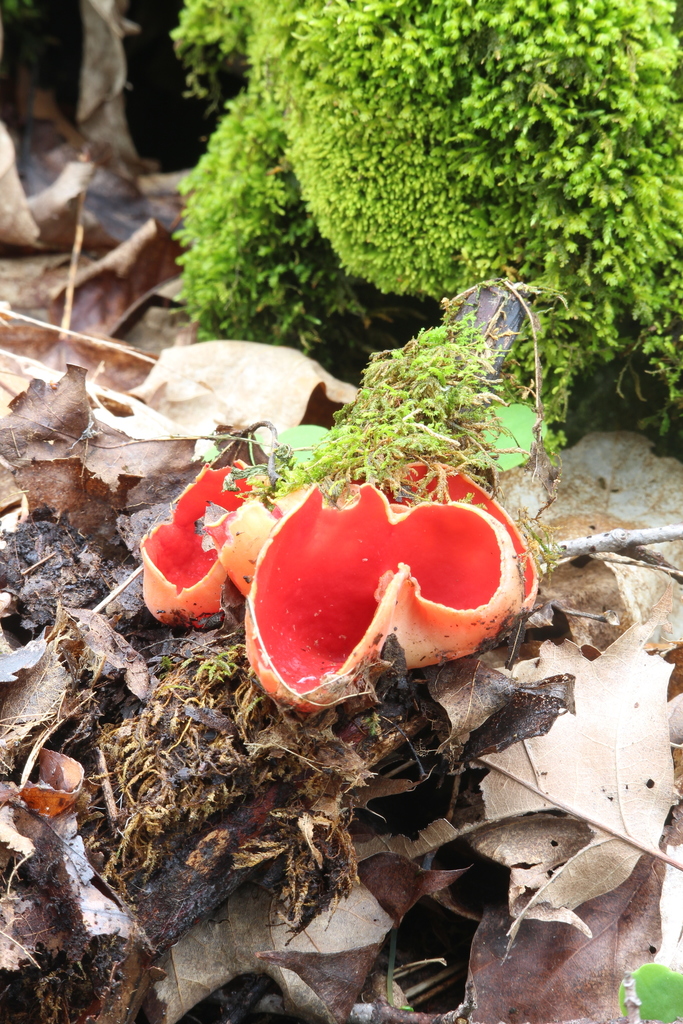
Sarcoscypha dudleyi
Sarcoscypha dudleyi, commonly known as the crimson cup or the scarlet cup, is a species of fungus in the family Sarcoscyphaceae of the order Pezizales. It has been frequently confused with Sarcoscypha coccinea, but can be distinguished from this and other related species in Sarcoscypha by differences in microscopic characteristics, such as the presence and number of oil droplets in the spores. An imperfect form of the fungus, lacking a sexually reproductive stage in its life cycle, is classified as the species Molliardiomyces dudleyi.
In addition to its main distribution in the central to eastern United States, the fungus has also been recorded once in Bulgaria.
From the article Sarcoscypha dudleyi on Wikipedia (CC BY-SA), quoted section by section
Description
The fruit body is 2–6 cm (3⁄4–2+1⁄4 in) broad and shallowly to deeply cup-shaped. The exterior surface of the fruit body is covered with whitish, matted "hairs", while the interior fertile surface of the cup (the hymenium) is scarlet- to orange-red. The edge of the cup (or margin) is curved inwards in young fruit bodies. The stem, if present at all, is short. The asci are 400–500 by 12–14 μm, cylindrical, and operculate. The ascospores are elliptical to cylindrical with rounded ends, uniseriate, hyaline, and measure 26–40 by 10–12 μm. They contain two large oil drops at either end; the oil drops are useful taxonomic characters that may be used to help distinguish S. dudleyi from some other Sarcoscypha species. The spores are covered with a sheath of mucilage, which typically causes the eight spores of the ascus to be ejected together. The paraphyses (sterile filamentous hyphal end cells in the hymenium) are slender, slightly enlarged above, and contain numerous red granules. The granules contain carotenoid pigments such as plectaniaxanthine or beta carotene, and give the fruit body its color.
Anamorph form. Anamorphic or imperfect fungi are those that seem to lack a sexual stage in their life cycle, and typically reproduce by the process of mitosis in structures called conidia. …
Range & habitat
Sarcoscypha dudleyi is a saprobic species, and derives nutrients by breaking down the complex insoluble polysaccharides found in woody material, such as cellulose and lignin. Fruit bodies are found growing singly or in very small groups, and are attached to buried or partially buried sticks in forests. Basswood has been noted to be a preferred wood type for the species. Fruit bodies typically appear during early spring, but may occasionally also in late fall. Although the distribution appears to be largely restricted to the eastern United States, it was once reported in Bulgaria in 1994, representing the first European collection.
== References ==
Wikipedia: “Habitat and distribution”
Where it lives
Recorded sightings
—
geo-referenced records in GBIF, from museums, herbaria and field observers.
Drag the globe to turn it. Dots are where records exist, not a range map; darker means more records.
In the stacks
Searching the stacks…
Every page naming Sarcoscypha dudleyi in the Biodiversity Heritage Library →
This page is assembled live from iNaturalist, GBIF, Wikipedia, the Source Library and the Internet Archive. It is not yet part of the hand-edited codex. iNaturalist taxon 544610.