- Animals
- ›Chordates
- ›Vertebrates
- ›Birds
- ›Hawks, Eagles, Kites, and Allies
- ›Hawks, Eagles, and Kites
- ›Typical Old World Vultures
- ›Necrosyrtes
On eBird ↗
Hooded Vulture
Live sightings near you, the range map, bar charts of when it is seen, and Macaulay Library photos and recordings.
Hooded Vulture
Necrosyrtes monachus
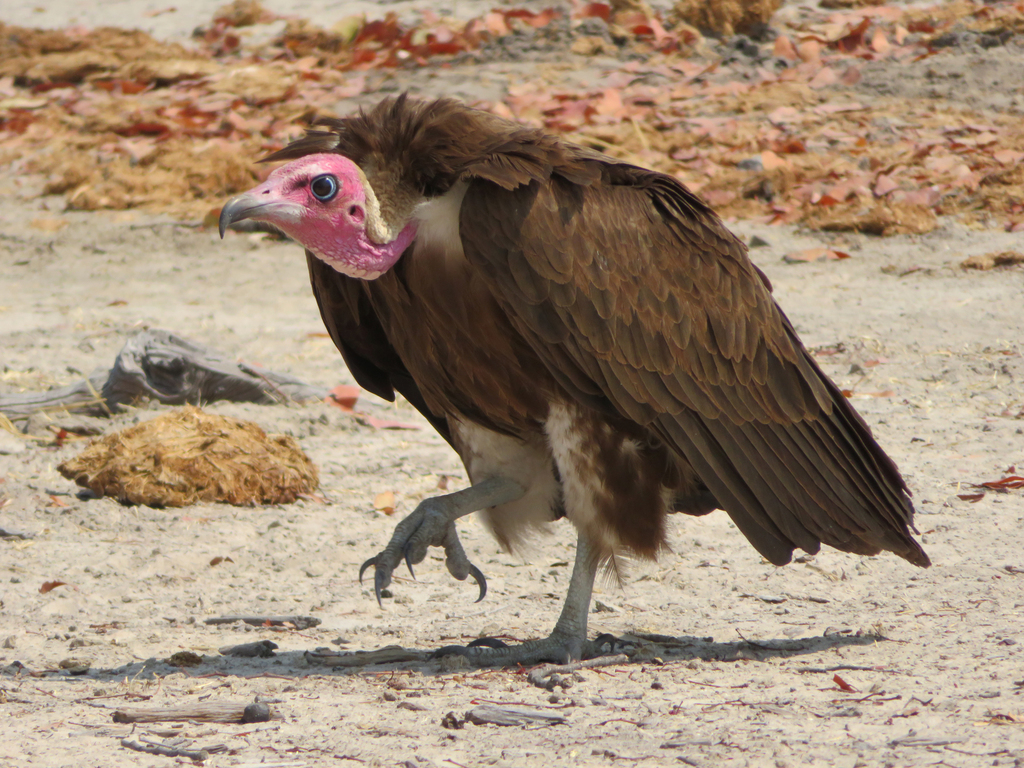
The hooded vulture (Necrosyrtes monachus) is an Old World vulture in the order Accipitriformes, which also includes eagles, kites, buzzards and hawks. It is the only member of the genus Necrosyrtes, which is sister to the larger Gyps genus, both of which are a part of the Aegypiinae subfamily of Old World vultures. It is native to sub-Saharan Africa, where it has a widespread distribution with populations in southern, East and West Africa. It is a scruffy-looking, small vulture with dark brown plumage, a long thin bill, bare crown, face and fore-neck, and a downy nape and hind-neck. Its face is usually a light red colour. It typically scavenges on carcasses of wildlife and domestic animals. Although it remains a common species with a stable population in the lower region of Casamance, some areas of The Gambia, and Guinea-Bissau, other regions such as Dakar, Senegal, show more than 85% losses in population over the last 50 years. Threats include poisoning, hunting, loss of habitat and collisions with electricity infrastructure, and the International Union for Conservation of Nature has rated its conservation status as "critically endangered" in their latest assessment (2022). The highest current regional density of hooded vultures is in the western region of The Gambia.
From the article Hooded vulture on Wikipedia (CC BY-SA), quoted section by section
Description
The hooded vulture is a typical vulture, with a head that is usually pinkish-white, but flushes red when agitated, and a grey to black "hood". It has fairly uniform dark brown body plumage. It has broad wings for soaring and short tail feathers. This is one of the smaller Old World vultures. They are 62–72 cm (24–28 in) long, have a wingspan of 155–180 cm (61–71 in) and a body weight of 1.5–2.6 kg (3.3–5.7 lb). Both sexes are alike in appearance, although females often have longer eyelashes than males. Juveniles look like adults, only darker and plainer, and body feathers have a purplish sheen.
Wikipedia: “Appearance”
Range & habitat
Although hooded vultures have relatively small home ranges, they are widely distributed across Africa. It occurs in Senegal, Mauritania, Guinea-Bissau, The Gambia, Niger and Nigeria in West Africa; in East Africa it is found in Chad, Sudan, South Sudan, Ethiopia, Rwanda and Somalia; in southern Africa it has been recorded in northern Namibia, Botswana, Zambia, Zimbabwe, Mozambique and South Africa. Within South Africa, the species is essentially restricted to the Kruger National Park and surrounding protected areas in Mpumalanga and Limpopo provinces, though vagrants have been recorded further west in Kwa-Zulu Natal and Kgalagadi Transfrontier Park.
Wikipedia: “Distribution”
What it does
It breeds in a stick nest in trees (often palms) in much of Africa south of the Sahara, laying one egg. Birds may form loose colonies. The population is mostly resident and sedentary, rarely moving more than 200 km.
Wikipedia: “Nesting, breeding and behaviour”
In human culture
The common name "hooded vulture" stems from the fact that the vulture has a small patch of downy feathers that runs along the back of its neck to the crown of its head, making it look like it is wearing a fluffy, cream-colored hood. The scientific name, Necrosyrtes monachus, can be broken down into 3 sections: "necro", since it feeds on carrion; "syrtes" which means "cord" and "monachus" which is Latin for "monk" and relates to the hood of the vulture.
Wikipedia: “Etymology”
Listen
Looking for field recordings…
Where it lives
Recorded sightings
—
geo-referenced records in GBIF, from museums, herbaria and field observers.
Drag the globe to turn it. Dots are where records exist, not a range map; darker means more records.
In the stacks
Searching the stacks…
Every page naming Necrosyrtes monachus in the Biodiversity Heritage Library →
This page is assembled live from iNaturalist, GBIF, Wikipedia, the Source Library and the Internet Archive. It is not yet part of the hand-edited codex. iNaturalist taxon 5426.