- Fungi Including Lichens
- ›Basidiomycete Fungi
- ›Higher Basidiomycetes
- ›Mushrooms, Bracket Fungi, Puffballs, and Allies
- ›Auriculariales
- ›Pseudohydnum
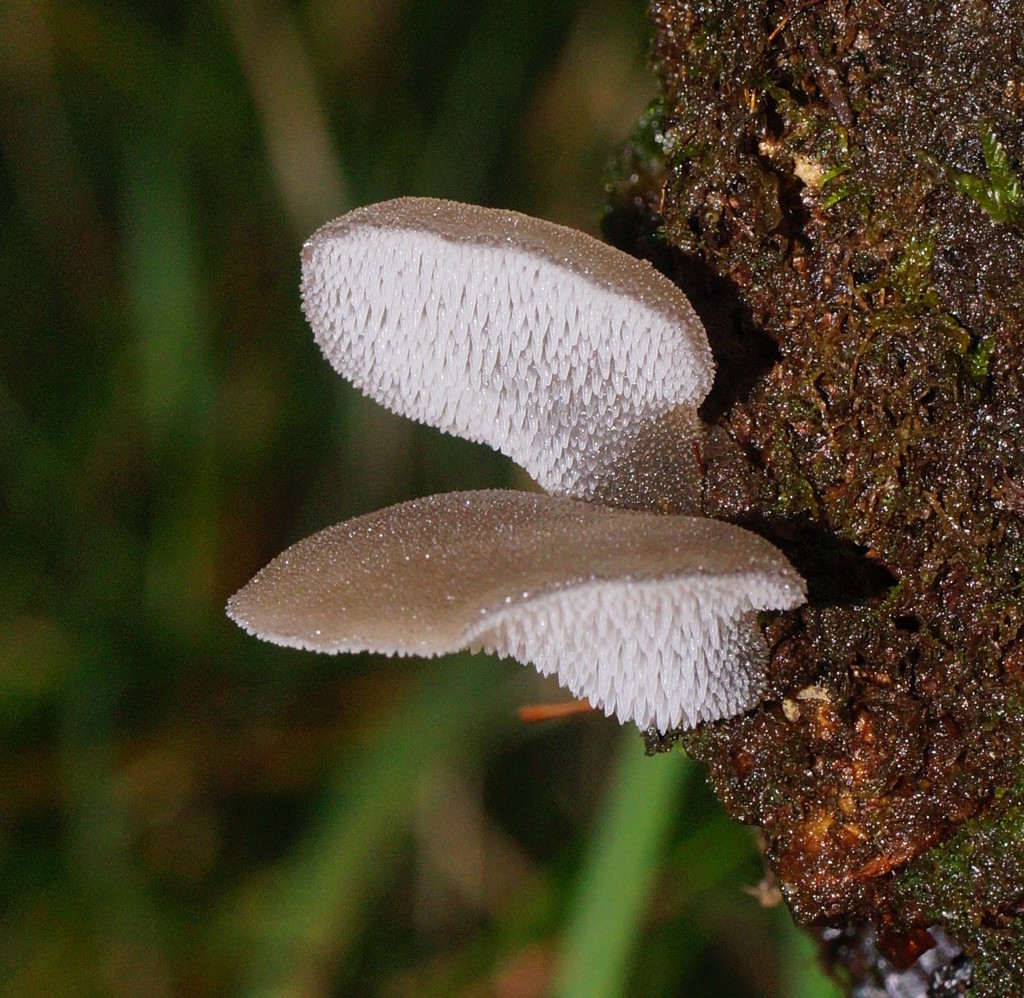
Toothed Jelly Fungus
Pseudohydnum gelatinosum
Pseudohydnum gelatinosum (common names include toothed jelly fungus, false hedgehog mushroom, cat's tongue, and white jelly mushroom) is an edible mushroom. Although bland, it can be candied or marinated. A widely distributed species, it is found in Asia, Australia, New Zealand, Europe, North America, Central America, and South America. The fungus grows in woodlands on dead trunks, logs, and stumps.
From the article Pseudohydnum gelatinosum on Wikipedia (CC BY-SA), quoted section by section
Description
The gelatinous fruit bodies are whitish to light grayish or tan, 2–7 centimetres (3⁄4–2+3⁄4 inches) wide and tall, with teeth up to 3 millimetres (1⁄8 in) long. The spore print is white. It has little to no flavour.
Range & habitat
The species was thought to be cosmopolitan, but recent DNA evidence suggests that it is confined to Europe and northern Asia, with superficially similar (but distinct) taxa elsewhere. P. gelatinosum grows on dead conifer wood. The North American species can be found near both coasts, between November– February on the west and July–September in other places. Western specimens usually have a distinct vertical stalk compared to those in the east.
Wikipedia: “Distribution and habitat”
At the table
The jelly tooth is edible, perhaps even raw, although can benefit from marination. It is consumed as a wild food in parts of Bulgaria, Russia, and Siberia.
Wikipedia: “Uses”
Where it lives
Recorded sightings
—
geo-referenced records in GBIF, from museums, herbaria and field observers.
Drag the globe to turn it. Dots are where records exist, not a range map; darker means more records.
In the stacks
Searching the stacks…
Every page naming Pseudohydnum gelatinosum in the Biodiversity Heritage Library →
This page is assembled live from iNaturalist, GBIF, Wikipedia, the Source Library and the Internet Archive. It is not yet part of the hand-edited codex. iNaturalist taxon 54164.