- Animals
- ›Chordates
- ›Vertebrates
- ›Birds
- ›Hawks, Eagles, Kites, and Allies
- ›Hawks, Eagles, and Kites
- ›Honey-buzzards, Pernine Kites, and Allies
- ›Henicopernis
On eBird ↗
Black Honey-buzzard
Live sightings near you, the range map, bar charts of when it is seen, and Macaulay Library photos and recordings.
Black Honey-buzzard
Henicopernis infuscatus
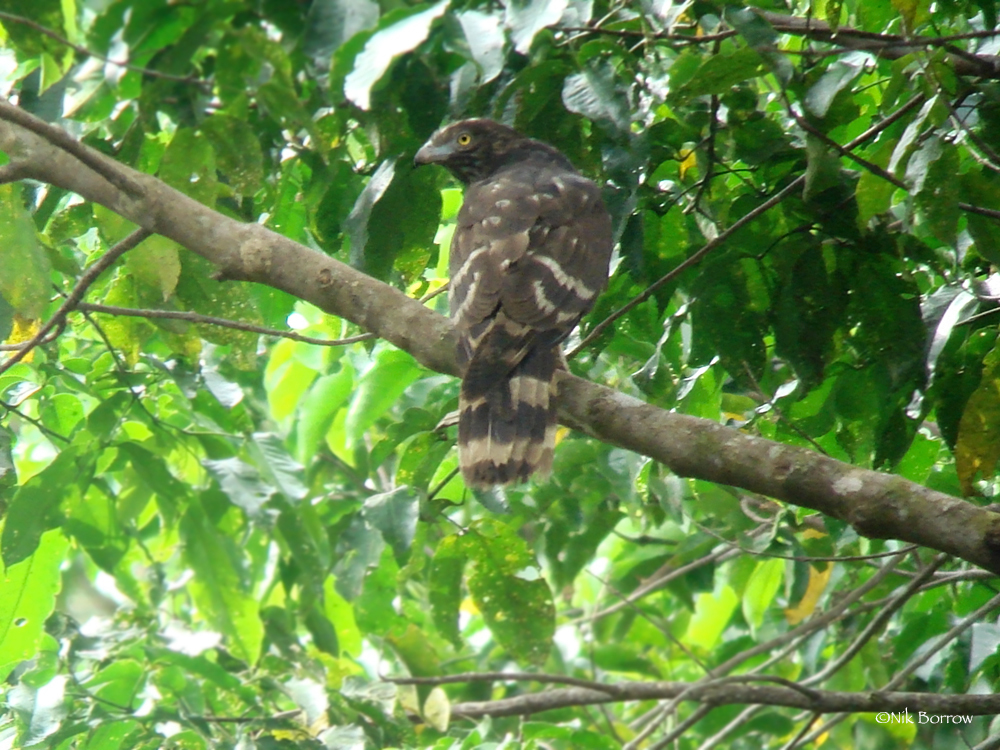
The black honey buzzard (Henicopernis infuscatus), also known as the New Britain honey buzzard, is a large raptor of the family Accipitridae. Standing at around 50 cm (20 in) tall, the adult black honey buzzard has a dark head and body, with striking white bands on its tail and flight feathers. When in flight, the buzzard can be recognized by its long wings and noticeably large secondary feathers. It is thought to be sedentary, with a range limited to the island of New Britain in Papua New Guinea, where it is endemic. Due to its remote habitat and tendency to remain in densely forested areas, there is still much to learn about this species.
From the article Black honey buzzard on Wikipedia (CC BY-SA), quoted section by section
Description
The black honey buzzard is a dark grey-brown colour with pale silvery bars on the wings and tail. When perched, the wing and tail bars are clearly visible. In flight, the wing bars are notable and the wing shape is distinctive, with a narrow base and broad tips, and bulging outer primaries. Juvenile markings are unknown. Its height ranges 48–52 cm (19–20 in), and wingspan ranges 110–115 cm (43–45 in). It was first identified and catalogued among European natural historians by James Sligo Jameson in 1877.
Range & habitat
The black honey buzzard occurs on the island of New Britain, part of the Bismarck archipelago in Papua New Guinea. Its habitat consists of primary rainforest, usually in hilly areas. Its altitudinal range extends up to 1,300 m (4,300 ft). The population is estimated to be between 6000 and 15 000 mature individuals.
Wikipedia: “Habitat and distribution”
What it does
The diet is largely unknown, but it is assumed that it is similar to that of the long-tailed honey buzzard, which typically feeds on arthropods, lizards, birds and birds' eggs.
Wikipedia: “Diet”
Listen
Looking for field recordings…
Where it lives
Recorded sightings
—
geo-referenced records in GBIF, from museums, herbaria and field observers.
Drag the globe to turn it. Dots are where records exist, not a range map; darker means more records.
In the stacks
Searching the stacks…
Every page naming Henicopernis infuscatus in the Biodiversity Heritage Library →
This page is assembled live from iNaturalist, GBIF, Wikipedia, the Source Library and the Internet Archive. It is not yet part of the hand-edited codex. iNaturalist taxon 5404.