- Animals
- ›Chordates
- ›Vertebrates
- ›Reptiles
- ›Snakes and Lizards
- ›Lizards
- ›Iguanas and Allies
- ›Iguanas, Anoles, and Allies
- ›Phrynosomatid Lizards
- ›Sceloporine Lizards
- ›Sceloporus
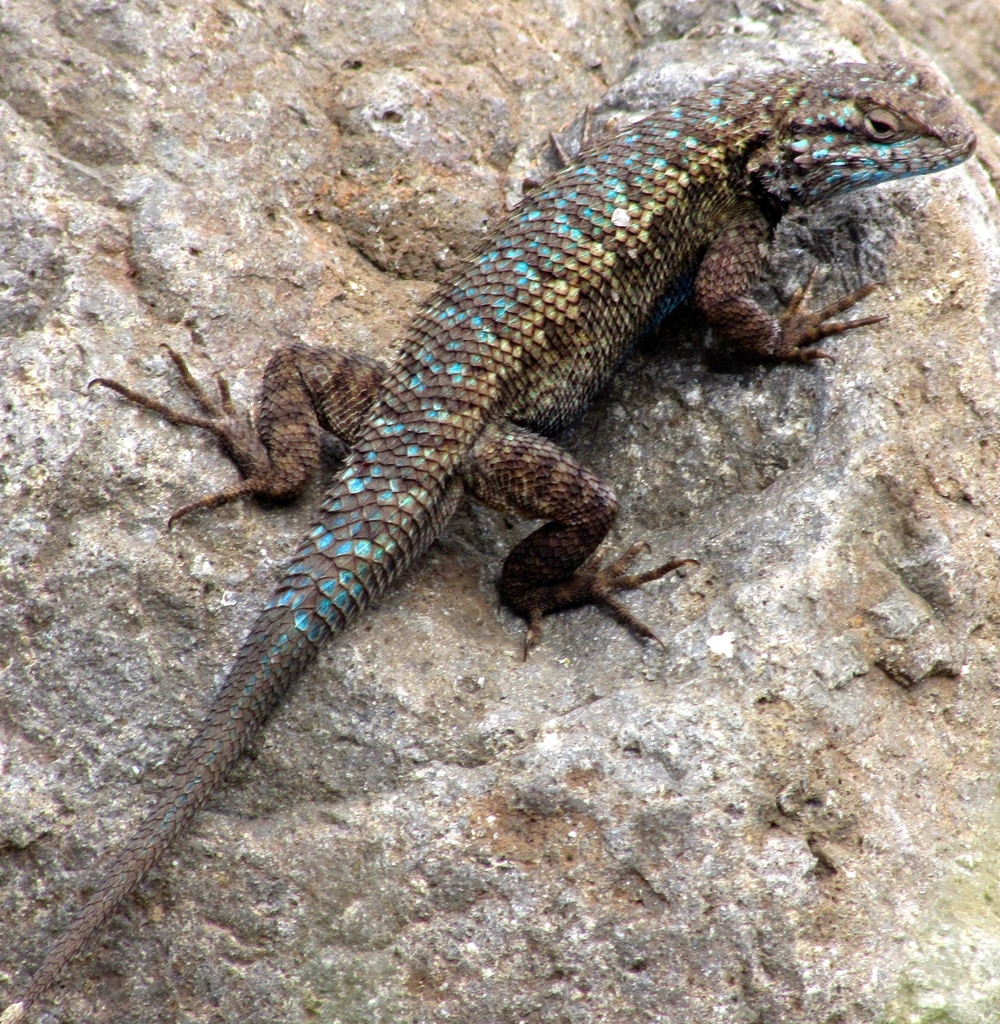
Island Fence Lizard
Sceloporus becki
Sceloporus becki, also known as the island fence lizard, is a species of lizard endemic to the Channel Islands of California.
From the article Sceloporus becki on Wikipedia (CC BY-SA), quoted section by section
Description
Despite it being a distinct subspecies, it shares a physically similar appearance as various mainland sub-species of the western fence lizard, a very common lizard in California. The island fence lizard is a relatively small species characterized by keeled and pointed dorsal scales of uniform size across the back, sides, and belly. The scales on the thighs are mostly keeled and noticeably smaller, while the rear of the limbs is colored yellow or orange. A distinctive blue coloration is present on the sides of the belly. The lizard's overall coloration varies between brown, gray, or black with blotches, and it may have light markings forming stripes or irregular lines along the sides of the back. In some cases, dark blotching creates irregular bands. The belly is pale in color. Males are distinguished by blue markings on the sides of the belly, bordered in black, a black patch on the throat, enlarged postanal scales, and a swollen tail base. When exposed to light, some of the dorsal scales may exhibit a blue or greenish tint. In contrast, females show faint or absent blue belly markings, no blue or green coloration on their upper surfaces, and display dark bars or crescents on their backs. Juveniles typically lack blue throat markings and may have faint or no blue coloration on the belly. …
What it does
These lizards are most active when temperatures are warm, and are often inactive during extreme thermal conditions. However, the moderate and consistent temperatures of the channel islands usually allow for year long activity. They are often seen in sunny areas, such as stream banks, beach driftwood, grassy hillsides, and human settlements. They are frequently seen basking on rocks, logs, fences, and walls. Males typically establish territory on elevated perches in order to observe potential mates or rivals. Males defend their territory through physical combat, and try to attract females through displays of head-bobbing and pushups to show off blue throat and ventral colors. Island fence lizards portray common behaviors of tail detachment and regeneration, being able to easily detach their tail to flee from predators. The detach tail squirms to distract a predator, allowing time for the lizard's body to escape.
Wikipedia: “Behavior”
In human culture
The specific epithet, becki, is in honor of Rollo Howard Beck, an American ornithologist who collected the first specimens.
Wikipedia: “Etymology”
Where it lives
Recorded sightings
—
geo-referenced records in GBIF, from museums, herbaria and field observers.
Drag the globe to turn it. Dots are where records exist, not a range map; darker means more records.
In the stacks
Searching the stacks…
Every page naming Sceloporus becki in the Biodiversity Heritage Library →
This page is assembled live from iNaturalist, GBIF, Wikipedia, the Source Library and the Internet Archive. It is not yet part of the hand-edited codex. iNaturalist taxon 540190.