- Animals
- ›Chordates
- ›Vertebrates
- ›Reptiles
- ›Snakes and Lizards
- ›Lizards
- ›Wall lizards, amphisbaenians, and allies
- ›Whiptails and Tegus
- ›Whiptails and Ameivas
- ›Pholidoscelis
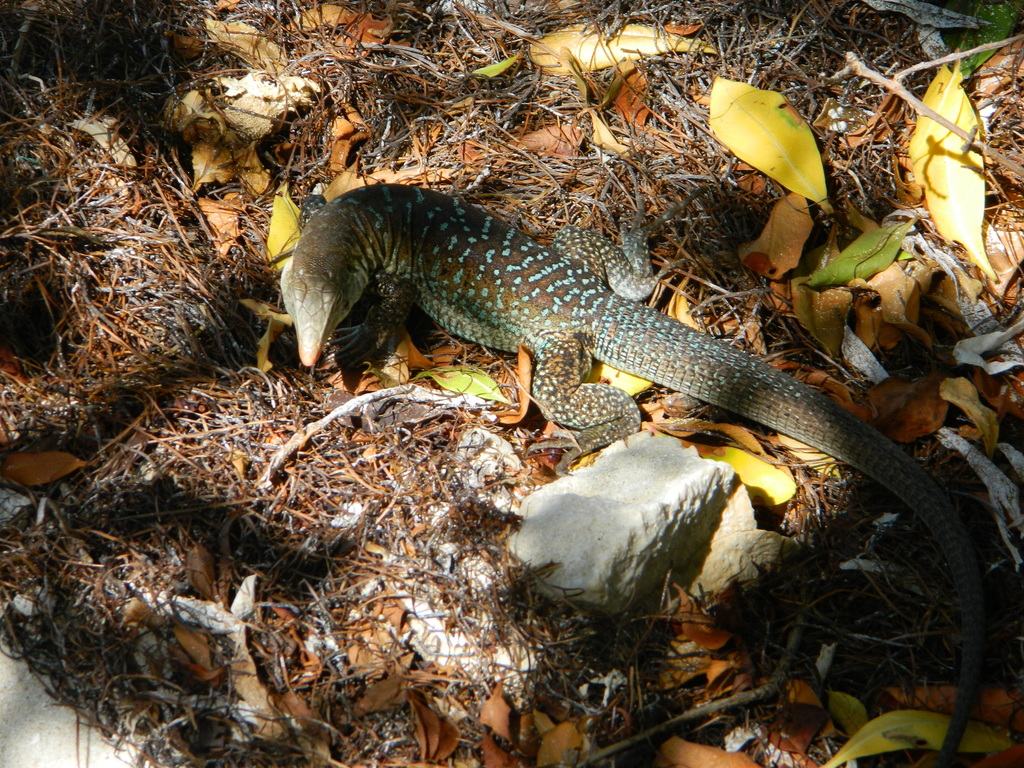
Antiguan ameiva
Pholidoscelis griswoldi
Griswold's ameiva (Pholidoscelis griswoldi), also known as the Antiguan ameiva, is a species of lizard in the family Teiidae. The species is endemic to Antigua and Barbuda, where it is found on both islands. It is also known commonly as the Antiguan ameiva and the Antiguan ground lizard.
From the article Griswold's ameiva on Wikipedia (CC BY-SA), quoted section by section
Description
Griswold's ameiva has a brownish background colour with bluish green vermiculations, a dark buish-green chest and lighter bluish-green on the belly. The legs are spotted and there is a pale stripe on the rear of the hindlimbs.
Range & habitat
Griswold's ameiva is endemic to the nation of Antigua and Barbuda, where it is found on both Antigua and Barbuda, and the satellite islands to these islands. This lizard lives on the ground in open and sunny areas, although in Antigua it is only found in association with humans in built up areas.
Wikipedia: “Distribution and habitat”
In human culture
The specific name, griswoldi, is in honor of Dr. Donald W. Griswold, who was director of the Rockefeller West Indian Hookworm Commission.
Wikipedia: “Etymology”
Where it lives
Recorded sightings
—
geo-referenced records in GBIF, from museums, herbaria and field observers.
Drag the globe to turn it. Dots are where records exist, not a range map; darker means more records.
In the stacks
Searching the stacks…
Every page naming Pholidoscelis griswoldi in the Biodiversity Heritage Library →
This page is assembled live from iNaturalist, GBIF, Wikipedia, the Source Library and the Internet Archive. It is not yet part of the hand-edited codex. iNaturalist taxon 540073.