- Animals
- ›Chordates
- ›Vertebrates
- ›Reptiles
- ›Snakes and Lizards
- ›Snakes
- ›Blind snakes
- ›Typical Blind Snakes
- ›Asiatyphlopinae
- ›Indotyphlops
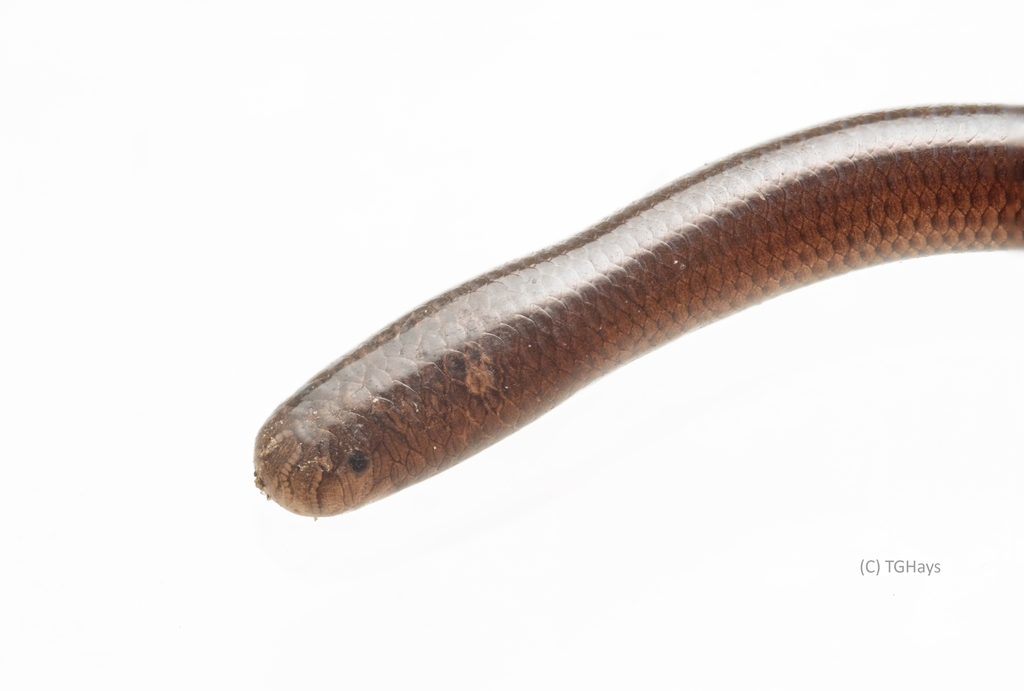
Brahminy Blindsnake
Indotyphlops braminus
Indotyphlops braminus, commonly known as the brahminy blind snake (), is a non-venomous blind snake species, found mostly in Africa and Asia, and has been introduced in many other parts of the world. It is a completely fossorial (i.e., burrowing) reptile, with habits and appearance similar to an earthworm, for which it is often mistaken and shares convergent evolution with, although close examination reveals tiny scales and eyes rather than the annular segments characteristic of a true earthworm. The species is parthenogenetic and all known specimens have been female. The specific name is a Latinized form of the word Brahmin. No subspecies are currently recognized as being valid.
From the article Indotyphlops braminus on Wikipedia (CC BY-SA), quoted section by section
Description
Adults of I. braminus measure 2–4 inches (5.1–10.2 cm) long, uncommonly to 6 inches (15 cm). The head and tail are superficially similar as the head and neck are indistinct. Unlike other snakes, the head scales resemble the body scales. The eyes are barely discernible as small dots under the head scales. The tip of the tail has a small, pointed spur. Along the body are fourteen rows of dorsal scales. Coloration ranges from charcoal gray, silver-gray, light yellow-beige, purplish, or infrequently albino, the ventral surface more pale. Coloration of the juvenile form is similar to that of the adult. Behavior ranges from lethargic in appropriate habitat to energetic, quickly seeking the cover of soil or leaf litter to avoid light.
The tiny eyes are covered with translucent scales, rendering this snake almost entirely blind. The eyes cannot form images, but are still capable of registering light intensity.
Range & habitat
Most likely originally native to Africa and Asia, I. braminus is an introduced species in many parts of the world, including Australia, the Americas, and Oceania. The vertical distribution is from sea level to 1,200 metres (3,900 ft) in Sri Lanka and up to 1,500 metres (4,900 ft) in Guatemala. The type locality given is "Vishakhapatam" [India].
Native range. In Africa, I. braminus has been reported in Uganda, DRC, Egypt, Kenya, Senegal, Benin, Togo, Nigeria, Ivory Coast, Cameroon, Zambia, Zimbabwe, Somalia, Zanzibar, Tanzania, Mozambique, South Africa (an isolated colony in Cape Town and Natal Midlands; about eight have been found in Lephalale, Limpopo Province at the Medupi Power Station during construction), Madagascar (Nossi Be), the Comoro Islands, Mauritius, the Mascarene Islands and the Seychelles. It has also been found in Libya. In Asia, it occurs in the Arabian Peninsula, Lebanon, Iran, Iraq, Philippines, Pakistan, Nepal, mainland India (as well as the Andaman Islands, the Nicobar Islands, and the Lakshadweep Islands, where it is the only snake reported), the Maldives, Sri Lanka, Bangladesh, Myanmar, Singapore, the Malay Peninsula, Thailand, Cambodia, Vietnam, Laos, southern China (including Hainan), Hong Kong, Taiwan, and Japan (in the Ryukyu Islands of Okinawashima and Miyakoshima). In Maritime Southeast Asia, it occurs on Sumatra and nearby islands (the Riau Archi …
Wikipedia: “Distribution”
What it does
The diet of I. braminus consists of the larvae, eggs, and pupae of ants and termites.
Wikipedia: “Feeding”
Where it lives
Recorded sightings
—
geo-referenced records in GBIF, from museums, herbaria and field observers.
Drag the globe to turn it. Dots are where records exist, not a range map; darker means more records.
In the stacks
Searching the stacks…
Every page naming Indotyphlops braminus in the Biodiversity Heritage Library →
This page is assembled live from iNaturalist, GBIF, Wikipedia, the Source Library and the Internet Archive. It is not yet part of the hand-edited codex. iNaturalist taxon 539844.