- Animals
- ›Chordates
- ›Vertebrates
- ›Reptiles
- ›Snakes and Lizards
- ›Snakes
- ›Colubrid Snakes
- ›Natricine Snakes
- ›Herpetoreas
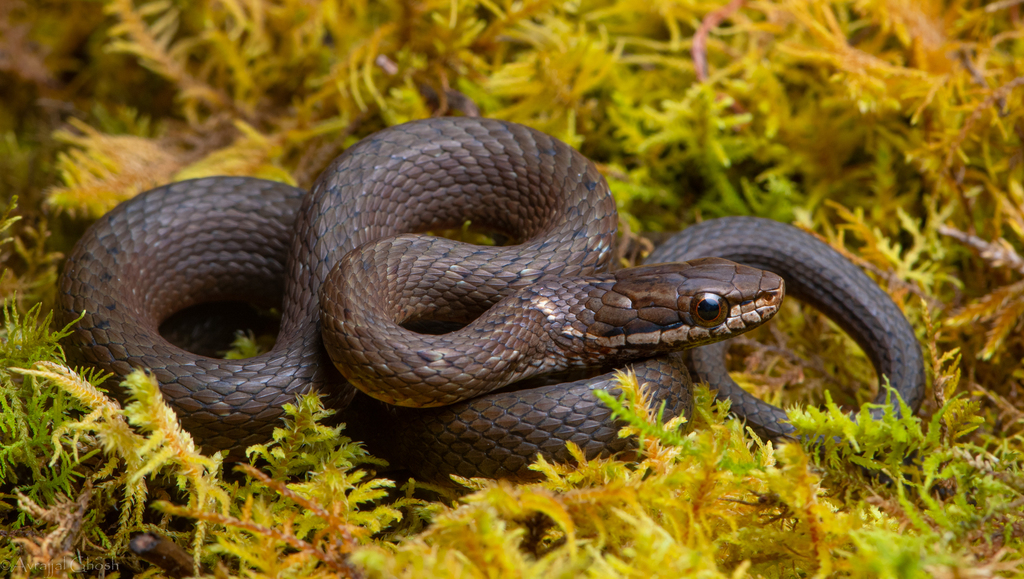
Himalayan Keelback
Herpetoreas platyceps
The Himalayan keelback (Herpetoreas platyceps), also known commonly as the eastern keelback, is a species of snake in the subfamily Natricinae of the family Colubridae. The species is native to South Asia.
From the article Himalayan keelback on Wikipedia (CC BY-SA), quoted section by section
Description
Herpetoreas platyceps has the following characteristics: Eye moderate; rostral just visible from above; suture between the internasals as long as that between the prefrontals or shorter; frontal longer than its distance from the end of the snout, shorter than the parietals; loreal longer than deep; one preocular (sometimes divided); two or three postoculars; temporals 1+1, or 1+2, or 2+2; 8 upper labials, third, fourth, and fifth entering the eye; 4 or 5 lower labials in contact with the anterior chin shields, which are much shorter than the posterior chin shields. Dorsal scales in 19 rows, faintly or feebly keeled. 177-235 ventrals; anal divided; subcaudals 75–107, also divided. Olive-brown above, with small black spots; frequently two black parallel lines or an elliptic marking on the nape; a light, black-edged streak on each side of the head, or a black line from eye to gape (corner of mouth); belly yellowish, with or without blackish dots; frequently a black line or series of elongate blackish spots along each side of the belly; lower surface of tail frequently mottled with blackish; throat sometimes black. In life, a coral-red band is said to run along the ends of the ventrals. Total length 90 cm (3 feet); tail 23 cm (9 inches).
Range & habitat
Herpetoreas platyceps is known from India along the sub-Himalayan region, Nepal, Bangladesh, Pakistan, Bhutan and China, at elevations of 1,040–4,000 m (3,410–13,120 ft).
Wikipedia: “Geographic range”
What it does
Herpetoreas platyceps preys upon a variety of small vertebrates, including fishes, frogs and their tadpoles, lizards, snakes and their eggs, birds, and mammals.
Wikipedia: “Diet”
Where it lives
Recorded sightings
—
geo-referenced records in GBIF, from museums, herbaria and field observers.
Drag the globe to turn it. Dots are where records exist, not a range map; darker means more records.
In the stacks
Searching the stacks…
Every page naming Herpetoreas platyceps in the Biodiversity Heritage Library →
This page is assembled live from iNaturalist, GBIF, Wikipedia, the Source Library and the Internet Archive. It is not yet part of the hand-edited codex. iNaturalist taxon 539829.