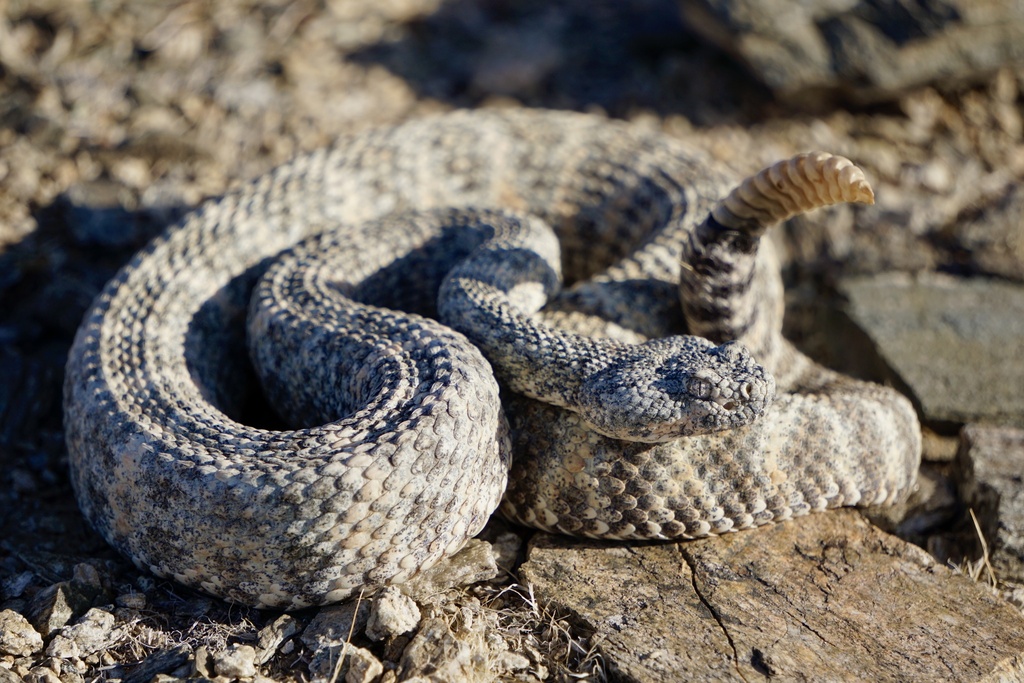
Southwestern Speckled Rattlesnake
Crotalus pyrrhus
Common names: southwestern speckled rattlesnake, Mitchell's rattlesnake, more.
Crotalus pyrrhus is a venomous pitviper species found in the southwestern United States and northwestern Mexico. A medium-sized snake, it is found mostly in rocky country, active at night and feeding on small mammals. The coloration is variable and depends on the color of the rocks and soil of the habitat.
From the article Crotalus pyrrhus on Wikipedia (CC BY-SA), quoted section by section
Description
Adults grow to an average length of 3 feet (91 cm), but may sometimes exceed 4 feet (120 cm). The color pattern is variable, depending on the color of the rocks and soil of the habitat. The snake's ground color may be pink, brown, gray, yellow or nearly white, and speckled with black and white. The pattern (if present) may consist of rhombs, bands or blotches. The tail is ringed.
Range & habitat
Found in the United States in southern California, southern Nevada, southwestern Utah and western Arizona. Also found in Mexico in northwestern Sonora and northern Baja California. No type locality was included in Cope's original 1867 description. Coues In Wheeler (1875) lists it as "Cañon Prieto, a locality near Fort Whipple [Yavapai County], Arizona."
Wikipedia: “Geographic range”
What it does
Primarily nocturnal, these snakes shelter in rock crevices and mammal burrows during the heat of the day. They become more diurnal during the cooler months of the year.
Wikipedia: “Behavior”
Toxicity
Hartnett (1931) describes a case of a man who was bitten on his left thumb. Aside from the sharp stab of the fangs being embedded, there was no pain until after an incision had been made and antivenin had been administered. There was then severe pain that lasted for about an hour after the bite, followed eventually by much discoloration and swelling, his fingers looking like red bananas. His fingers and wrist were covered with blebs and his palm with one large blister. In another case, a man was bitten on his heel, through his overalls and a sock. At first, the sensation was like being struck by a thorn, with only a drop of blood at fang mark. After 45 minutes and a 1+1⁄4 miles (2.0 km) walk, a tourniquet was applied and an incision made. Four hours later, his calf was considerably swollen and discolored, which was later followed by pain in the groin. Further symptoms were obscured by the treatment and an uneventful recovery was made.
Wikipedia: “Venom”
Where it lives
Recorded sightings
—
geo-referenced records in GBIF, from museums, herbaria and field observers.
Drag the globe to turn it. Dots are where records exist, not a range map; darker means more records.
In the stacks
Searching the stacks…
Every page naming Crotalus pyrrhus in the Biodiversity Heritage Library →
This page is assembled live from iNaturalist, GBIF, Wikipedia, the Source Library and the Internet Archive. It is not yet part of the hand-edited codex. iNaturalist taxon 539508.