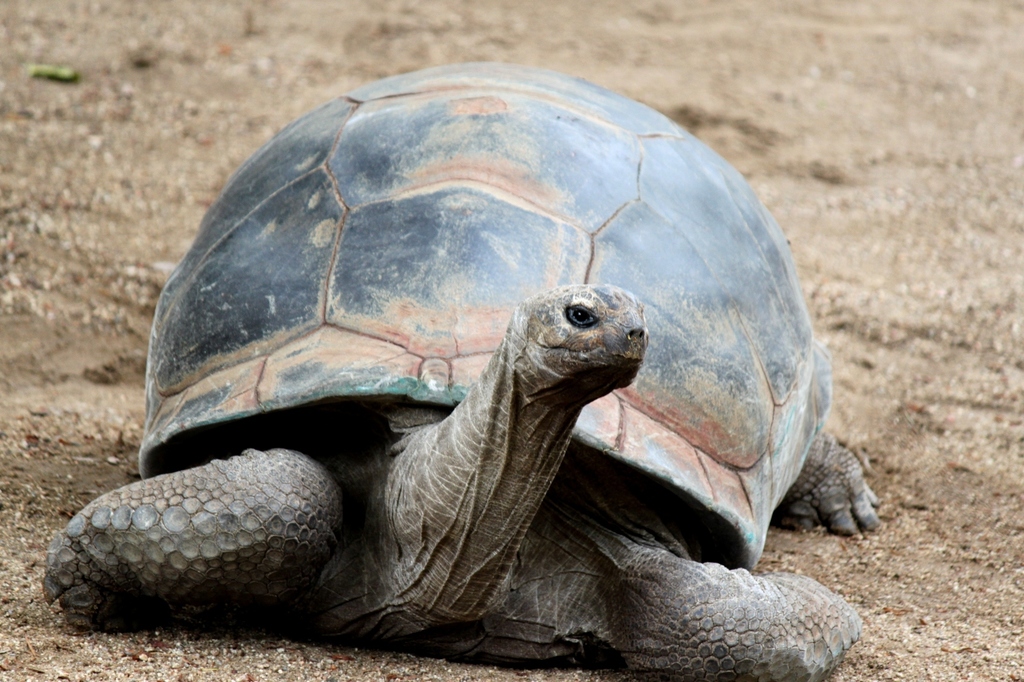
Aldabra Giant Tortoise
Aldabrachelys gigantea
The Aldabra giant tortoise (Aldabrachelys gigantea), Aldabra tortoise, or simply giant tortoise, is a species of tortoise in the family Testudinidae and genus Aldabrachelys. The species is endemic to the Seychelles, with the nominate subspecies, A. g. gigantea native to Aldabra atoll. It is one of the largest tortoises in the world. Historically, giant tortoises were found on many of the western Indian Ocean islands, as well as Madagascar, and the fossil record indicates giant tortoises once occurred on every continent and many islands with the exception of Antarctica.
Many of the Indian Ocean species were thought to be driven to extinction by over-exploitation by European sailors, and they were all seemingly extinct by 1840 with the exception of the Aldabran giant tortoise on the island atoll of Aldabra. Although some remnant individuals of A. g. hololissa and A. g. arnoldi may remain in captivity, in recent times, these have all been reduced as subspecies of A. gigantea.
From the article Aldabra giant tortoise on Wikipedia (CC BY-SA), quoted section by section
Description
The carapace of A. gigantea is a brown or tan in color with a high, domed shape. The species has stocky, heavily scaled legs to support its heavy body. The neck of the Aldabra giant tortoise is very long, even for its great size, which helps the animal to exploit tree branches up to a meter from the ground as a food source. Similar in size to the famous Galápagos giant tortoise, its carapace averages 122 cm (48 in) in length. Males have an average weight of 250 kg (550 lb). Females are generally smaller than males, with average specimens measuring 91 cm (36 in) in carapace length and weighing 159 kg (351 lb). Medium-sized specimens in captivity were reported as 70 to 110 kg (150 to 240 lb) in body mass. Another study found body masses of up to 132 kg (291 lb) most commonplace.
Range & habitat
The main population of the Aldabra giant tortoise resides on the islands of the Aldabra Atoll in the Seychelles. The atoll has been protected from human influence and is home to some 180,000 giant tortoises, the world's largest population of the animal. Smaller populations of A. gigantea in the Seychelles exist on Frégate Island and in the Sainte Anne Marine National Park (e.g. Moyenne Island), where they are a popular tourist attraction. Conservationists have also reintroduced 50 small individuals to Aride Island, joining 10 larger tortoises previously rehomed there. Another isolated population of the species resides on the island of Changuu, near Zanzibar. Other captive populations exist in conservation parks in the Mascarene Islands of Mauritius and Rodrigues (Aldabrachelys is not native to the Mascarenes, which were inhabited by their own later-extinct giant tortoises belonging to the unrelated genus Cylindraspis). The tortoises exploit many different kinds of habitat, including grasslands, low scrub, mangrove swamps, and coastal dunes.
Wikipedia: “Range and distribution”
What it does
Primarily herbivores, Aldabra giant tortoises eat grasses, leaves, woody plant stems, and fruit. They occasionally indulge in small invertebrates and carrion, even eating the bodies of other dead tortoises. In captivity, Aldabra giant tortoises are known to consume fruits, such as apples and bananas, as well as compressed vegetable pellets. In 2020, a female Aldabra giant tortoise on Fregate Island was observed hunting and eating a juvenile lesser noddy, indicating that the species was in the process of learning to catch birds. Little fresh water is available for drinking in the tortoises' natural habitat, so they obtain most of their moisture from their food. The Aldabra giant tortoise has two main varieties of shells, related to their habitat. Specimens living in habitats with food available primarily on the ground have more dome-shaped shells with the front extending downward over the neck. Those living in an environment with food available higher above the ground have more flattened top shells with the front raised to allow the neck to extend upward freely.
Wikipedia: “Feeding ecology”
Where it lives
Recorded sightings
—
geo-referenced records in GBIF, from museums, herbaria and field observers.
Drag the globe to turn it. Dots are where records exist, not a range map; darker means more records.
In the stacks
Searching the stacks…
Every page naming Aldabrachelys gigantea in the Biodiversity Heritage Library →
This page is assembled live from iNaturalist, GBIF, Wikipedia, the Source Library and the Internet Archive. It is not yet part of the hand-edited codex. iNaturalist taxon 539233.