- Animals
- ›Molluscs
- ›Gastropods
- ›True Limpets
- ›Nacellid Limpets, Lottiid Limpets, and Allies
- ›Lottiid Limpets and Allies
- ›Lottiid Limpets
- ›Lottiinae
- ›Lottiini
- ›Lottia
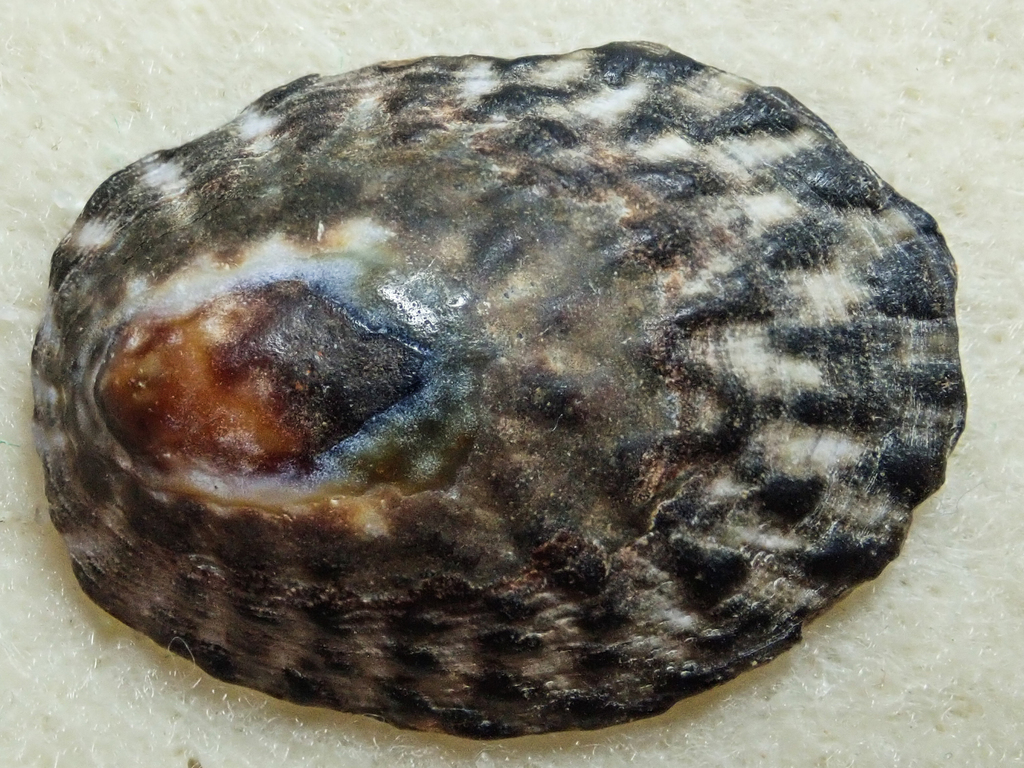
Owl Limpet
Lottia gigantea
Lottia gigantea, common name the owl limpet, giant owl limpet or solitary giant owl limpet, is a species of sea snail, a true limpet, a marine gastropod mollusc in the family Lottiidae. Its genome has been sequenced at the Joint Genome Institute.
From the article Lottia gigantea on Wikipedia (CC BY-SA), quoted section by section
Description
The owl limpet grows to a length of up to nine centimetres. The often much eroded shell has an elongated low cone shape with the apex close to one end. The anterior slope is concave. The general colour is brownish grey with pale markings and the foot is pale grey with a yellow or orange sole. There is also a small form that lives on the shells of mussels. It is even more elongated, up to twenty-five millimetres long, and dark blue with concentric growth rings. Lottia gigantea present a muscular orange foot. Round the edge of the foot the owl limpet has a distinctive pallial gill system which uses currents caused by the beating of cilia to circulate water over the gills when submerged.
Range & habitat
The owl limpet is found on the Pacific coast of North America from northern California to southern Baja California.
Wikipedia: “Distribution”
What it does
Owl limpets are protandric hermaphrodites. They spend about two years as juveniles before starting their reproductive lives as male limpets. If they survive long enough, some of them later transform into females. Spawning takes place once a year in the winter. The larvae are pelagic and form part of the zooplankton. They may be transported large distances by currents before settling on suitable rock surfaces. Larger individuals will themselves have encrusting animals such as barnacles and algae growing on their shells. Sometimes the shell will be used by other limpets or chitons for grazing on the microalgae that grows there. The black oystercatcher, Haematopus bachmani is the only known predator of the owl limpet but they are also harvested by humans for food.
Wikipedia: “Life cycle”
Where it lives
Recorded sightings
—
geo-referenced records in GBIF, from museums, herbaria and field observers.
Drag the globe to turn it. Dots are where records exist, not a range map; darker means more records.
In the stacks
Searching the stacks…
Every page naming Lottia gigantea in the Biodiversity Heritage Library →
This page is assembled live from iNaturalist, GBIF, Wikipedia, the Source Library and the Internet Archive. It is not yet part of the hand-edited codex. iNaturalist taxon 53750.