- Animals
- ›Chordates
- ›Vertebrates
- ›Ray-finned Fishes
- ›Spiny-rayed fishes
- ›Blennies, Damselfishes and Allies
- ›Damselfishes
- ›Giant Damselfishes
- ›Hypsypops
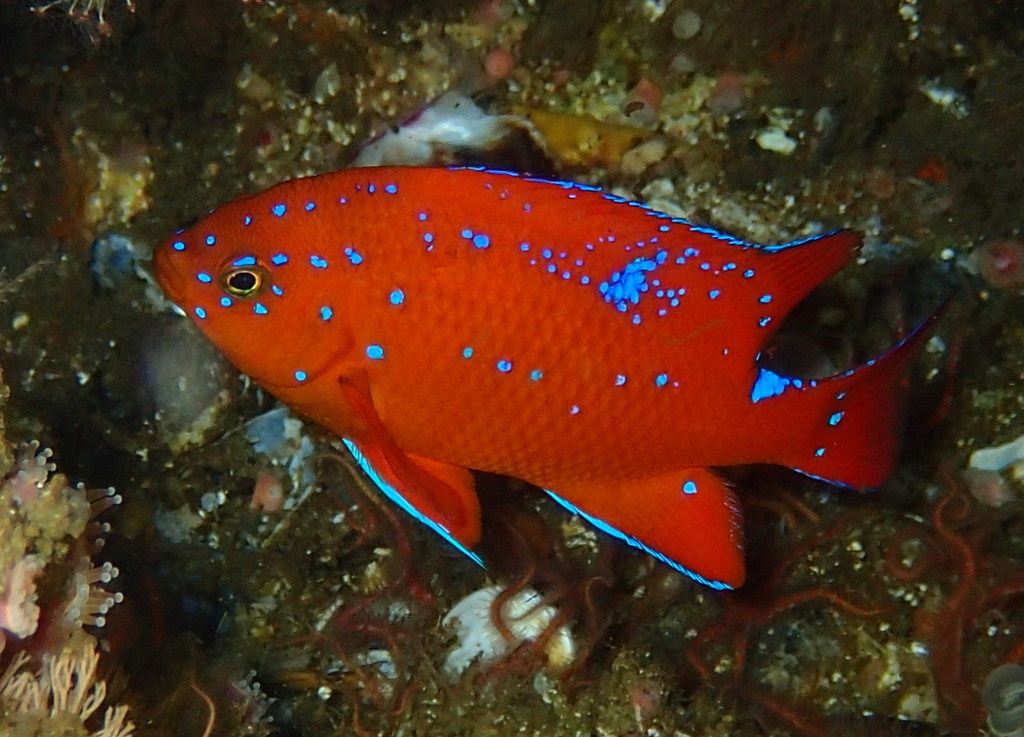
Garibaldi
Hypsypops rubicundus
The Garibaldi (Hypsypops rubicundus), known historically as the Catalina goldfish and marine goldfish and now commonly as the Garibaldi damselfish, is a species of bright orange fish in the damselfish family. It occurs in the subtropical northeastern part of the Pacific Ocean. The Garibaldi was named the official marine state fish of California in 1995, and has since been protected in California coastal waters from recreation and commercial fishing.
The English name is a reference to the 19th-century Italian general and political figure Giuseppe Garibaldi, whose followers often wore a characteristic scarlet or red shirt. Male Garibaldis aggressively defend the nest site after the female lays eggs, as is the case with other damselfish.
From the article Garibaldi (fish) on Wikipedia (CC BY-SA), quoted section by section
Description
Garibaldi are deep-bodied or laterally compressed fish, and covered in coarse scales. They have a single dorsal fin with about 12 spines and 16 rays. Adult fish of this species are uniformly bright orange in color. It is the largest member of the damselfish family growing up to 35.6 cm (14 inches) in length. Among Garibaldi there is a sexual size dimorphism, with average adult males measuring 25 mm (1 inch) larger than females, — an unusual trait for damselfish species and other marine fish in southern California, where typically adult females are larger. Juveniles are a deeper, more reddish shade of orange than adults. They are covered in many small iridescent blue stripes and spots, which they gradually lose as they become adults. Their tail (caudal fin) and dorsal fins are more translucent compared to their adult counterparts.
Role of coloration difference. A study conducted by Caron & Rainboth in 1992 found that vibrant colorations reduce aggressive behavior that territorial fish express toward members of their own species, especially during the breeding season. They tested orange and patterned orange (in addition to non-orange) as stimuli for territorial behavior in Garibaldi. The study found that orange was a very successful stimulus, and that adding disruptive patterns to the color orange counteracted or nullified the effect of pure orange. …
Range & habitat
Garibaldis are found in marine waters up to 30 metres (98 ft) in depth. They usually nest in association with rock reefs and typically over rocky sea-bottoms. They prefer to live over rocky bottoms on exposed or semi-protected coasts with clear water and plenty of crevices as well as small caves for cover. Juveniles can be found in tide pools up to depths of 40 feet (just over 12 m). H. rubicundus is native to subtropical parts of the northeastern Pacific Ocean, ranging from Monterey Bay, California, to Guadalupe Island, Baja California.
Wikipedia: “Distribution and habitat”
What it does
Classified as generalist omnivores, Garibaldi feed mainly on invertebrates, which they remove from the rocks. Their diet also includes a variety of algae and occasionally their own eggs. Garibaldi are found to most commonly feed upon fleshy red algae, polychaete worms, anemones, and sponge fragments. But they have also been found to eat encrusting bryozoans, hydroids, branching bryozoans, mollusks, and brown algae.
Wikipedia: “Diet”
In human culture
The breeding season for Garibaldi may begin as early as March and continue through July. During this time, the male clears a sheltered nest site within his territory, and then the female deposits eggs in the nest. When first deposited, the elliptical eggs are bright yellow and turn gray after approximately 5 days. After fertilizing the eggs, the male guards the nest area until the eggs hatch, which takes 19–21 days. Garibaldi have diel patterns of egg-hatching, meaning that spawning occurs at regular intervals within a day (24 hours), every day during the spawning season. Embryos hatch within 2 hours after sunset and before early morning, potentially to minimize risk of predation by planktivorous reef fishes. The embryos hatch and disperse as planktonic larvae, eventually reaching the first juvenile stage with a striped blue head and iridescent blue markings over an otherwise translucent orange body. In their juvenile stage, Garibaldi will inhabit tiny crevices, or shelter holes, in their habitat. As they grow older, their orange color deepens, and they gradually lose their blue markings. Garibaldi will typically achieve adult coloration at around 5 years and reach sexual maturity at 6 years. The average lifespan is believed to be around 12 years, and for the longest time the maximum age for an individual was thought to be 17 years. …
Wikipedia: “Life history”
Where it lives
Recorded sightings
—
geo-referenced records in GBIF, from museums, herbaria and field observers.
Drag the globe to turn it. Dots are where records exist, not a range map; darker means more records.
In the stacks
Searching the stacks…
Every page naming Hypsypops rubicundus in the Biodiversity Heritage Library →
This page is assembled live from iNaturalist, GBIF, Wikipedia, the Source Library and the Internet Archive. It is not yet part of the hand-edited codex. iNaturalist taxon 53693.