- Animals
- ›Chordates
- ›Vertebrates
- ›Ray-finned Fishes
- ›Salmons, Pikes and Mudminnows
- ›Salmons, Trouts, and Whitefishes
- ›Salmons, Trouts, and Whitefishes
- ›Salmons and Trouts
- ›Oncorhynchus
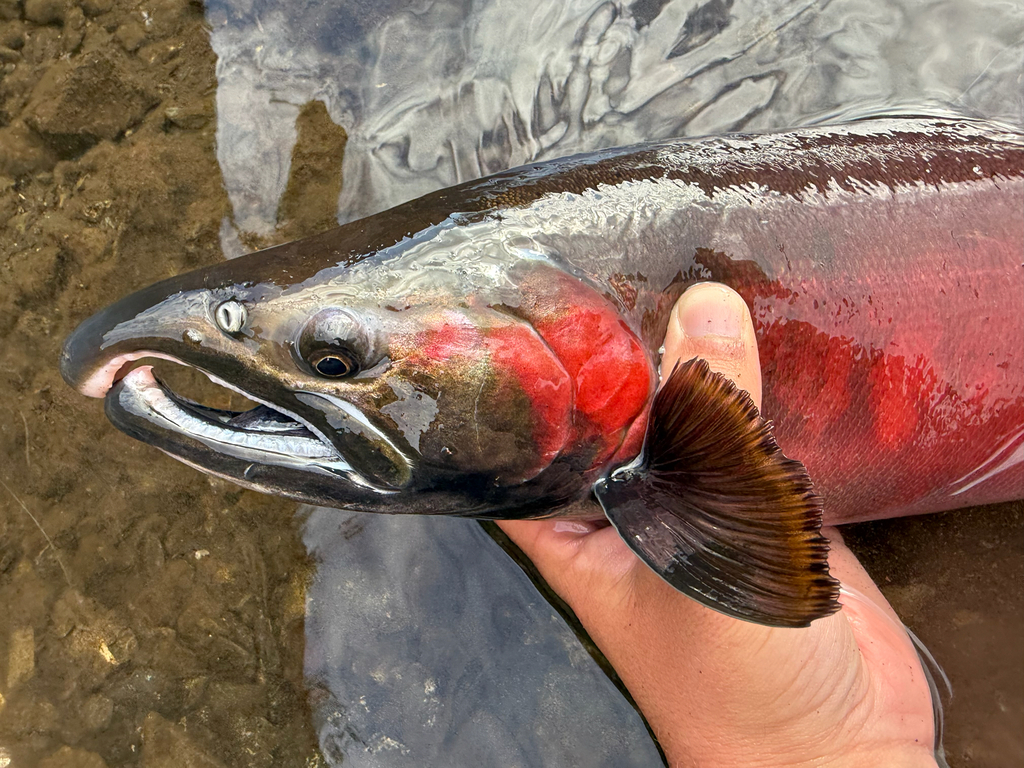
Coho Salmon
Oncorhynchus kisutch
The coho salmon (Oncorhynchus kisutch) is a species of anadromous fish in the salmon family and one of the six Pacific salmon species. Coho salmon are also known as silver salmon (or "silvers") and is often sold as medium red salmon. "Coho" was borrowed into English from the word k̓ʷə́xʷəθ, the species' name in the downriver dialect of the Halkomelem language spoken in Vancouver. The scientific species name is based on the Russian common name kizhuch (кижуч).
From the article Coho salmon on Wikipedia (CC BY-SA), quoted section by section
Description
During their ocean phase, coho salmon have silver sides and dark-blue backs with spots on their back and upper tail lobe. During their spawning phase, their jaws and teeth become hooked. After entering fresh water, they develop bright-red sides, bluish-green heads and backs, dark bellies and dark spots on their backs. Sexually maturing fish develop a light-pink or rose shading along the belly, and the males may show a slight arching of the back. Mature adults have a pronounced red skin color with darker backs and spots, with females having darker shades than males. Coho salmon average 20 to 28 inches (50.8 to 71 cm) and 7 to 11 pounds (3.2 to 5.0 kg), occasionally reaching up to 36 pounds (16 kg). Size can vary depending on age and geographic location. Males tend to be slightly larger than females. Mature adults also develop a large kype (hooked beak) which is used to attract a mate during spawning, with males having a more pronounced kype than females. The coho salmon's lower jaw can be distinguished by a light shade at its superior edge.
Range & habitat
The traditional range of the coho salmon runs along both sides of the North Pacific Ocean, from Hokkaidō, Japan and eastern Russia, around the Bering Sea to mainland Alaska, and south to Monterey Bay, California. Coho salmon have also been introduced in all the Great Lakes, as well as many landlocked reservoirs throughout the United States. Coho salmon were first introduced in Lake Erie in the 1920s to control the lake's alewife population. Large-scale stocking began in 1966, when 660,000 fingerlings were introduced in Lake Michigan. Wisconsin began a program of introduction of 500,000 fry a year, mainly on the coastline of Lake Michigan. By 1970, the species was present in all of the Great Lakes. Ontario and Minnesota adopted stocking programs in 1969, but later abandoned them. Colorado began stocking coho salmons in the early 1900s, although only limited reproduction is recorded in the Colorado River. Another stocking was done in New Hampshire in the late 1960s, which dispersed to Maine and Massachusetts and were recorded to engage in sporadic reproduction. Natural reproduction in introduced areas is generally low. Limited self-sustaining populations are recorded in Lake Superior and Michigan, but the salmon does not reproduce naturally in the Wisconsin tributaries of Lake Michigan and relies on stocking to maintain a large population. …
Wikipedia: “Range”
What it does
Once the mature coho has reached three or four years old, it swims up freshwater rivers and streams to spawn. Coho will swim up streams as far as they are physically able, usually reaching areas of water as little as 5 centimetres (2.0 in) deep. Females seek out beds of gravel at the head of a riffle, where they turn on their sides to dig a nest with movements of their tail, creating round or oval depressions roughly the same lengths and width as the fish. This process is repeated for up to seven nests, each called a redd. Females become extremely aggressive with each other over nesting sites, and with males until these are dug. Males then fight for the right to mate. Once a female has chosen a mate, usually the largest male, she lays her eggs onto the redd, while he simultaneously releases milt (sperm) onto the eggs. Unchosen males also sneak in to release milt at this time. Once all eggs are laid, she covers them with rocks and pebbles using her tail. The adults then begin semelparity, whereby they stop eating and deteriorate to death.
Wikipedia: “Reproduction”
At the table
Ocean-caught coho is regarded as excellent table fare. It has a moderate to high amount of fat, which is considered to be essential when judging taste. Only spring chinook and sockeye salmon have higher levels of fat in their meat. When smoking coho it is best to use a cold-smoking rather than hot-smoking process, due to their lower fat content compared to sockeye and chinook.
Wikipedia: “Nutritional value”
In human culture
Historically coho, along with other species, has been a staple in the diet of several indigenous peoples, who would also use it to trade with other tribes farther inland. The coho salmon is also a symbol of several tribes, representing life and sustenance.
Wikipedia: “Cultural tradition”
Where it lives
Recorded sightings
—
geo-referenced records in GBIF, from museums, herbaria and field observers.
Drag the globe to turn it. Dots are where records exist, not a range map; darker means more records.
In the stacks
Searching the stacks…
Every page naming Oncorhynchus kisutch in the Biodiversity Heritage Library →
This page is assembled live from iNaturalist, GBIF, Wikipedia, the Source Library and the Internet Archive. It is not yet part of the hand-edited codex. iNaturalist taxon 53692.