- Animals
- ›Molluscs
- ›Bivalves
- ›Autobranchia
- ›Pteriomorphia
- ›Oysters and Allies
- ›Ostreoidea
- ›True Oysters
- ›Ostreinae
- ›Ostrea
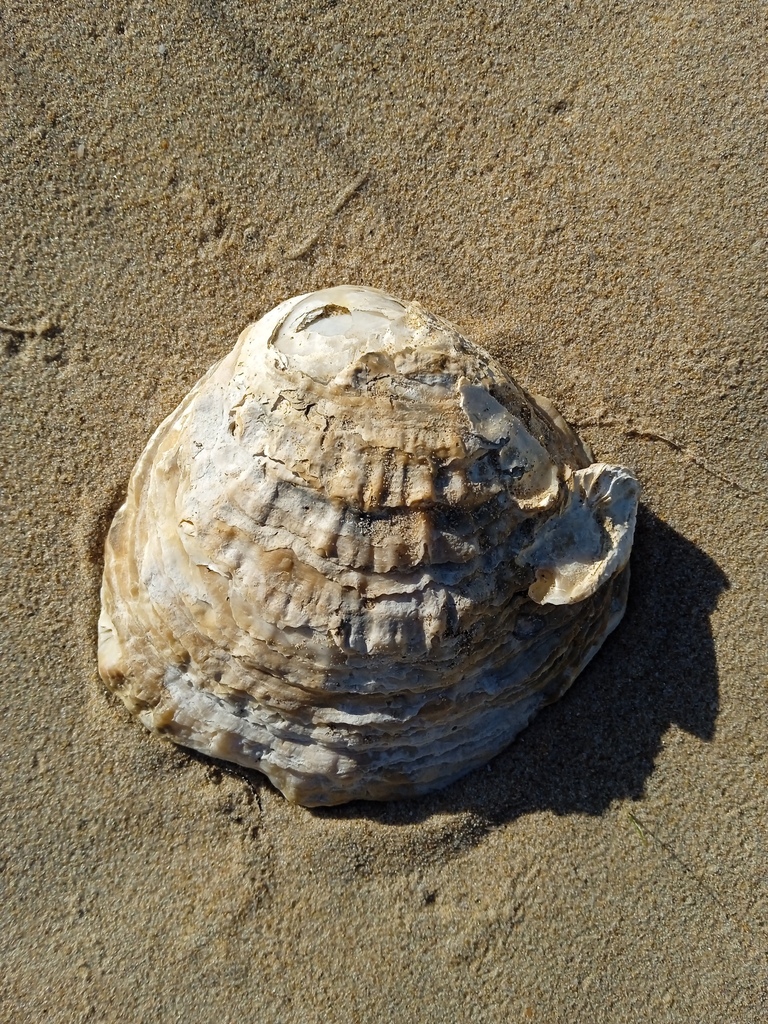
European Flat Oyster
Ostrea edulis
Ostrea edulis, commonly known as the European flat oyster, is a species of oyster native to Europe. In Great Britain and Ireland, localized names include Colchester native oyster, mud oyster, or edible oyster. In France, Ostrea edulis are known as huîtres plates (flat oysters) except for those that come from the Belon River estuary in Brittany, France, which are known as Belons.
The fossil record of this species dates back to the Miocene (age range: 15.97 million years ago to present day). Fossils have been found in Belgium, Italy, the Netherlands, Egypt, Greece, Spain, the United Kingdom, Austria, France and Germany.
From the article Ostrea edulis on Wikipedia (CC BY-SA), quoted section by section
Description
When mature, O. edulis adults range from 3.8 to 11 centimetres (1.5 to 4.3 in) across. Shells are oval or pear shaped, white, yellowish or cream in colour, with a rough outer surface showing pale brown or bluish concentric bands on the right valve. The two valves are quite different in shape and size, as the left one is concave and fixed to the substratum, while the right one is almost flat and fits inside the left. The inner surface is smooth, whitish or bluish-grey.
Range & habitat
The species naturally ranges along the western and southern coasts of Europe from Norway to Morocco and including most of the British Isles and the Mediterranean coast. Naturally viable populations have appeared in eastern North America from Maine to Rhode Island subsequent to artificial introduction in the 1940s and 1950s.
Wikipedia: “Distribution”
Where it lives
Recorded sightings
—
geo-referenced records in GBIF, from museums, herbaria and field observers.
Drag the globe to turn it. Dots are where records exist, not a range map; darker means more records.
In the stacks
Searching the stacks…
Every page naming Ostrea edulis in the Biodiversity Heritage Library →
This page is assembled live from iNaturalist, GBIF, Wikipedia, the Source Library and the Internet Archive. It is not yet part of the hand-edited codex. iNaturalist taxon 53462.