- Plants
- ›Vascular Plants
- ›conifers
- ›conifers
- ›pine family
- ›pines, spruces, larches, and allies
- ›Pinus
- ›Pinus
- ›Trifoliae
- ›Attenuatae
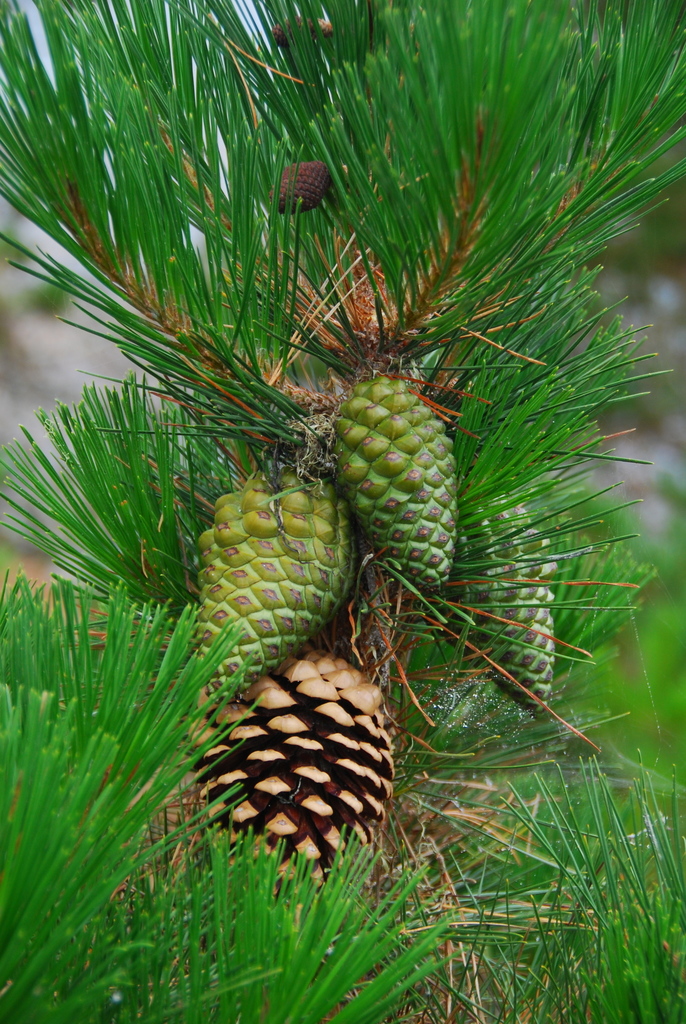
Monterey pine
Pinus radiata
Pinus radiata (syn. Pinus insignis), the Monterey pine, insignis pine or radiata pine, is a species of conifer in the family Pinaceae, a pine native to the Central Coast of California, and the Guadalupe and Cedros islands of Mexico.
Pinus radiata is a versatile, fast-growing, medium-density softwood, suitable for a wide range of uses and valued for rapid growth (up to two meters (6.5 feet) in one year), as well as desirable lumber and pulp qualities. Its silviculture reflects a century of research, observation and practice. It is often considered a model for growers of other plantation species.
From the article Pinus radiata on Wikipedia (CC BY-SA), quoted section by section
Description
Pinus radiata is a coniferous tree growing to 15–30 m (50–100 ft) tall in the wild, but up to 60 m (200 ft) in cultivation in optimum conditions, with upward pointing branches and a rounded top. The leaves ("needles") are bright green, in clusters of three (two in var. binata), slender, 8–15 cm (3–6 in) long and with a blunt tip. The ovulate cones are 7–17 cm (3–6+1⁄2 in) long, brown, ovoid (egg-shaped), and usually set asymmetrically on a branch, attached at an oblique angle. The bark is fissured and dark gray to brown. When not cut short by disease or harvesting, it has a lifespan of 80 to 90 years. The specific epithet radiata refers to the cracks which radiate from the umbo of the cone scales. It is closely related to bishop pine and knobcone pine, hybridizing readily with both species; it is distinguished from the former by needles in threes (not pairs), and from both by the cones not having a sharp spine on the scales. The modern plantation tree is vastly different from the native tree of Monterey. In plantations the tree is commonly planted at 4 square meter spacing on a wide variety of landscapes from flat to moderately steep hills. Because of selective breeding and more recently the extensive use of growth factor seedlings, forests planted since the 1990s have very straight tall trunks without the problem of twin leaders. …
Range & habitat
In the United States, it is native to three very limited areas located in Santa Cruz, Monterey, and San Luis Obispo Counties of California. In Mexico, it is found on two islands in the Pacific Ocean, Guadalupe Island and Cedros Island. On Guadalupe Island, located 280 km (150 nmi) off the mainland coast, the pines are found on the steep northern end of the island, at elevations of around 500 to 1,200 m (1,600 to 3,900 ft), where they follow the ridgetops and steep slopes. Edward Palmer and Francescho Franceschi were the first to discover the pines on Guadalupe Island. When Franceschi visited in 1892, he noted that they extended all over the northern and northwestern part of the island, comprising a very thick forest, with some of the finest trees growing with the Guadalupe palm. On Cedros Island, the pines are more abundant, being found in far greater numbers partly due to the lack of feral goats. (Goats were exterminated on Guadalupe island by 2007.) They are found at lower elevations than on Guadalupe, at around 285 to 690 m (935 to 2,264 ft), on the windward ridges and canyons of the north and central parts of the island. …
Wikipedia: “Distribution and habitat”
What it does
Pinus radiata is adapted to cope with stand-killing fire disturbance. Its cones are serotinous, i.e. they remain closed until opened by the heat of a forest fire; the abundant seeds are then discharged to regenerate on the burned forest floor. The cones may also burst open in hot weather. In its native range, P. radiata is associated with characteristic flora and fauna. It is the co-dominant canopy tree, together with Cupressus macrocarpa, which also naturally occurs only in coastal Monterey County. Furthermore, one of the pine forests in Monterey, California, was the discovery site for Hickman's potentilla, an endangered species. Piperia yadonii, a rare species of orchid, is endemic to the same pine forest adjacent to Pebble Beach. In its native range, P. radiata is a principal host for the dwarf mistletoe Arceuthobium littorum. The habitat of the pines on Cedros Island contrasts greatly with the desert scrub on other parts of the island, forming zones of abrupt transition. The numerous groves form a mostly-monotypic forest of the species, with very few other plants besides seedlings emerging in the understory. In some areas, the edges of the forest form a zone that supports chaparral species, including Malosma laurina, Diplacus stellatus, and the endemic Eriogonum molle. With their large surfaces to condense fog, the pines create irrigation for themselves and their associates. …
Wikipedia: “Ecology”
At the table
As timber P. radiata is suitable for a wide variety of uses, and has a resinous fragrance while being worked. It holds screws and nails well and takes paint and stain without difficulty, and modern kiln dried timber is very easy to work. It is about 1/3 heavier than dried western red cedar. It is brittle when bent, so does not have the same load-bearing features as Oregon pine (Douglas fir, Pseudotsuga). Pinus radiata is used in house construction as weatherboards, posts, beams or plywood, in fencing, retaining walls, for concrete formers. It is also used to a limited extent in boat building where untreated ply is sometimes used, but must be encased in epoxy resin to exclude moisture. The wood is normally kiln dried to 12% moisture in 6 m (19 ft 8 in) long, clear lengths. It is available treated with a range of chemical salts, or untreated. Chemical salt treatment is well proven and such timber is frequently used in the ground as posts and poles as part of structures such as retaining walls and pole houses. The name applied to this treatment is tanalized wood. H1 and H2 treatment is suited to indoor use. H3 is the standard house timber and this grade is used for fence palings. H4 and H5 are the standard for inground use. …
Wikipedia: “Uses”
Where it lives
Recorded sightings
—
geo-referenced records in GBIF, from museums, herbaria and field observers.
Drag the globe to turn it. Dots are where records exist, not a range map; darker means more records.
In the stacks
Searching the stacks…
Every page naming Pinus radiata in the Biodiversity Heritage Library →
This page is assembled live from iNaturalist, GBIF, Wikipedia, the Source Library and the Internet Archive. It is not yet part of the hand-edited codex. iNaturalist taxon 53421.