- Animals
- ›Arthropods
- ›Chelicerates
- ›Arachnids
- ›Spiders
- ›Typical Spiders
- ›Entelegyne Spiders
- ›RTA Clade Spiders
- ›Oval calamistrum clade spiders
- ›Wolf Spiders and Allies
- ›Wandering Spiders
- ›Phoneutria
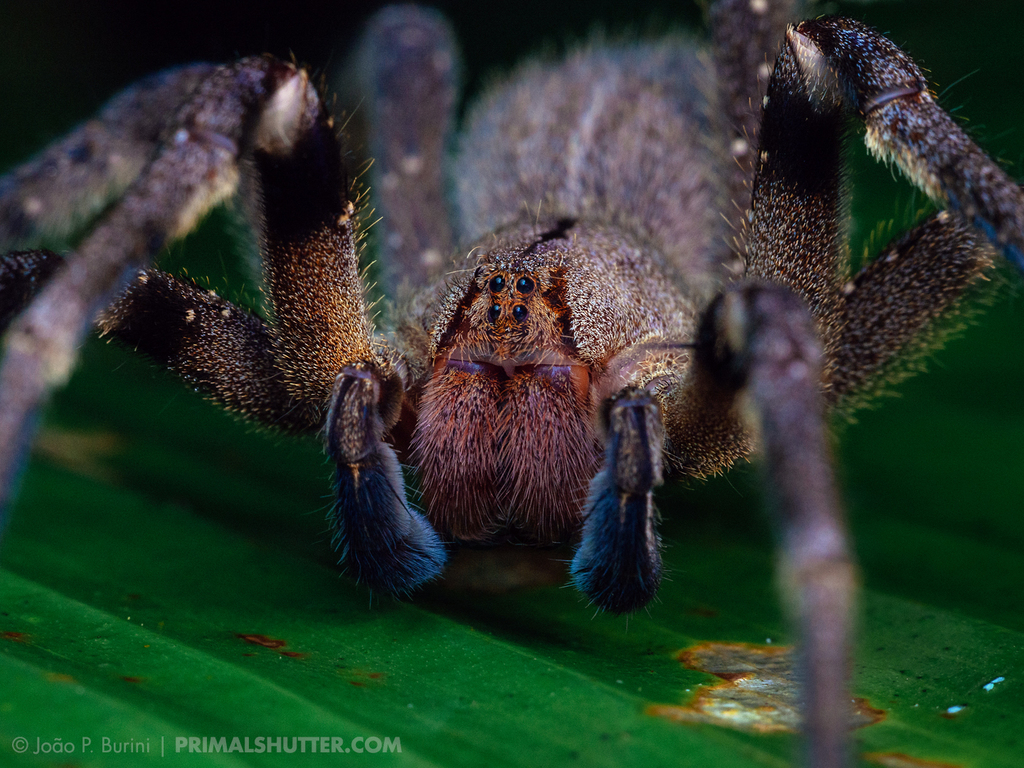
Brazilian Wandering Spider
Phoneutria nigriventer
Phoneutria nigriventer is a species of medically significant spider in the family Ctenidae, found in the Southern Cone of South America (Brazil, Uruguay, Paraguay, and Argentina). Along with other members of the genus, they are often referred to as Brazilian wandering spiders.
Its bite can cause severe symptoms, including increased pulse, blood pressure, and respiratory rate, very severe pain, priapism, and in several documented cases, death.
From the article Phoneutria nigriventer on Wikipedia (CC BY-SA), quoted section by section
Description
Phoneutria nigriventer is a large spider. Its maximum body length is around 5 cm and its legs can span 15 cm in larger individuals. Its body is covered in thick brown hair. They are nocturnal, and hunt at night, killing by ambush rather than using a web; during the day, they are found hidden under logs or crevices. When threatened, it raises its first two pairs of legs as a warning. It also occurs in banana trees, foliage, and urban regions, mainly inside residences.
Wikipedia: “Description and behavior”
What it does
As with most spider species, the female is larger than the male. The mating ritual takes place with the male dancing to get the female's attention, with the males even fighting each other. After mating, females may attack males. The female can store the sperm in a chamber separate from the eggs, until she is ready for fertilization. They may lay about 1,000 eggs, which are stored in a silk sac. One study claims that females with egg sacs are slightly more toxic than females without egg sacs.
Wikipedia: “Reproduction”
Toxicity
The bite of P. nigriventer in humans can cause several symptoms such as priapism, tachycardia, arrhythmias, cardiogenic shock, acute pulmonary edema and convulsions. P. nigriventer can choose to deliver a dry bite (without injecting venom) or a minimal dose. The venom of P. nigriventer has been reported to contain at least six neurotoxic peptides globally known as PhTx3 and individually identified as Tx3-1 to Tx3-6. Tx3-3 has also been named ω-Phoneutria nigriventer toxin ω-PnTx3-3 and Tx3-4, phonetoxin IIA or ω-Ptx-IIA. These toxins act as broad-spectrum calcium channel blockers that inhibit glutamate release, calcium uptake and also glutamate uptake in neural synapses. At deadly concentrations, these neurotoxins cause loss of muscle control and breathing problems, resulting in paralysis and eventual asphyxiation. In addition, the venom causes intense pain and inflammation following a bite, due to an excitatory effect the venom has on the serotonin 5-HT4 receptor of sensory nerves. This sensory nerve stimulation causes a cascading release of neuropeptides such as substance P, which triggers inflammation and pain. Studies on the effects of the venom in dogs have shown low lethal doses to be around 0.2 mg/kg (SC). The median lethal dose for females is 0.63 mg / kg (95% confidence interval [0.54-0.71], for females with egg sacs the LD50 is 0.61 mg / kg [0.56-0.73]. …
Wikipedia: “Toxicity and prey”
Where it lives
Recorded sightings
—
geo-referenced records in GBIF, from museums, herbaria and field observers.
Drag the globe to turn it. Dots are where records exist, not a range map; darker means more records.
In the stacks
Searching the stacks…
Every page naming Phoneutria nigriventer in the Biodiversity Heritage Library →
This page is assembled live from iNaturalist, GBIF, Wikipedia, the Source Library and the Internet Archive. It is not yet part of the hand-edited codex. iNaturalist taxon 53391.