- Animals
- ›Chordates
- ›Vertebrates
- ›Birds
- ›Hawks, Eagles, Kites, and Allies
- ›Hawks, Eagles, and Kites
- ›Typical Hawks and Harriers
- ›Melierax
On eBird ↗
Pale Chanting-Goshawk
Live sightings near you, the range map, bar charts of when it is seen, and Macaulay Library photos and recordings.
Pale Chanting-Goshawk
Melierax canorus
The (southern) pale chanting goshawk (Melierax canorus) is a bird of prey in the family Accipitridae. This hawk breeds in southern Africa. It is a resident species of dry, open semi-desert with 75 cm or less annual rainfall. It is commonly seen perched on roadside telephone poles.
From the article Pale chanting goshawk on Wikipedia (CC BY-SA), quoted section by section
Description
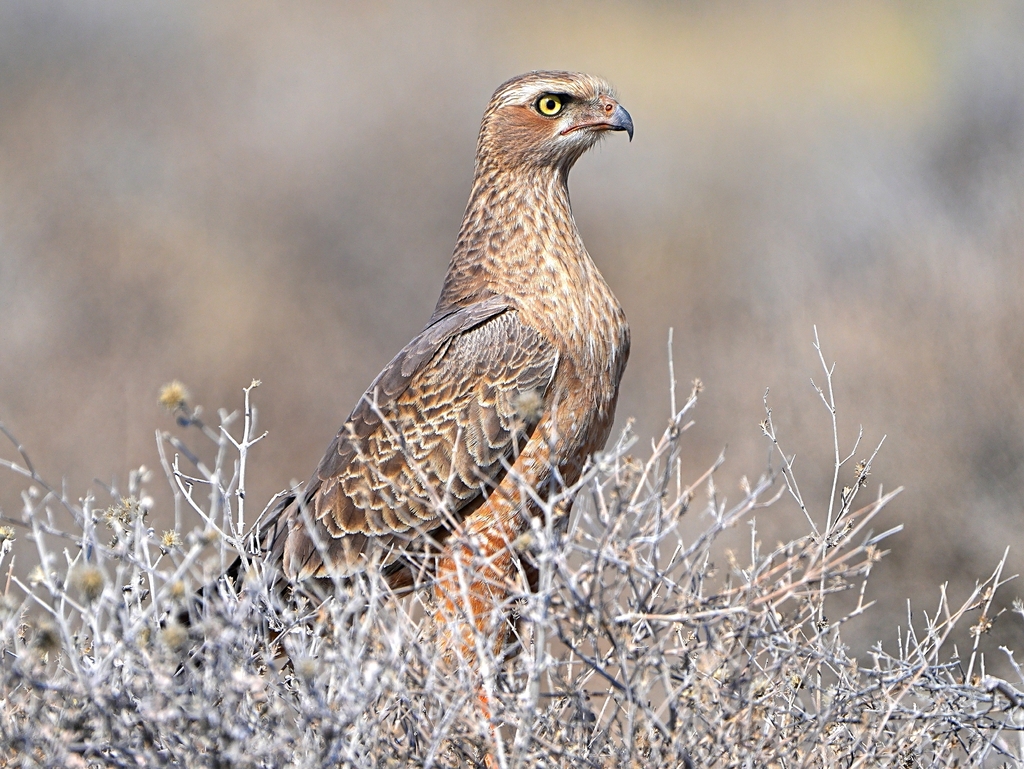
This species is approximately 55 cm in length with a wingspan of 110 cm. The adult has grey upperparts with a white rump. The central tail feathers are black tipped with white and the outer tail feathers are barred grey and white. The head and upper breast are pale grey while the rest of the underparts are finely barred in dark grey and white. The eyes are dark brown in the adult and pale yellow in the immature. The bill is red at the base and dark grey at the tip. The cere, facial skin and long legs are also red. In flight, the adult has black primary flight feathers, very pale grey (white from a distance) secondaries, and grey forewings. Immatures have brown upperparts, with a white rump and black bars on the tail. From below, the flight feathers and tail are white with black barring, the throat is dark-streaked white, and the rest of the underparts are rufous. It is larger and paler than the barred-rumped dark chanting goshawk, Melierax metabates. Both sexes are vocal during the breeding season. The call is a tuneful whistling kleeu-kleeu-kleeu-ku-ku-ku usually given from a tree-top perch.
Range & habitat
Pale chanting goshawks have a large range throughout most of the drier regions of Southern Africa. They inhabit dry semi-desert areas with open ground and appropriate perches from which to hunt. There is no evidence of migration though both short and long-distance movements are common. In the Karoo one pair or family group occupies between 4.4 and 8.6 km2 while around Windhoek one pair occupies between 5.4 and 6.7 km2.
Wikipedia: “Habitat and abundance”
At the table
The pale chanting goshawk hunts predominantly from elevated perches such as trees and telephone poles but also walks on the ground in pursuit of prey. It is an opportunistic raptor and eats a wide variety of prey including small mammals up to the size of Cape hares, lizards, birds, large insects and carrion. It has also been recorded predating upon tent tortoise and leopard tortoise hatchlings which are swallowed whole while the shell is still soft. There is some evidence of social hunting in breeding groups but solitary hunting is the norm. Pale chanting goshawks commonly associate with foraging honey badgers and feed on organisms that are flushed by the honey badger's feeding activity. This association increases the hunting opportunities and prey capture success of the pale chanting goshawk while the honey badger does not suffer any loss of foraging efficiency.
Wikipedia: “Food and foraging”
Listen
Looking for field recordings…
Where it lives
Recorded sightings
—
geo-referenced records in GBIF, from museums, herbaria and field observers.
Drag the globe to turn it. Dots are where records exist, not a range map; darker means more records.
In the stacks
Searching the stacks…
Every page naming Melierax canorus in the Biodiversity Heritage Library →
This page is assembled live from iNaturalist, GBIF, Wikipedia, the Source Library and the Internet Archive. It is not yet part of the hand-edited codex. iNaturalist taxon 5338.