- Fungi Including Lichens
- ›Ascomycete Fungi
- ›Sac Fungi and Lichens
- ›Common Lichens
- ›Shield Lichens, Sunburst Lichens, Rosette Lichens, and Allies
- ›Sunburst Lichens and Allies
- ›sunburst lichens, firedots, and allies
- ›Xanthorioideae
- ›Rusavskia
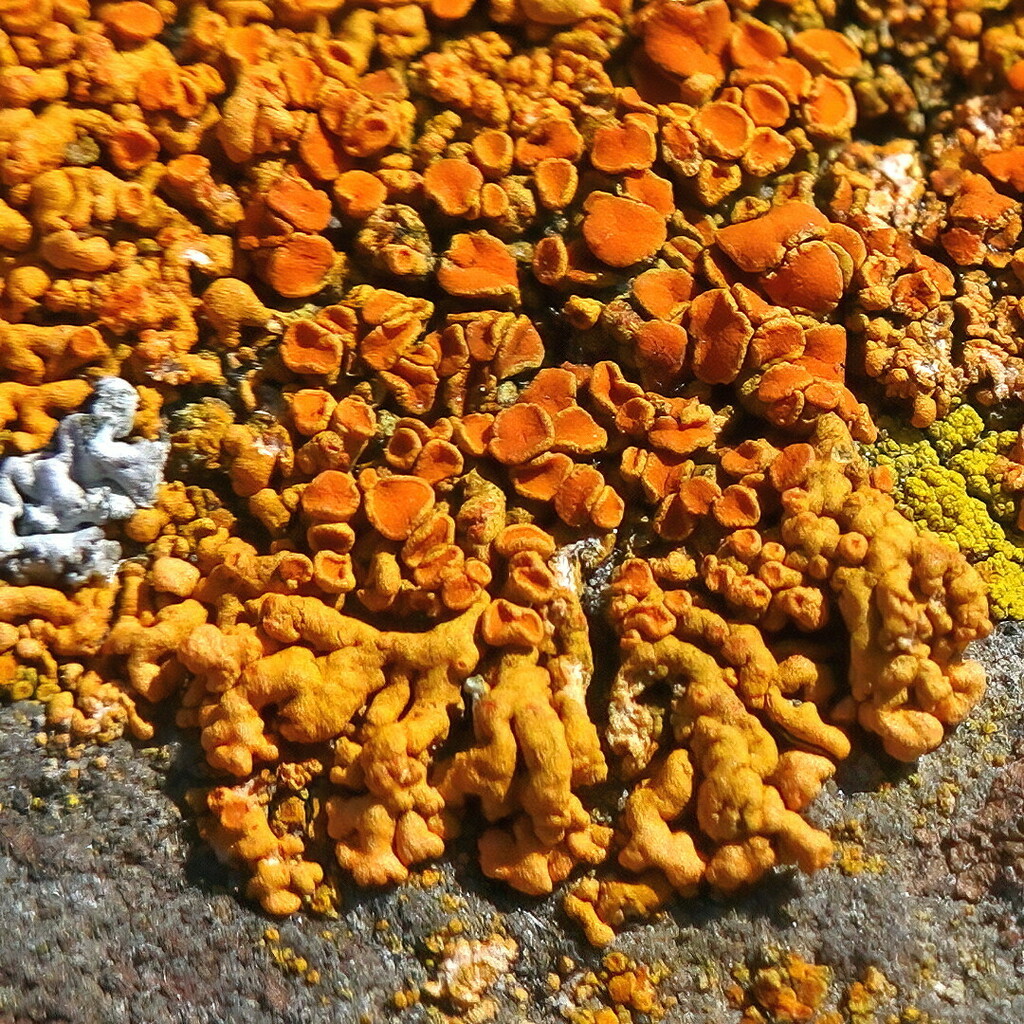
Elegant Sunburst Lichen
Rusavskia elegans
Rusavskia elegans (formerly Xanthoria elegans), commonly known as the elegant sunburst lichen, is a lichenized species of fungus in the genus Rusavskia, family Teloschistaceae. Recognized by its bright orange or red pigmentation, this species grows on rocks, often near bird or rodent perches. It has a circumpolar and alpine distribution. It was one of the first lichens to be used for the rock-face dating method known as lichenometry.
From the article Rusavskia elegans on Wikipedia (CC BY-SA), quoted section by section
Description
The thallus of this lichen is described as foliose, having the aspect of leaves, although the central portions of the thallus may appear nearly crustose. It is small, typically less than 5 cm (2 in) wide, with lobes less than 2 mm (0.08 in) broad, appressed to loosely appressed. The upper surface is some shade of orange while the lower surface is white, corticate, with short, sparse hapters (an attachment structure produced by some lichens). The vegetative propagules called soredia and isidia are absent, although apothecia are common. It has been described as possessing swollen, orange-yellow thalli (in streams), compact orange thalli (on boulders) or dark orange-red thalli on the driest rock faces. The variety R. elegans var. granulifera, characterized by having isidium-like vegetative propagules, has been reported from Greenland and Spitsbergen.
Range & habitat
This species grows on rock, both calcareous and siliceous, occasionally overgrowing moss or litter. It is often found on exposed to somewhat sheltered sites, often near bird or small-mammal droppings. It has also adapted successfully to growth on man-made and natural growing surfaces from the sea-water spray zone to the boreal forest and in the grasslands of the continental interior. It can thrive in areas having less than 6 centimetres (2.4 in) annual precipitation and can survive submerged in streams for much of the growing season. Rusavskia elegans has a broad circumpolar and alpine distribution, and is found on all continents except Australia. It is widespread in Antarctic regions. In Nepal, the lichen has been reported from 3,750 to 6,000 m elevation in a compilation of published records; this reported range extends above the tree line used in the study. The lichen is used as a model system to study the potential to resist extreme environments of outer space. Out of various lichens tested, it showed the ability to recover from space-simulating situations, including exposure to 16 hours of vacuum at 10−3 Pa and UV radiation at wavelengths less than 160 nm or greater than 400 nm. R. elegans has survived an 18-month exposure to solar UV radiation, cosmic rays, vacuum and varying temperatures in an experiment performed by the ESA outside of the ISS.
Wikipedia: “Habitat and distribution”
Where it lives
Recorded sightings
—
geo-referenced records in GBIF, from museums, herbaria and field observers.
Drag the globe to turn it. Dots are where records exist, not a range map; darker means more records.
In the stacks
Searching the stacks…
Every page naming Rusavskia elegans in the Biodiversity Heritage Library →
This page is assembled live from iNaturalist, GBIF, Wikipedia, the Source Library and the Internet Archive. It is not yet part of the hand-edited codex. iNaturalist taxon 532267.