- Animals
- ›Chordates
- ›Vertebrates
- ›Birds
- ›Hawks, Eagles, Kites, and Allies
- ›Hawks, Eagles, and Kites
- ›Honey-buzzards, Pernine Kites, and Allies
- ›Elanoides
On eBird ↗
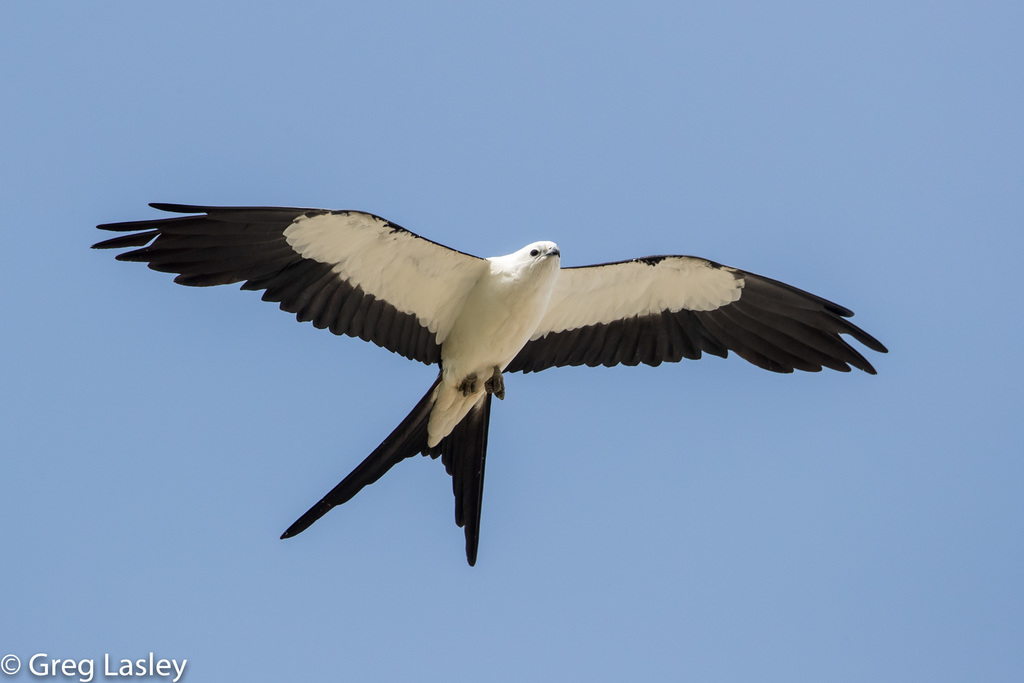
Swallow-tailed Kite
Live sightings near you, the range map, bar charts of when it is seen, and Macaulay Library photos and recordings.
Swallow-tailed Kite
Elanoides forficatus
The swallow-tailed kite (Elanoides forficatus) is a pernine raptor which breeds from the southeastern United States to eastern Peru and northern Argentina. It is the only species in the genus Elanoides. Most North and Central American breeders winter in South America where the species is resident year round. It was formerly named Falco forficatus.
From the article Swallow-tailed kite on Wikipedia (CC BY-SA), quoted section by section
Description
The species is 50 to 68 cm (20 to 27 in) in length, with a wingspan of approximately 1.12–1.36 m (3.7–4.5 ft). Male and female individuals appear similar. The body weight is 310–600 g (11–21 oz). The body is a contrasting deep black and white. The flight feathers, tail, feet, bill are all black. Another characteristic is the elongated, forked tail at 27.5–37 cm (10.8–14.6 in) long, hence the name swallow-tailed. The wings are also relatively elongated, as the wing chord measures 39–45 cm (15–18 in). The tarsus is fairly short for the size of the bird at 3.3 cm (1.3 in). The body is a contrasting deep black and white. The upper side of the wings is black along with the tail, feet, and bill. The underside of the wings is partly black and partly white. Young swallow-tailed kites are duller in color than the adults, and the tail is not as deeply forked. Sometimes a high-pitched chirp is emitted, though the birds mostly remain silent.
Range & habitat
The swallow-tailed kite is largely associated with large tracts of wetland forests which accommodates the bird's nesting habits. Loblolly pines (Pinus taeda) are the most prevalent choice for building nests but bald cypress (Taxodium distichum) are also used when the pines are unavailable. The major requirement of these nesting sites are food availability and tree height. Nesting locations are often found in trees as high as 100 ft (30 m). Historic ranges in the United States covered the majority of the Southern states and much of the Midwest (in Kentucky, Indiana, Ohio, Illinois, Missouri, Iowa, Kansas, Nebraska, and as far north as Wisconsin and Minnesota). Aside from the US, it resides in many areas throughout Central and South America. Habitat degradation and changes in wetland hydrology have caused the range to shrink in the US to just coastal regions of the southeastern and southwestern US, roughly an 80% decline in population. Swallow-tailed kites are considered migratory raptors and during the spring months often move from areas in Central and South America to breed. Roughly 3% of the world's population breed in the United States. Traveling thousands of miles these birds move towards the most suitable nesting habitat found within coastal wetlands between the Americas. …
Wikipedia: “Habitat and distribution”
Listen
Looking for field recordings…
Where it lives
Recorded sightings
—
geo-referenced records in GBIF, from museums, herbaria and field observers.
Drag the globe to turn it. Dots are where records exist, not a range map; darker means more records.
In the old herbals & bestiaries

In the stacks
Searching the stacks…
Every page naming Elanoides forficatus in the Biodiversity Heritage Library →
This page is assembled live from iNaturalist, GBIF, Wikipedia, the Source Library and the Internet Archive. It is not yet part of the hand-edited codex. iNaturalist taxon 5301.