- Animals
- ›Arthropods
- ›Chelicerates
- ›Arachnids
- ›Spiders
- ›Typical Spiders
- ›Entelegyne Spiders
- ›RTA Clade Spiders
- ›Dionycha clade spiders
- ›Ant-mimic Sac Spiders and Allies
- ›Long-legged Sac Spiders
- ›Cheiracanthium
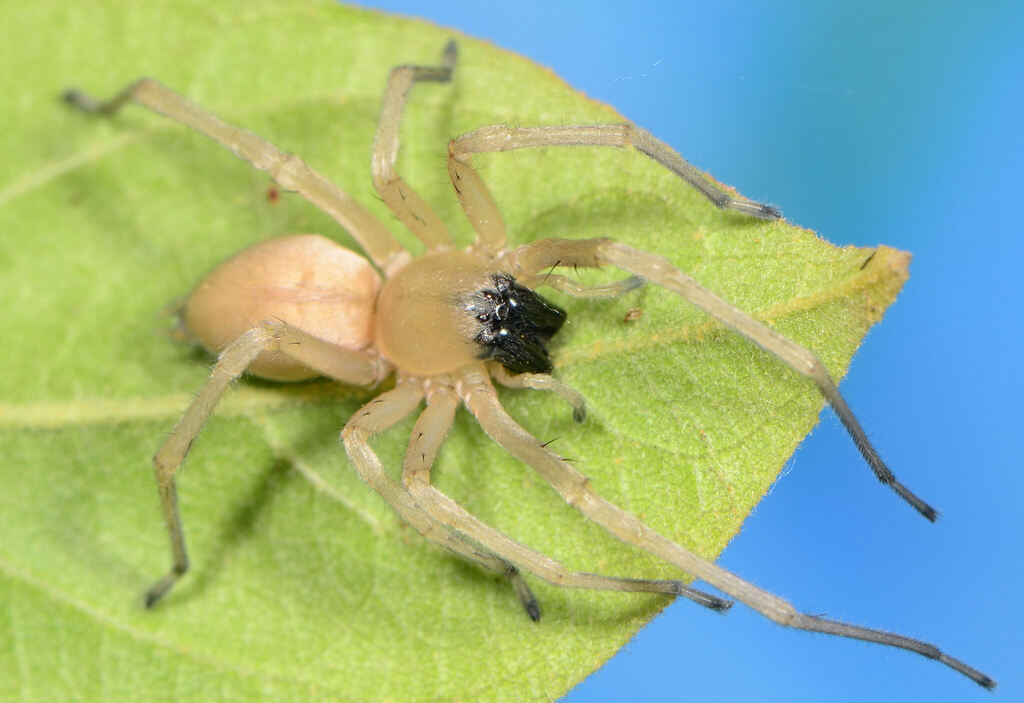
Common House Sac Spider
Cheiracanthium furculatum
Cheiracanthium furculatum is a species of spider in the family Cheiracanthiidae, commonly known as the Common House Sac Spider. It is an African endemic that has been introduced to Belgium.
From the article Cheiracanthium furculatum on Wikipedia (CC BY-SA), quoted section by section
Description
The species displays characteristic cream-yellow body coloration with blackish-brown chelicerae and eye region typical of Cheiracanthium. It constructs sac-like retreats in vegetation, particularly in rolled-up leaves.
Range & habitat
C. furculatum is widely found throughout Africa, Madagascar and Comoro Islands. In South Africa, it occurs in all nine provinces in more than 10 protected areas, at elevations from 3-1752 m above sea level.
Wikipedia: “Distribution”
What it does
C. furculatum is an aggressive predator that kills prey it encounters, though it may not always feed on them. Four types of retreats are constructed: resting, mating, breeding, and hibernating.
Agricultural importance. This species is highly significant in South African agriculture, recorded from avocado, citrus, cotton, lucerne, macadamia, maize, mango, pecans, pistachio, potatoes, strawberries, tomatoes, and vineyards. In citrus orchards, individuals can kill up to 29.3 citrus mites per spider per day.
Economic impact. While beneficial in vineyards, these spiders can become trapped in table grape containers during export. They can survive long periods at low temperatures and may escape when containers are opened in recipient countries.
Wikipedia: “Ecology and behavior”
In medicine
C. furculatum is frequently found in houses and can bite when threatened. It produces cytotoxic venom affecting tissue around bite sites, potentially causing lesions up to 10 cm in diameter. It is the most abundant spider species found in houses in Gauteng and Free State provinces.
Wikipedia: “Medical significance”
Where it lives
Recorded sightings
—
geo-referenced records in GBIF, from museums, herbaria and field observers.
Drag the globe to turn it. Dots are where records exist, not a range map; darker means more records.
In the stacks
Searching the stacks…
Every page naming Cheiracanthium furculatum in the Biodiversity Heritage Library →
This page is assembled live from iNaturalist, GBIF, Wikipedia, the Source Library and the Internet Archive. It is not yet part of the hand-edited codex. iNaturalist taxon 527754.