- Animals
- ›Chordates
- ›Vertebrates
- ›Birds
- ›Hawks, Eagles, Kites, and Allies
- ›Hawks, Eagles, and Kites
- ›Elanine Kites
- ›Elanus
On eBird ↗
White-tailed Kite
Live sightings near you, the range map, bar charts of when it is seen, and Macaulay Library photos and recordings.
White-tailed Kite
Elanus leucurus
The white-tailed kite (Elanus leucurus) is a small raptor found in South America and parts of western North America. It replaces the related Old World black-winged kite in its native range.
From the article White-tailed kite on Wikipedia (CC BY-SA), quoted section by section
Description
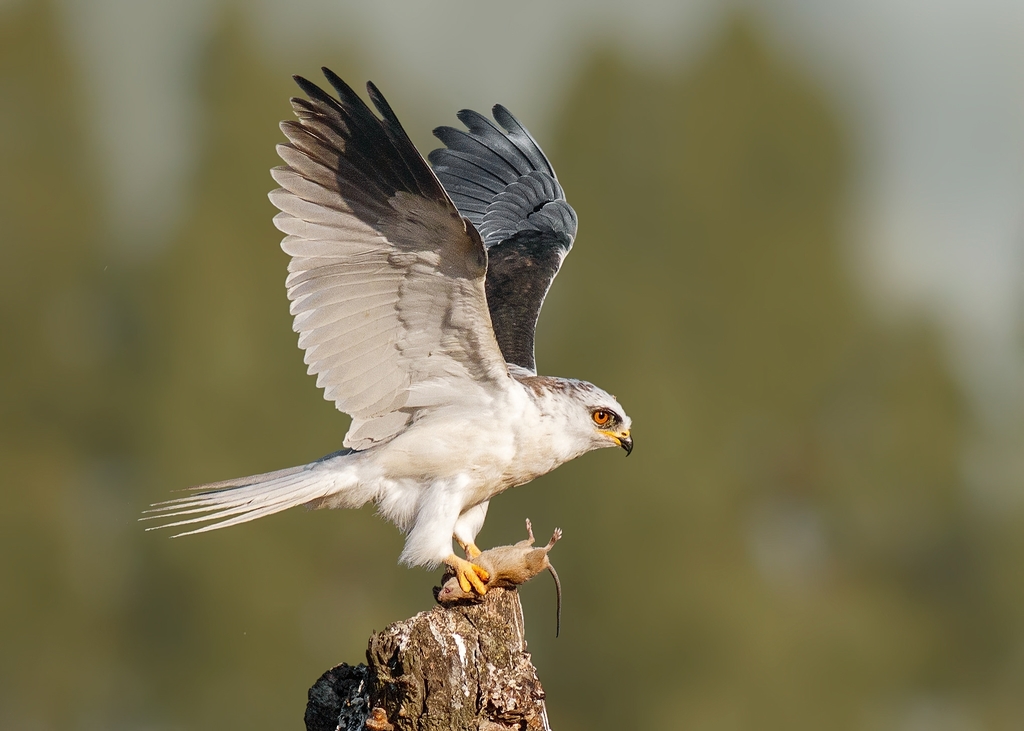
The coloration of the white-tailed kite is gull-like, but its shape and flight are falcon-like, with a rounded tail. While it has white faces and white underparts, it has black wingtips, beaks, and shoulders. Contrastingly, the white-tailed kite has deep red eyes that stand out at night. A mid-sized kite, it measures 35–43 cm (14–17 in) in length, spans 88–102 cm (35–40 in) across the wings, and weighs 250–380 g (8.8–13.4 oz). Both the wings and tail are relatively elongated, and the tarsi measure around 3.6 cm (1.4 in).
Range & habitat
The white-tailed kite was rendered almost extinct in California in the 1930s and 1940s due to shooting and egg-collecting, but they are now common again, but their distribution is patchy. They can be found in Central Valley and southern coastal areas, open land around Goleta including the Ellwood Mesa Open Space, marshes in Humboldt County, and also around the San Francisco Bay. Elsewhere in California, they are still rare or absent. Although they are not migratory birds, they are also found from southern Texas and eastern Mexico to the Baja California Peninsula and through Central and South America to central Argentina and Chile. Globally, they are not considered threatened species by the IUCN. On rare occasions, the bird can be found far outside its usual range. At different times, two had been sighted in New England as of 2010. White-tailed kites typically nest at the top of trees, usually around 20 to 50 feet above ground level. These nests can be in open-country trees growing in isolation or at the edge of or within a forest. Their nests are built from medium-sized sticks and twigs, grasses, weeds, hay, and moss and are measured about 21 inches across with a cup that is around 7 in across and 4 in deep.
Wikipedia: “Distribution and habitat”
What it does
The white-tailed kite is famously known for "kiting", hovering in a position by facing into the wind and fluttering its wings. Although it may seem like irrelevant behavior at first, it does serve a purpose for hunting. While hovering around 80 feet in the air, it tips its head down to look for small mammals moving in the grass below. When prey is spotted, it dives down, quickly grabs the animal with its talons, and flies back up to eat. White-tailed kites feed principally on rodents, small opossums, shrews, reptiles, amphibians, and large insects, and they are readily seen patrolling or hovering over lowland scrub or grassland. They rarely if ever eat other birds, and even in open cerrado, mixed-species feeding flocks generally ignore them. Most of the hunted insects are consumed on the wing while flying; instead of returning to a perch to feed, these birds transfer the prey from their talons to their beaks while flying to eat. In the case of larger prey such as rodents and lizards, they fly to a perch to pluck and eat. Outside the breeding season during the winter, they roost, congregate or settle to rest at night, communally in groups of up to 100. …
Wikipedia: “Behaviour”
Listen
Looking for field recordings…
Where it lives
Recorded sightings
—
geo-referenced records in GBIF, from museums, herbaria and field observers.
Drag the globe to turn it. Dots are where records exist, not a range map; darker means more records.
In the stacks
Searching the stacks…
Every page naming Elanus leucurus in the Biodiversity Heritage Library →
This page is assembled live from iNaturalist, GBIF, Wikipedia, the Source Library and the Internet Archive. It is not yet part of the hand-edited codex. iNaturalist taxon 5277.