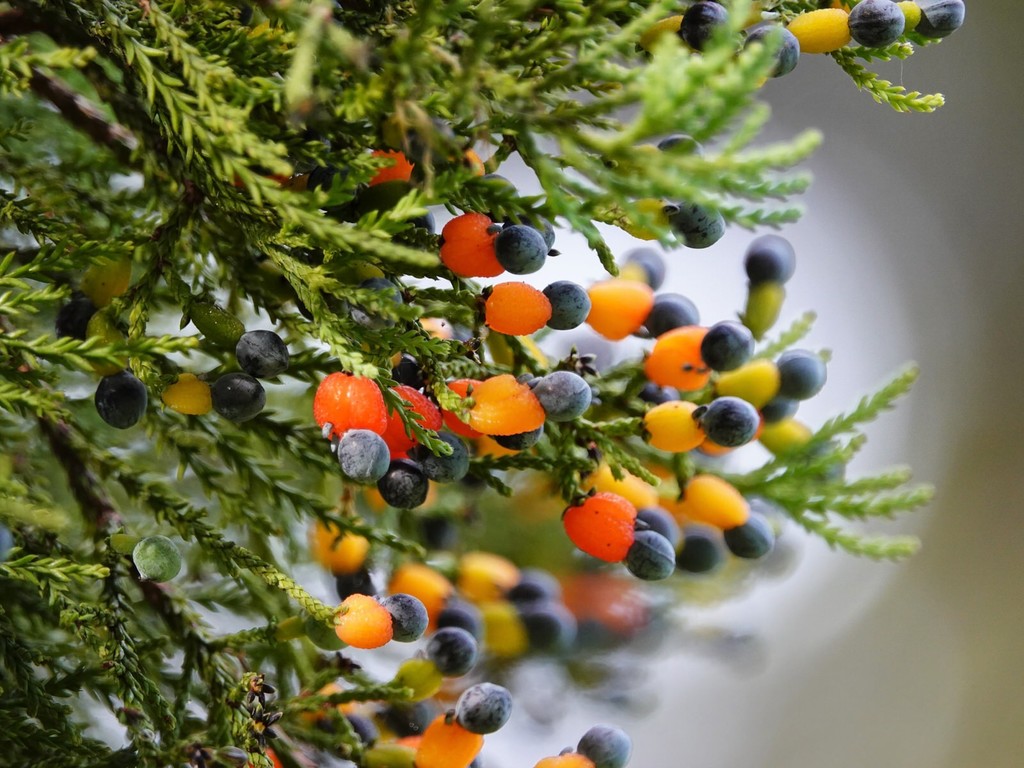
kahikatea
Dacrycarpus dacrydioides
Dacrycarpus dacrydioides, the kahikatea (from Māori) or white pine, is a coniferous tree in the family Podocarpaceae, endemic to New Zealand. It is New Zealand's tallest tree species, gaining heights of 60 metres (200 feet) over a life span of 600 years. It was first described botanically by the French botanist Achille Richard in 1832 as Podocarpus dacrydioides, and was given its current binomial name Dacrycarpus dacrydioides in 1969 by the American botanist David de Laubenfels. Analysis of DNA has confirmed its evolutionary relationship with other species in the genera Dacrycarpus and Dacrydium.
In Māori culture, it is an important source of timber for the building of waka and making of tools, of food in the form of its berries, and of dye. Its use for timber and its damp fertile habitat, ideal for dairy farming, have led to its decimation almost everywhere except South Westland.
From the article Dacrycarpus dacrydioides on Wikipedia (CC BY-SA), quoted section by section
Description
Kahikatea is a coniferous tree reaching a height of 50–65 m (164–213 ft), making it the tallest New Zealand tree, with a trunk 1–2 m (3.3–6.6 ft) through. It has a 600 year life span and gains maturity after between 250 and 450 years. Near the base of the tree, the roots are typically buttressed and grooved. Adult trees that grow in clusters develop interlocking root islands that may help prevent individual trees from falling during high winds. The wood itself is odourless and white. The majority of the trunk is branchless—in adults around three quarters—and has grey or dark grey coloured bark which falls off thickly in flakes. Young adults have no branches in a third to a half of the trunk and have a conic shape. In juveniles the leaves are 3–7 (reaching 4 mm (0.16 in) in young adults) by 0.5–1 mm (0.020–0.039 in) and a dark green to red colour that come to a marked point. They are narrow, arranged in almost opposite pairs spreading away from a wider base, and curved like a scythe. In adulthood the leaves change dramatically and are a brown-green colour and just 1–2 mm (0.039–0.079 in) long, waxy, and grow overlapping one another tightly.
As a conifer, kahikatea has no flowers and instead has cones. Male cones, which occur on different trees to female ones, are 1 cm (0.39 in) long and rectangular. …
Range & habitat
Kahikatea is endemic to the North, South, and Stewart Islands of New Zealand, and is the only member of the genus Dacrycarpus found in the country. It inhabits mostly lowland forests between 0–600 m (0–1,969 ft) above sea level, though may in rare cases reach montane areas. It used to dominate a swamp forest type that now exists almost only on the South Westland region of the South Island. Kahikatea prefers flooded or alluvial soils with low levels of drainage, which in Westland occur from post glaciation events.
Wikipedia: “Distribution and habitat”
What it does
Under optimal circumstances a mature kahikatea can produce 800 kilograms (1,800 lb) of fruit, equivalent to 4.5 million seeds, in a year. The fruit contains a special fleshy structure called a receptacle which helps attract birds such as the kererū, tūī, and bellbird, who then eat the fruit and disperse the seed elsewhere. One 2008 study in the New Zealand Journal of Ecology found a mean retention time of kahikatea seeds in kererū of 44.5 minutes. It was suggested in a 1989 study that the high water content of the receptacle may also help protect the seeds, which are vulnerable to drying out, from dry conditions. It may also serve as a storage vessel for water. The bluish seeds have very strong UV reflectance, which is visible to some species of birds. Kahikatea can support a vast number of non-parasitic plants that live in its branches, called epiphytes. One 2002 study identified between 90 and 100 species occurring on one mature tree. This included 49 vascular plants and over 50 non-vascular plants, which the authors identified as comparable to the number found on a Prumnopitys exigua in Bolivian cloud forest. Intraspecific competition between kahikatea trees was found in a 1999 study to be an important factor in their survival and overall success, affecting both the rates of growth and of mortality. …
Wikipedia: “Ecology”
At the table
After visiting the Waihou River area in November 1769, Captain James Cook was impressed by the trees, believing that these would be a good source for masts and timber for ships. This led to an early shipbuilding industry in the late 18th and early 19th centuries, where European vessels would visit the Waihou River area to trade for kahikatea timber, despite the timber being easily water logged and not suitable for this purpose. By the 1820s, kauri spurs had begun to be used instead. During the 19th century, kahikatea wood, due to being soft and odourless, was made into pulp, barrels and boxes, notably butter boxes for butter being exported to the United Kingdom, and occasionally to create furniture.
Wikipedia: “Early European uses”
In human culture
The genus name Dacrycarpus derives from Greek, and means tear shaped fruit, and the specific epithet dacrydioides is after its similarity to species in the genus Dacrydium. Common names include kahikatea, from the Māori language, and white pine. Other Māori names recorded by 19th century ethnographers include: katea, kaikatea, koroī, kōaka, kahika, and the name kāī (for the young tree). The Māori name kahikatea means "white kahika", with kahika being descended from the Proto-Oceanic word *Kapika, primarily used in other Polynesian languages to describe Syzygium malaccense, or the malay apple. The name white pine was coined by James Cook.
Wikipedia: “Etymology”
Where it lives
Recorded sightings
—
geo-referenced records in GBIF, from museums, herbaria and field observers.
Drag the globe to turn it. Dots are where records exist, not a range map; darker means more records.
In the stacks
Searching the stacks…
Every page naming Dacrycarpus dacrydioides in the Biodiversity Heritage Library →
This page is assembled live from iNaturalist, GBIF, Wikipedia, the Source Library and the Internet Archive. It is not yet part of the hand-edited codex. iNaturalist taxon 52390.