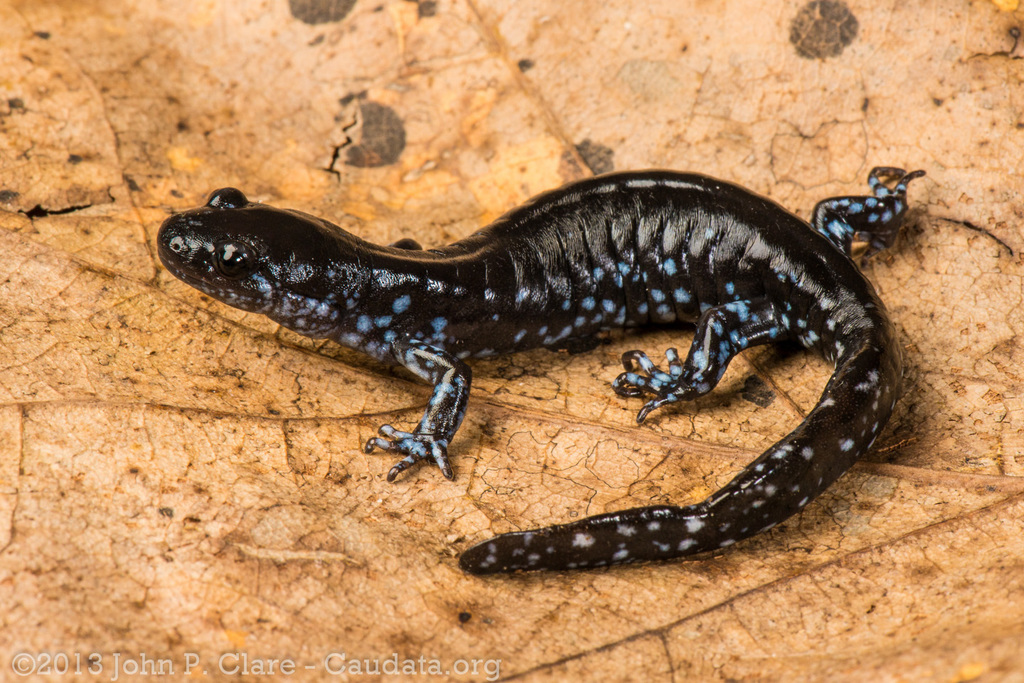
Blue-spotted Salamander
Ambystoma laterale
The blue-spotted salamander (Ambystoma laterale) is a mole salamander native to the Great Lakes states and northeastern United States, and parts of Ontario and Quebec in Canada. Their range is known to extend to James Bay to the north, and southeastern Manitoba to the west. Blue-spotted salamanders include unisexual lineages that can reproduce without fertilization (gynogenesis).
From the article Blue-spotted salamander on Wikipedia (CC BY-SA), quoted section by section
Description
Blue-spotted salamanders are between 10 and 14 cm (3.9 and 5.5 in) in length, of which the tail comprises 40%. Generally, males are slightly smaller than their female counterparts. Their skin is bluish-black, with characteristic blue and white flecks on its back, and bluish-white spots on the sides of its body and tail. They have elongated bodies. The vent is typically black, which contrasts with the paler belly. Larvae that have transformed may have yellow splotches; these turn blue once the individual becomes terrestrial. Occasionally, a melanistic individual may be found in the wild. They have long toes: four on the front feet and five on the hind feet. Typically, specimens will have 12–14 costal grooves. Males tend to be smaller than females, though they have longer, flattened tails. Blue-spotted salamanders are nocturnal, staying underground during the day and coming out at night to find food.
Range & habitat
Blue-spotted salamanders can be found in the northeastern parts of North America. New England in the United States has large populations of many types of salamanders, including Ambystoma laterale. Blue-spotted salamanders can be found as far west as the Great Lakes in Michigan and up into the eastern provinces of Canada.
Wikipedia: “Geographic range”
What it does
Blue-spotted salamanders mate through the depositing and collecting of a spermatophore. A spermatophore is a packet of sperm that is deposited by the male. Reproduction is initiated by the male by taking hold of the female and rubbing her head with his chin. The female's eggs can be fertilized by the sperm in the spermatophore, but she must be in close proximity to the spermatophore. The male will try to position her so she is close enough that this can happen. Eggs are laid in small agglomerations attached to twigs, rocks or plants at the edge of a woodland pond or ditch. Clutches average a dozen eggs, and females may lay up to 500 eggs yearly. Males and females first mate when two years old. Breeding occurs in early spring near vernal pools. Eggs take about one month to hatch. At hatching, larvae have a well-developed mouth and eyes, as well as external gills and broad tail fins. Front limbs form at two weeks, and hind limbs form at three weeks. Larvae live underwater until they transform into the terrestrial form of the salamander. While still in water, the larvae will have more neutral coloring such as browns, greens and grays. The spots will also be yellow instead of blue. It will fully transform to its terrestrial state by late summer.
Interaction with unisexual populations and species. …
Wikipedia: “Reproduction”
Listen
Looking for field recordings…
Where it lives
Recorded sightings
—
geo-referenced records in GBIF, from museums, herbaria and field observers.
Drag the globe to turn it. Dots are where records exist, not a range map; darker means more records.
In the stacks
Searching the stacks…
Every page naming Ambystoma laterale in the Biodiversity Heritage Library →
This page is assembled live from iNaturalist, GBIF, Wikipedia, the Source Library and the Internet Archive. It is not yet part of the hand-edited codex. iNaturalist taxon 52354.