- Animals
- ›Chordates
- ›Vertebrates
- ›Birds
- ›Cranes, Rails, and Allies
- ›Rails, Gallinules, and Coots
- ›Porphyrio
On eBird ↗
Allen's Gallinule
Live sightings near you, the range map, bar charts of when it is seen, and Macaulay Library photos and recordings.
Allen's Gallinule
Porphyrio alleni
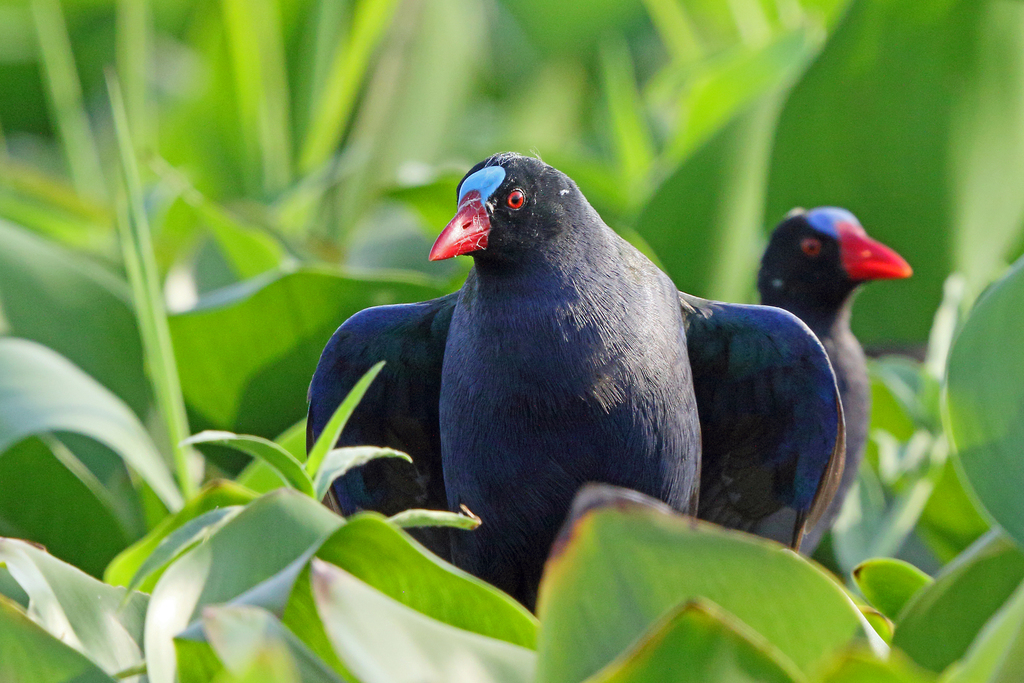
Allen's gallinule (Porphyrio alleni), formerly known as the lesser gallinule, is a small waterbird of the family Rallidae. Its former binomial name is Porphyrula alleni. Porphyrio is the Latin for "swamphen", and alleni, like the English name, commemorates British naval officer Rear-Admiral William Allen (1792–1864).
From the article Allen's gallinule on Wikipedia (CC BY-SA), quoted section by section
Description
They are similar in size to the only slightly larger water rail. The Allen's gallinule has a short red bill, greenish back and purple upperparts. They have red legs with long toes, and a short tail which is white with a dark central bar underneath. Breeding males have a blue frontal shield, which is green in the female. Immature Allen's gallinules are sandy brown with a buff undertail. The downy chicks are black, as with all rails. They nod their heads as they swim.
Range & habitat
Allen's gallinules are found year-round in marshes and lakes in Sub-Saharan Africa. It has occurred as a vagrant in several European countries, and is the only purely Sub-Saharan bird species to reach Great Britain.
Wikipedia: “Distribution and habitat”
What it does
These birds probe with their bill in mud or shallow water, also picking up food by sight. They mainly eat insects and aquatic animals.
Wikipedia: “Diet”
Listen
Looking for field recordings…
Where it lives
Recorded sightings
—
geo-referenced records in GBIF, from museums, herbaria and field observers.
Drag the globe to turn it. Dots are where records exist, not a range map; darker means more records.
In the stacks
Searching the stacks…
Every page naming Porphyrio alleni in the Biodiversity Heritage Library →
This page is assembled live from iNaturalist, GBIF, Wikipedia, the Source Library and the Internet Archive. It is not yet part of the hand-edited codex. iNaturalist taxon 522.