- Animals
- ›Chordates
- ›Vertebrates
- ›Reptiles
- ›Snakes and Lizards
- ›Snakes
- ›Colubrid Snakes
- ›Colubrine Snakes
- ›Lampropeltis
- ›Lampropeltis triangulum
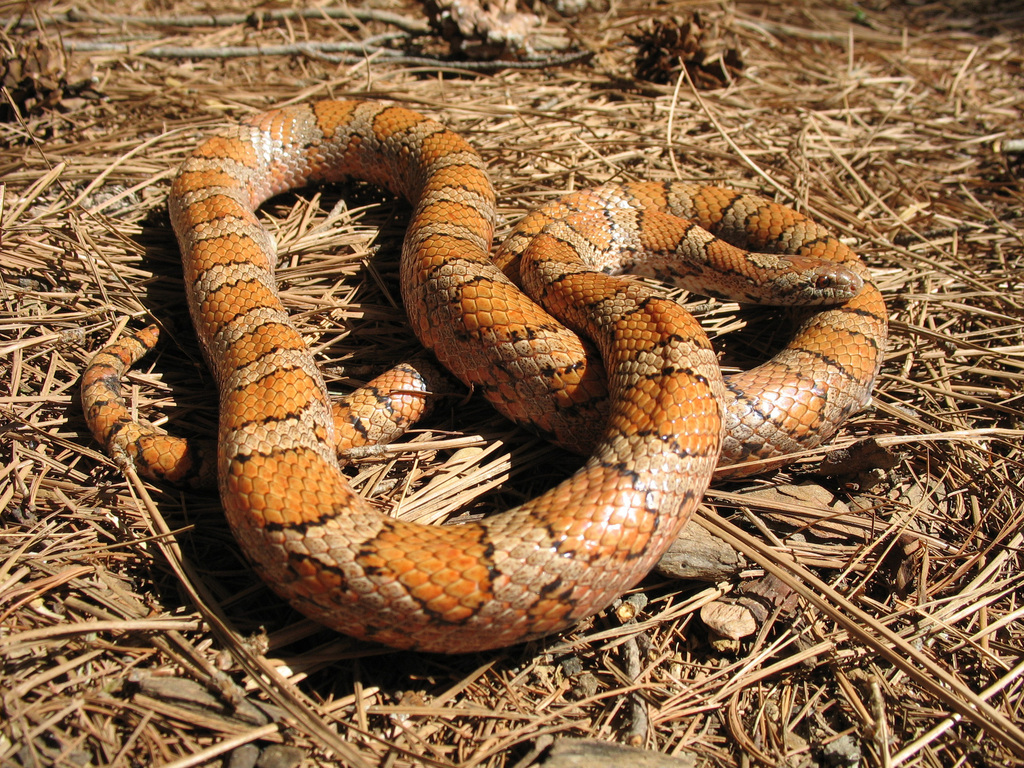
Eastern Milksnake
Lampropeltis triangulum
The milk snake or milksnake (Lampropeltis triangulum), is a species of kingsnake; there were once up to 24 subspecies recognized, however fewer are officially recognized today. Lampropeltis elapsoides, the scarlet kingsnake, was formerly classified as a 25th subspecies (L. t. elapsoides), but is now recognized as a distinct species. The previously delineated subspecies have strikingly different appearances, and many of them have their own common names. Morphological and genetic data suggest that this species could be split into several separate species, and it has been by several authorities. Lampropeltis gentilis, Lampropeltis annulata, Lampropeltis abnorma, Lampropeltis polyzona, and Lampropeltis micropholis have been elevated to the species level. Milksnakes are not venomous.
From the article Milk snake on Wikipedia (CC BY-SA), quoted section by section
Description
There is a significant amount of variation among milk snakes in terms of size. Depending on subspecies, they can be as small as 14 in (36 cm) or as large as 72 in (180 cm) long. Adults in the wild apparently average from 38 to 225 g (1.3 to 7.9 oz) in North America. However, unusually large milk snakes can become rather bulkier than average-sized adults and potentially weigh up to 750 to 1,400 g (1.65 to 3.09 lb), though high weights as such are generally reported from captivity. Males typically are larger than females in maturity, although females can be bulkier than males similar in length as well. Generally more tropical populations, from Mexico and further south, reach larger adult sizes than milk snakes living in the temperate zones. Milk snakes have smooth and shiny scales and their typical color pattern is alternating bands of red-black-yellow or white-black-red; however, red blotches instead of bands are seen in some populations. Some milk snakes have a striking resemblance to coral snakes, in Batesian mimicry, which likely scares away potential predators. Both milk snakes and coral snakes possess transverse bands of red, black, and yellow. Experts now recognize that common mnemonics that people use to distinguish between the deadly coral snake and the harmless milk snake are not 100% reliable. Some coral snakes do not have the typical banding colors or patterns. …
Range & habitat
Milk snakes can be found from the southeastern extreme of Ontario, Canada, into southeastern Maine and all the states of the Eastern Seaboard of the United States of America, south to Florida, Alabama, Mississippi; from central Minnesota to Colorado, Nebraska, and the Dakotas; they are found in the foothills of the Appalachian Mountains; and in Georgia, Tennessee, Kentucky, Arkansas, Missouri, Kansas, Oklahoma, Texas and Louisiana. There are further subspecies found in nearly all of Mexico, from the state of Sonora east to the Gulf coast of Tamaulipas and throughout the rest of south and central Mexico; all through Central America and into Colombia and Ecuador.
Wikipedia: “Geographic range”
What it does
Milk snakes are mostly nocturnal, especially during summer months. They are primarily terrestrial and attempt to blend in with ground litter. However, they are able to climb and swim. These snakes tend to be secretive and remain hidden. When threatened, a milk snake will usually first try to escape. If cornered or harassed, it may vibrate its tail and strike energetically, though they are non-venomous, have only tiny teeth and their tails lack a rattle. Unless frightened, milk snakes move slowly. They are often fairly docile.
Wikipedia: “Behavior”
Where it lives
Recorded sightings
—
geo-referenced records in GBIF, from museums, herbaria and field observers.
Drag the globe to turn it. Dots are where records exist, not a range map; darker means more records.
In the stacks
Searching the stacks…
Every page naming Lampropeltis triangulum in the Biodiversity Heritage Library →
This page is assembled live from iNaturalist, GBIF, Wikipedia, the Source Library and the Internet Archive. It is not yet part of the hand-edited codex. iNaturalist taxon 515419.