- Animals
- ›Chordates
- ›Vertebrates
- ›Birds
- ›Hawks, Eagles, Kites, and Allies
- ›Hawks, Eagles, and Kites
- ›Typical Eagles and Hawk-Eagles
- ›Hieraaetus
On eBird ↗
Booted Eagle
Live sightings near you, the range map, bar charts of when it is seen, and Macaulay Library photos and recordings.
Booted Eagle
Hieraaetus pennatus
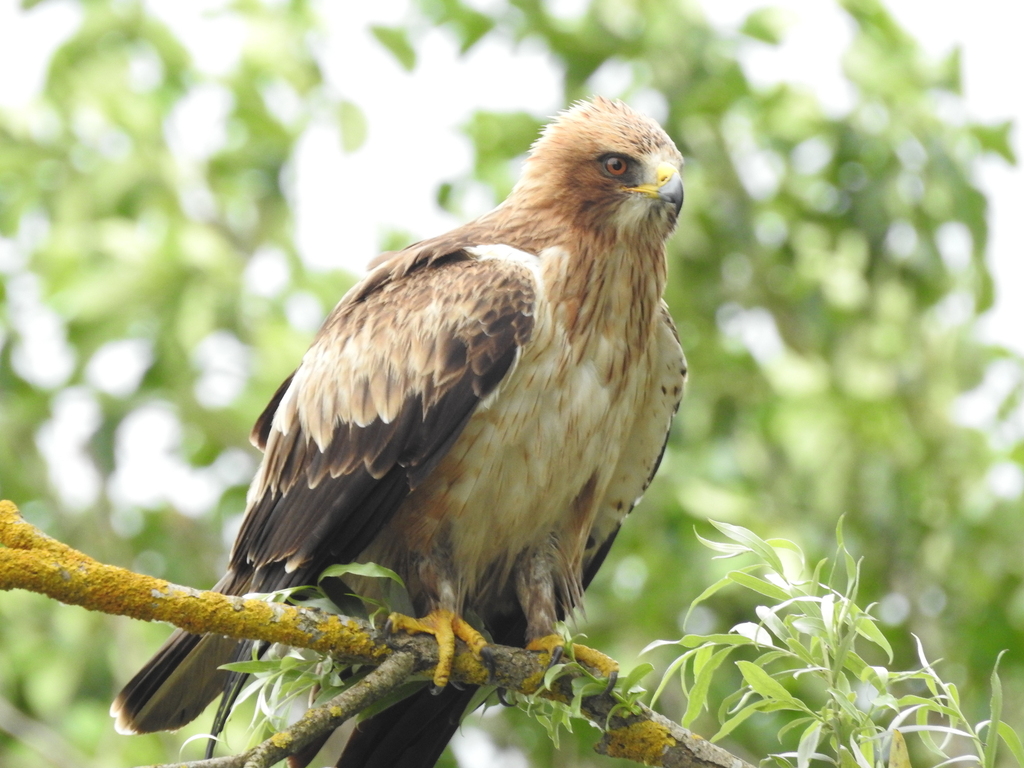
The booted eagle (Hieraaetus pennatus, also classified as Aquila pennata) is a medium-sized mostly migratory bird of prey with a wide distribution in the Palearctic and southern Asia, wintering in the tropics of Africa and Asia, with a small, disjunct breeding population in south-western Africa. Like all eagles, it belongs to the family Accipitridae.
From the article Booted eagle on Wikipedia (CC BY-SA), quoted section by section
Description
The booted eagle is a small eagle with a length of 40 cm (16 in) and a wingspan of 110–132 cm (43–52 in); males weigh about 510–770 g (18–27 oz) and females about 840–1,025 g (29.6–36.2 oz). There are two relatively distinct plumage forms; pale individuals are mainly light grey with a darker head and flight feathers. The other form has mid-brown plumage with dark grey flight feathers. These discrete colour morphs follow a Mendelian inheritance pattern, where the paler allele is dominant. The dark colour morph represents 20% of the population in South Africa, but it is much more common in eastern populations such as in Russia. Booted eagles are typically seen in pairs or as solitary individuals. The call is a shrill kli-kli-kli.
Range & habitat
The booted eagle has breeding populations in many different regions in both the northern and southern hemisphere. These include southern Europe, North Africa and across Asia, and also in western South Africa and Namibia. The northern populations are migratory spending November to February in Sub-Saharan Africa and South Asia, while the small southern African populations is sedentary. This is a species of wooded, often hilly countryside with some open areas. It breeds in rocky, broken terrain but migrants will use almost any type of habitat other than dense forest. The birds of the Palearctic breeding population tend to nest in coniferous or deciduous woodlands and often in trees.
Southern African populations. It is believed that there may be three separate groups of booted eagles in Southern Africa. There is evidence of a population which breeds in the south-western Cape region of South Africa, arriving in early August, laying eggs in September, and leaving in March of the following year. From about April to July the birds migrate northwards, some possibly overwintering in Namibia. A small breeding population in Northern Namibia has also been observed. The third group is a non-breeding population thought to migrate south from Eurasia and North Africa in summer, however no empirical evidence of this has been documented. …
Wikipedia: “Distribution and habitat”
What it does
The booted eagle typically flies at relatively low heights, making it conspicuous. However, the dark morph can be confused with other local medium sized birds of prey. In South Africa, 20% of the population is the dark colour morph.
Diet and hunting. The booted eagle typically hunts on the wing, stooping quickly with wings folded in and feet extended. It hunts small mammals, reptiles and birds. In Southern Africa, it has been noted that birds are the most common prey. It has been suggested that frogs comprise an important part of the booted eagle diet, however this has not been observed in the Southern African populations. Studies conducted in south-western South Africa observed that they ate birds, lizards, and rodents.
Breeding. This eagle lays 1–2 eggs in a nest built from sticks and lined with green leaves in a tree or on a crag, or it takes over the disused nest of another large bird such as a black kite or grey heron. The female incubates the egg for around 45 days and is fed by the male, after hatching she guards the nest and the young while the male provides all the food. The chick fledges after 70–75 days. Booted eagles are monogamous and perform courtship rituals of sophisticated flight demonstrations.
Southern Africa. The population of eagles which breed in the Cape region of South Africa typically do so shortly after arriving in August. …
Wikipedia: “Behaviour and ecology”
Listen
Looking for field recordings…
Where it lives
Recorded sightings
—
geo-referenced records in GBIF, from museums, herbaria and field observers.
Drag the globe to turn it. Dots are where records exist, not a range map; darker means more records.
In the stacks
Searching the stacks…
Every page naming Hieraaetus pennatus in the Biodiversity Heritage Library →
This page is assembled live from iNaturalist, GBIF, Wikipedia, the Source Library and the Internet Archive. It is not yet part of the hand-edited codex. iNaturalist taxon 5154.