- Animals
- ›Chordates
- ›Vertebrates
- ›Birds
- ›Swifts and Hummingbirds
- ›Hummingbirds
- ›Bee Hummingbirds, Emeralds, Mountain-gems, and Allies
- ›Emerald Hummingbirds and Allies
- ›Stephanoxis
On eBird ↗
Purple-crowned Plovercrest
Live sightings near you, the range map, bar charts of when it is seen, and Macaulay Library photos and recordings.
Purple-crowned Plovercrest
Stephanoxis loddigesii
The purple-crowned plovercrest, or violet-crowned plovercrest, (Stephanoxis loddigesii) is a species of hummingbird in the "emeralds", tribe Trochilini of subfamily Trochilinae. It is found in Argentina, Brazil, and Paraguay.
From the article Purple-crowned plovercrest on Wikipedia (CC BY-SA), quoted section by section
Description
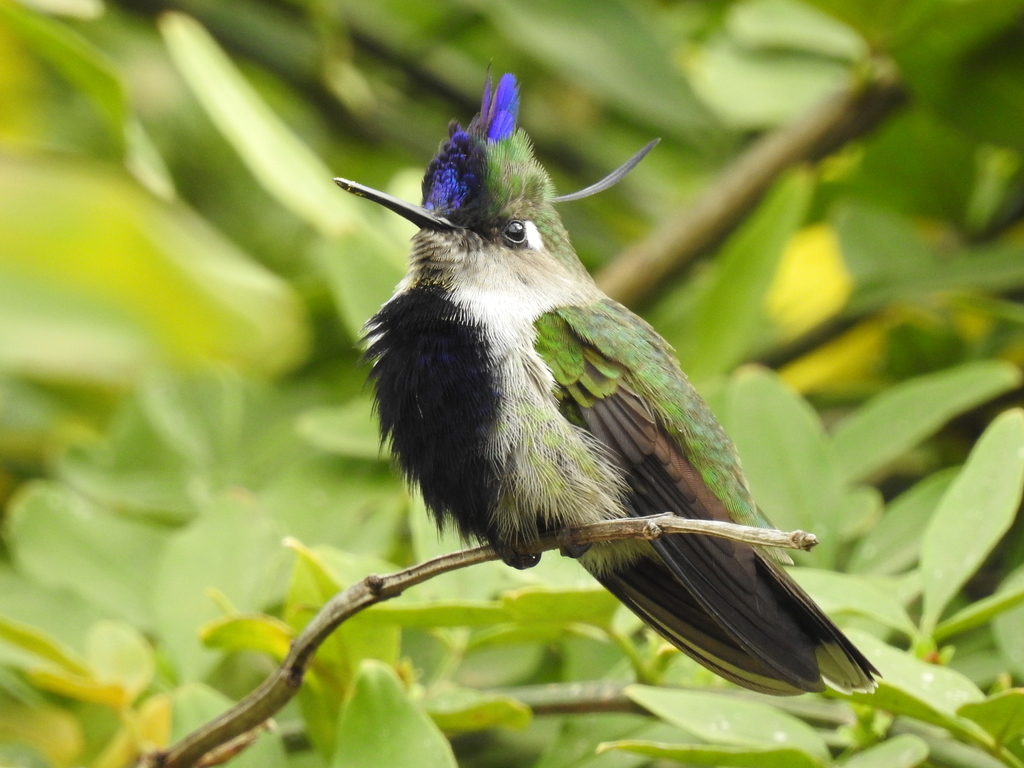
The purple-crowned plovercrest is 8.5 to 9.5 cm (3.3 to 3.7 in) long. Males weigh about 3.7 g (0.13 oz). Both sexes have a shortish, straight, black bill. Adult males have a shaggy violet-blue crest. Their face, chin, and throat are brownish with a white spot behind the eye. Their upperparts yellowish green. Their lower throat to upper belly is blackish violet-blue and the rest of the underparts are gray. Their central two pairs of tail feathers are green and the rest green with a blackish band near the end and whitish tips. Adult females and juveniles have a much smaller crest. Their upperparts are also yellowish green and their underparts gray.
Range & habitat
The purple-crowned plovercrest is found in eastern Paraguay, far northeastern Argentina, and southern Brazil as far north as southern São Paulo state. It inhabits the understory of forest, scrublands, and vegetation along watercourses. In elevation it ranges between sea level and about 900 m (3,000 ft).
Wikipedia: “Distribution and habitat”
What it does
The purple-crowned plovercrest forages for nectar from near the ground to the canopy, utilizing both native and introduced flowering species. Males defend feeding territories during the breeding season. In addition to nectar, the species feeds on insects caught in flight or gleaned from leaves.
Wikipedia: “Feeding”
Listen
Looking for field recordings…
Where it lives
Recorded sightings
—
geo-referenced records in GBIF, from museums, herbaria and field observers.
Drag the globe to turn it. Dots are where records exist, not a range map; darker means more records.
In the stacks
Searching the stacks…
Every page naming Stephanoxis loddigesii in the Biodiversity Heritage Library →
This page is assembled live from iNaturalist, GBIF, Wikipedia, the Source Library and the Internet Archive. It is not yet part of the hand-edited codex. iNaturalist taxon 513980.