- Animals
- ›Chordates
- ›Vertebrates
- ›Ray-finned Fishes
- ›Salmons, Pikes and Mudminnows
- ›Pikes and Mudminnows
- ›Pikes and Allied Mudminnows
- ›Pikes
- ›Esox
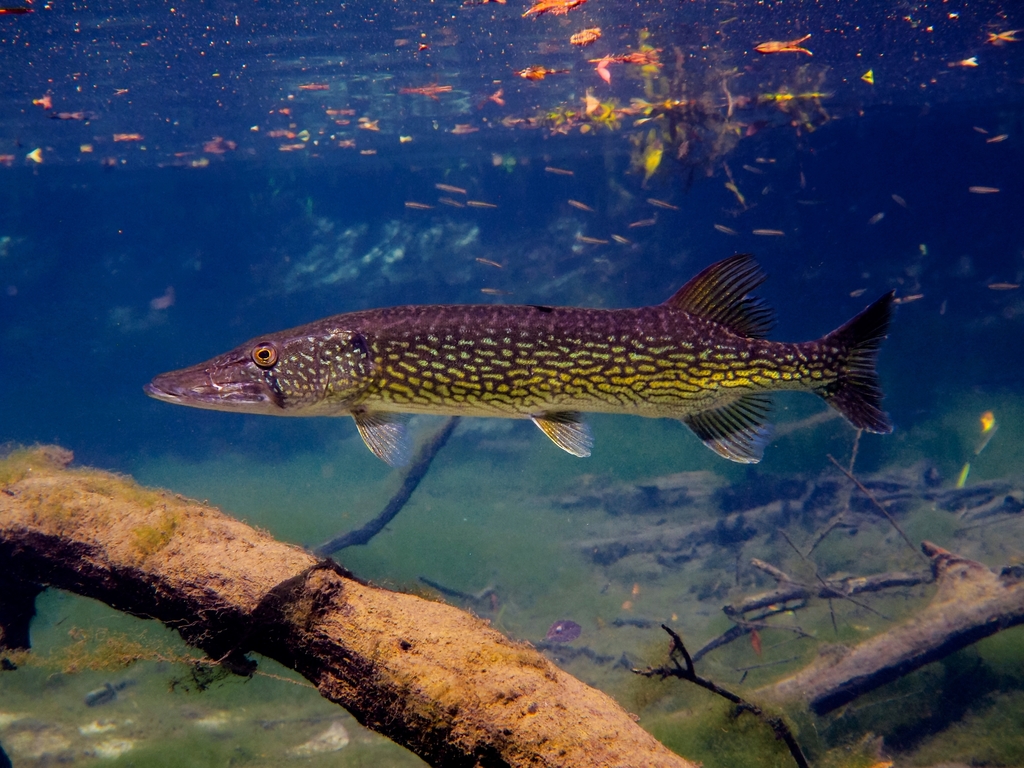
Chain Pickerel
Esox niger
The chain pickerel (Esox niger), also known as Jackfish, Mud Pike, or Southern Pike is a species of freshwater fish in the pike family (family Esocidae) of order Esociformes. The chain pickerel and the American pickerel (E. americanus) belong to the Esox genus of pike.
From the article Chain pickerel on Wikipedia (CC BY-SA), quoted section by section
Description
The chain pickerel has a distinctive, dark, chain-like pattern on its greenish sides. There is a vertical dark marking underneath the eye, which helps to distinguish the chain pickerel from redfin pickerel (Esox americanus americanus) and grass pickerel (E. a. vermiculatus), in which the mark curves posteriorly. Its body outline resembles that of the northern pike (E. lucius). Unlike northern pike, however, the opercles and cheeks of chain pickerel are entirely scaled. It may reach up to 78.7 centimetres (31.0 in) long only on rare occasions. The average size for chain pickerel, however, is 24 in (61 cm) and 3 lb (1 1/2 kg). (The average chain pickerel caught by fishermen is under 2 lb.) It lives around 8 yr. In some places the pickerel is known as a "gunfish", "gunny" or "slime dart", due to its characteristic slime coating. A blue color morph lacking the usual reticulated pattern has been described in a New York population.
Range & habitat
Its range is along the eastern coast of North America from southern Canada to Florida, and west to Texas. In the New England, the species occurs in Maine and New Hampshire. The fish inhabits fresh and brackish water from the Mississippi Valley. It also is commonly found in Lake Michigan and the lower portion of the Great Lakes. In the Canadian Maritimes, chain pickerel is known from New Brunswick and Nova Scotia. Chain pickerel is considered an invasive species in Nova Scotia, where native fish stocks have been severely impacted by the effects of its introduction, primarily through its role as a voracious predator. Historical angling destinations in the province's mainland, like Kejimkujik National Park, have been heavily impacted by the illegal introduction of this fish to the area.
Wikipedia: “Distribution”
What it does
Like the northern pike, the chain pickerel feeds primarily on smaller fish, until it grows large enough to ambush large fish from cover with a rapid lunge and to secure it with its sharp teeth. Chain pickerel are also known to eat frogs, snakes, worms, mice, other small mammals, crayfish, other small crustaceans, insects, and a wide variety of other foods. It is not unusual for pickerel to leap out of the water at flying insects, or even at dangling fishing lures. Raney (1942) studied chain pickerel in a New York pond and found that golden shiners were found in the stomachs of 47.3% of the 234 chain pickerel examined. Brown bullheads were found in 13.8%, and pumpkinseed sunfish were found in 13.2%. Crayfish of the genus Cambarus were present in 42% of the chain pickerel.
Wikipedia: “Diet”
Where it lives
Recorded sightings
—
geo-referenced records in GBIF, from museums, herbaria and field observers.
Drag the globe to turn it. Dots are where records exist, not a range map; darker means more records.
In the stacks
Searching the stacks…
Every page naming Esox niger in the Biodiversity Heritage Library →
This page is assembled live from iNaturalist, GBIF, Wikipedia, the Source Library and the Internet Archive. It is not yet part of the hand-edited codex. iNaturalist taxon 51367.