- Animals
- ›Chordates
- ›Vertebrates
- ›Cartilaginous Fishes
- ›Sharks and Rays
- ›Rays
- ›Stingrays
- ›Eagle Rays
- ›Myliobatis
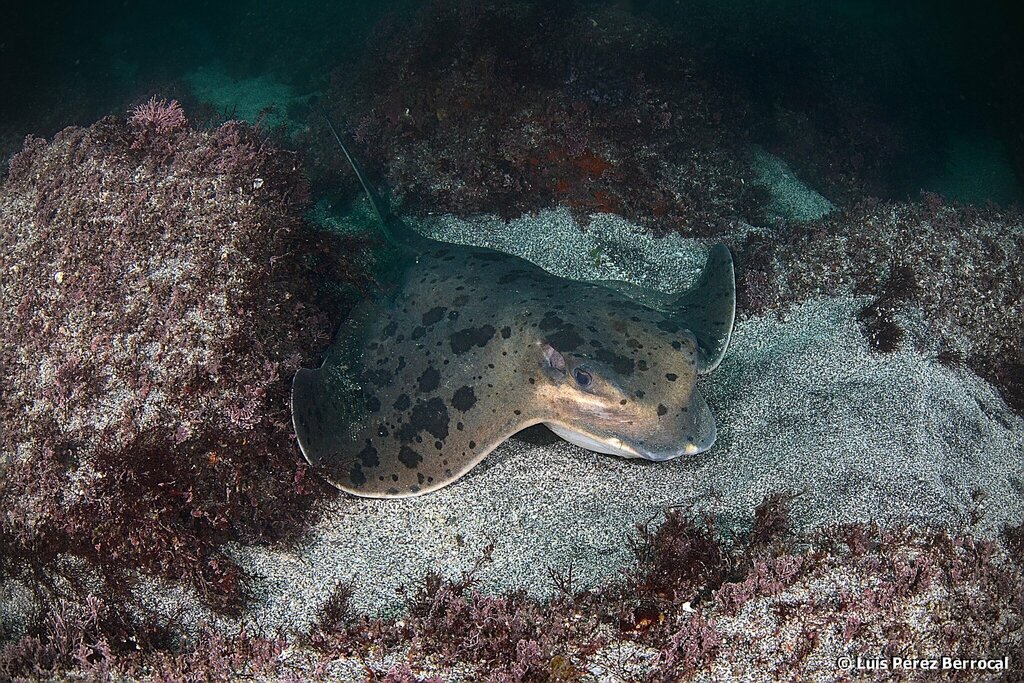
Kite Ray
Myliobatis tobijei
The Japanese eagle ray (Myliobatis tobijei), also known as the cowhead eagle ray, or kite ray, is a ray species in the family Myliobatidae.
From the article Japanese eagle ray on Wikipedia (CC BY-SA), quoted section by section
Description
The Japanese eagle ray grows to be up to 150 centimeters long and has a disc at least 114 centimeters wide. It is yellow-brown in color, and usually contains darker spots. It has rather long stinging spines, and its claspers are less than one-tenth the width of its disc. Each jaw of the species contains seven rows of teeth.
Range & habitat
The Japanese eagle ray lives in the waters of East Asia, particularly in Japan, Korea, and China. It is also found in Indonesia and the Philippines. It is a tropical marine species, and lives in depths of over 220 meters. The species is sometimes caught as a bycatch. It is also sometimes caught intentionally for its meat, as well as for its cartilage. Little else is known about its population and threats. There are currently no conservation measures taking place for this species, and it is listed as Vulnerable by IUCN.
Wikipedia: “Distribution, threats, and conservation”
What it does
The Japanese eagle ray is demersal, usually inhabiting sea floors and feeding on benthic animals. In particular, it is known to eat crustaceans, fish, and sometimes benthic plants. Like all mylobatids, the species is ovoviviparous. Embryos initially feed on yolk. They later receive nourishment by indirectly absorbing uterine fluid from their mother. Little else is known about the biology of this species.
Wikipedia: “Behavior”
Where it lives
Recorded sightings
—
geo-referenced records in GBIF, from museums, herbaria and field observers.
Drag the globe to turn it. Dots are where records exist, not a range map; darker means more records.
In the stacks
Searching the stacks…
Every page naming Myliobatis tobijei in the Biodiversity Heritage Library →
This page is assembled live from iNaturalist, GBIF, Wikipedia, the Source Library and the Internet Archive. It is not yet part of the hand-edited codex. iNaturalist taxon 51318.