- Animals
- ›Chordates
- ›Vertebrates
- ›Birds
- ›Pelicans, Herons, Ibises, and Allies
- ›Herons, Egrets, and Bitterns
- ›Tiger-Herons
- ›Tigrisoma
On eBird ↗
Rufescent Tiger-Heron
Live sightings near you, the range map, bar charts of when it is seen, and Macaulay Library photos and recordings.
Rufescent Tiger-Heron
Tigrisoma lineatum
The rufescent tiger heron (Tigrisoma lineatum) is a species of heron, birds in the family Ardeidae. It is found in wetlands from Central America through much of South America.
From the article Rufescent tiger heron on Wikipedia (CC BY-SA), quoted section by section
Description
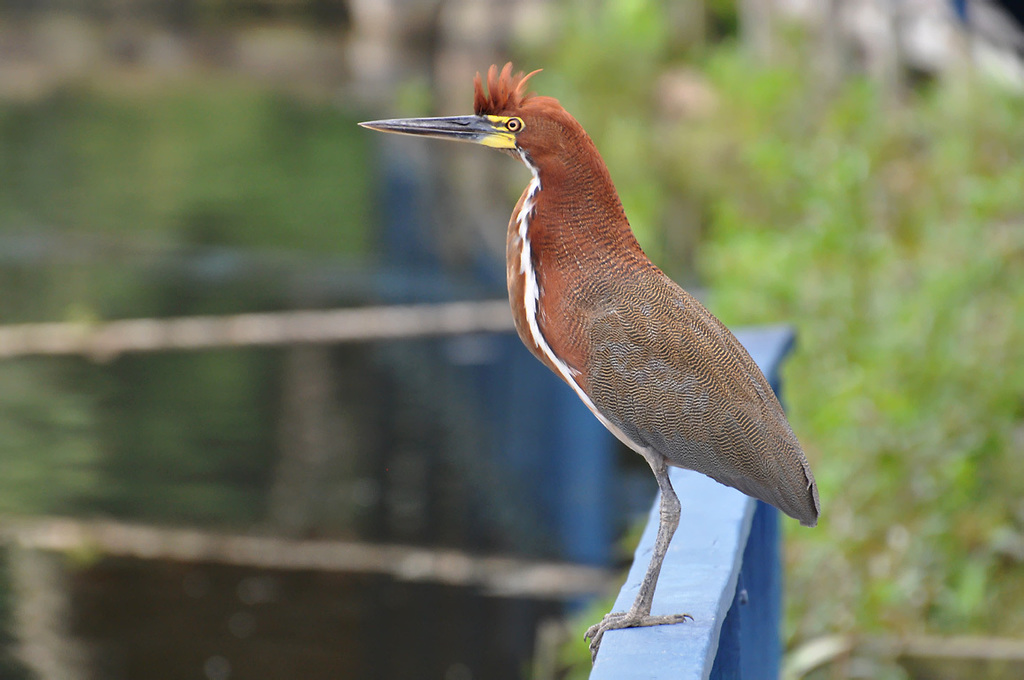
The rufescent tiger heron is a medium-sized heron, measuring 26–30 in (66–76 cm) in length, with a mass between 630 and 980 g (22 and 35 oz). The sexes are similarly plumaged. The adult's head, neck and chest are dark rufous, with a white stripe down the center of the foreneck. The remainder of its upperparts are brownish with fine black vermiculations, its belly and vent are buffy-brown, and its flanks are barred black and white. Its tail is black, narrowly barred with white. Its stout bill is yellowish to dusky, and its legs are dull green. Its irides, loral skin, and orbital ring are bright yellow. Unlike other tiger herons, it has no powder down feathers on its back. The juvenile bird is rusty-buff overall, coarsely barred with black; the buff and black banding on its wings is especially pronounced. Its throat, central chest, and belly are white. It takes some five years to acquire adult plumage.
Similar species. The adult rufescent tiger heron is relatively easy to distinguish from fasciated and bare-throated tiger herons, as it is rufous (rather than primarily gray) on the head and neck. Young birds, however, are much more difficult to identify.
Range & habitat
The rufescent tiger heron is found in wetlands from Central America through much of South America. It generally occurs below 500 m (1,600 ft), though it has been recorded as high as 1,600 m (5,200 ft) in Colombia.
Wikipedia: “Distribution and habitat”
What it does
As might be expected of a species that spends most of its time by the water, much of the rufescent tiger heron's diet is aquatic-based, including fish, crustaceans, water beetles, and dragonfly larvae. It also takes adult dragonflies and grasshoppers. It typically hunts alone, standing hunched in shallow pools or wet areas of a forest while it waits for prey.
Wikipedia: “Food and feeding”
Listen
Looking for field recordings…
Where it lives
Recorded sightings
—
geo-referenced records in GBIF, from museums, herbaria and field observers.
Drag the globe to turn it. Dots are where records exist, not a range map; darker means more records.
In the stacks
Searching the stacks…
Every page naming Tigrisoma lineatum in the Biodiversity Heritage Library →
This page is assembled live from iNaturalist, GBIF, Wikipedia, the Source Library and the Internet Archive. It is not yet part of the hand-edited codex. iNaturalist taxon 5048.