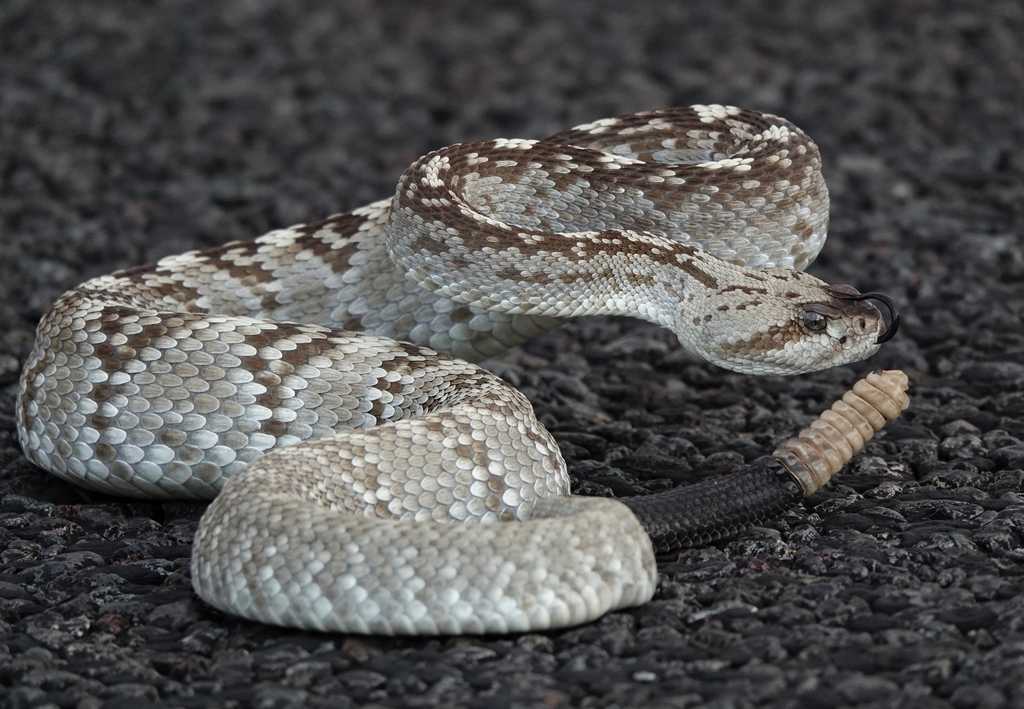
Eastern Black-tailed Rattlesnake
Crotalus ornatus
The black-tailed rattlesnake (Crotalus molossus) is a venomous pit viper species found in the southwestern United States and Mexico. Four subspecies are currently recognized, including the nominate subspecies described here.
From the article Black-tailed rattlesnake on Wikipedia (CC BY-SA), quoted section by section
Description
This medium-sized species averages from 76 to 107 cm (30 to 42 in) in length. Large specimens are usually not much more than 100 cm (39 in) long, although lengths of 125.0 cm (49.2 in) (Gloyd, 1940), 125.7 cm (49.5 in) (Klauber, 1972), and 129.5 cm (51.0 in) (Shaw & Campbell, 1974) have been reported. The females tend to be larger than the males. They range in color from yellows and olive greens to browns and black. As their name implies, one of their most distinguishing features is, despite variations in body color, entirely black tail scales. Often, this rattlesnake has a black band across its eyes extending diagonally down to the corners of its mouth, forming a sort of facial 'mask'. Like other rattlesnakes, C. molossus has a rattle composed of keratin on the end of its tail. Each time the snake sheds its skin, a new segment is added to the rattle. A snake can shed its skin several times a year, and the rattle is fairly fragile and can be broken, so that the length of a rattlesnake's rattle is not an accurate measure of its age, unless the terminal button is intact.
Range & habitat
The black-tailed rattlesnake is found in the southwestern United States in Arizona, New Mexico and west and central Texas, and Mexico as far south as Oaxaca, as well as the Gulf of California on San Estéban and Tiburón Islands. Its distribution reaches a maximum elevation of 2930 m, although it has been recorded at as high as 6900 feet at the McDonald Observatory in the Davis Mountains of west Texas. The type locality given is "Fort Webster, St. Rita del Cobre, N. Mex." (Fort Webster, Santa Rita del Cobre, Grant County, New Mexico, USA).
Wikipedia: “Distribution and habitat”
What it does
All rattlesnakes are carnivorous, their primary food sources being rodents, other small mammals, birds, and small reptiles (such as small lizards). The behavior of northern black-tailed rattlesnakes varies over the course of a year. In the spring and fall, they are primarily diurnal. In the summer, they shift to a nocturnal behavior, to avoid the heat of summer. In the winter, they hibernate in dens created and abandoned by other animals, often with other species of snakes. They are variable in their form of locomotion depending on what substrate they need to traverse and will actively change between sidewinding or rectilinear movement. Although it is an able climber and expert swimmer, C. molossus is primarily a terrestrial species and inhabits grasslands, desert areas, and rocky and mountainous areas, as well as high-altitude forests.
Docility and defense. Crotalus molossus is considered to be one of the most docile rattlesnakes because of its calm demeanor and curious nature. Bites are accordingly fairly rare. The snake relies mostly on camouflage to avoid discovery. It normally tries to slither away when confronted, but will rattle when cornered.
Venom. The venom of the C. molossus is primarily hemotoxic, like that of most crotalids. However, it is only about two-thirds as toxic as western diamondback venom and is generally not fatal to humans. …
Wikipedia: “Behavior and ecology”
Where it lives
Recorded sightings
—
geo-referenced records in GBIF, from museums, herbaria and field observers.
Drag the globe to turn it. Dots are where records exist, not a range map; darker means more records.
In the stacks
Searching the stacks…
Every page naming Crotalus ornatus in the Biodiversity Heritage Library →
This page is assembled live from iNaturalist, GBIF, Wikipedia, the Source Library and the Internet Archive. It is not yet part of the hand-edited codex. iNaturalist taxon 503374.