- Animals
- ›Chordates
- ›Vertebrates
- ›Reptiles
- ›Turtles and Tortoises
- ›Pond and Box Turtles
- ›Emydine Turtles
- ›Clemmys
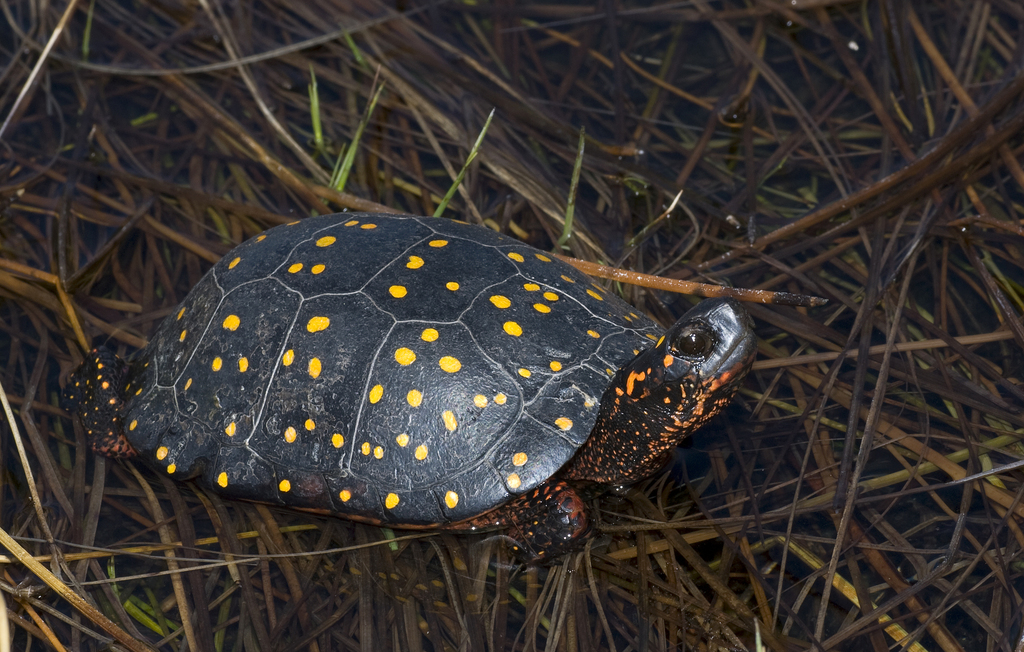
Spotted Turtle
Clemmys guttata
The spotted turtle (Clemmys guttata), the only species of the genus Clemmys, is a small, semi-aquatic turtle. Their broad, smooth, low upper shell, or carapace, reaches 8–12 cm (3.1–4.7 in) upon adulthood, and ranges in its exact colour from black to a bluish black with a number of tiny yellow round spots. The spotting patterning extends from the head, to the neck and out onto the limbs. Sexually mature males have a concave plastron and a long, thick tail. By contrast, sexually mature females possess a flat plastron and have a tail that is noticeably shorter and thinner than that of mature males. Mature males also have a dark iris and face; females typically have a yellow or orange iris and a similarly coloured face that is distinctly lighter than the males'. Juveniles appear female-like in this regard, and at maturity males begin to develop darker features.
Spotted turtles are aquatic omnivores that inhabit a variety of semi-aquatic or in other words, shallow, fresh-water areas such as flooded forests, marshes, wet meadows, bogs and woodland streams in southern Canada (Ontario) and the eastern US: the eastern Great Lakes and east of the Appalachian Mountains.
From the article Spotted turtle on Wikipedia (CC BY-SA), quoted section by section
Description
The spotted turtle is small and has a gray to black base color. Its upper shell (carapace) is smooth, does not have a central ridge running down the middle (called a "keel"), and grows to 3.5–12.5 cm (1.4–4.9 in) in length. It is also totally black and contains anywhere from zero to about one hundred yellow spots, which are a defining characteristic of this turtle. Although perhaps inconsequential, it has been found that the left side of the upper shell has more spots than the right. Spots can always be found on the head, neck, and limbs. The bottom shell (plastron) is yellow or orange-yellow and a black spot is present on each section (scute); however, with age, melanism of the plastron increases until the entire surface is black.
The head is black and the upper jaw is notched. On each side of the head is a large orange blotch. Also present are several yellow bands of varying size. Skin on the dorsal side of the turtle is black with sparse yellow spots while skin on the ventral side may be brighter: orange, pink, or red. These lightly pigmented areas do vary geographically and the tail of some individuals has yellow striping. Regarding the geographical variation in spots, southern individuals tend to have smaller and less conspicuous spots than those of individuals from farther north. …
Range & habitat
The spotted turtle ranges from southern Maine, Quebec, and Ontario, south along the eastern US to Florida in the east and central Indiana and Ohio in the west. Disjunct populations exist in the Canadian portion of its range and also in central Illinois, central Georgia, North Carolina, South Carolina, and Indiana. In Indiana and Illinois, the species is found only in the northern portion of the state but it is found on most of the lower peninsula of Michigan. The highly fragmented distribution of spotted turtles in Ohio only covers the northern two-thirds of the state. The spotted turtle occupies a variety of habitats including swamps, bogs, fens, marshes, woodland streams, and wet pastures. Also, brackish streams that are influenced by tides can also serve as a home to this turtle in addition to ditches, vernal pools, and sedge meadows. For a habitat to be sufficient for spotted turtle survival it must have areas of soft substrate and at least some aquatic vegetation. An optimum habitat would include shallow and slow-moving waters with soft muddy soil, sedge tussocks, water lilies, sphagnum moss, and cattails. Because it is so often found in areas that contain duckweed, the yellow spots on these turtles may serve as a form of camouflage. …
Wikipedia: “Distribution”
What it does
A study in Pennsylvania analyzed the reproductive biology of the spotted turtle. Sexual maturity is not reached until age 8, upon which researchers found that courtship and nesting periods typically ranged from March until June. The courtships involved females being frantically chased by one to several males for approximately 15 to 30 minutes. During the chase, females' tails and legs were often bit by males. If two males were present, they occasionally stopped the chase to fight with one another and the losing male retreated. When the female was caught, the male mounted her and placed his tail beneath the female while grasping her carapace tightly. Females later constructed their nest in well-drained areas that were exposed to full sunlight. Clutches can range from 1–8 with an average of 3–4. These animals also exhibit temperature-dependent sex determination, meaning that the outside temperature during the incubation period determines the sex of the hatchling with males resulting from the temperature being lower and females when it's higher. After the eggs were laid, they were arranged in the nest by alternate movements of the hind feet. The hind feet were also used to scrape soil and grass back into the nest cavity. Incubation periods were estimated to range between 70 and 83 days.
Population features. …
Wikipedia: “Reproduction”
Where it lives
Recorded sightings
—
geo-referenced records in GBIF, from museums, herbaria and field observers.
Drag the globe to turn it. Dots are where records exist, not a range map; darker means more records.
In the stacks
Searching the stacks…
Every page naming Clemmys guttata in the Biodiversity Heritage Library →
This page is assembled live from iNaturalist, GBIF, Wikipedia, the Source Library and the Internet Archive. It is not yet part of the hand-edited codex. iNaturalist taxon 50000.