 NL·0405
Herbarium of the Nature Library
- Name
- Danio rerio
- Family
- Danionidae
- Native to
- India, Bangladesh, Nepal and Bhutan (Ganges and Brahmaputra basins), possibly Pakistan and Myanmar
- Habitat
- Rice paddies, Slow streams, Ponds
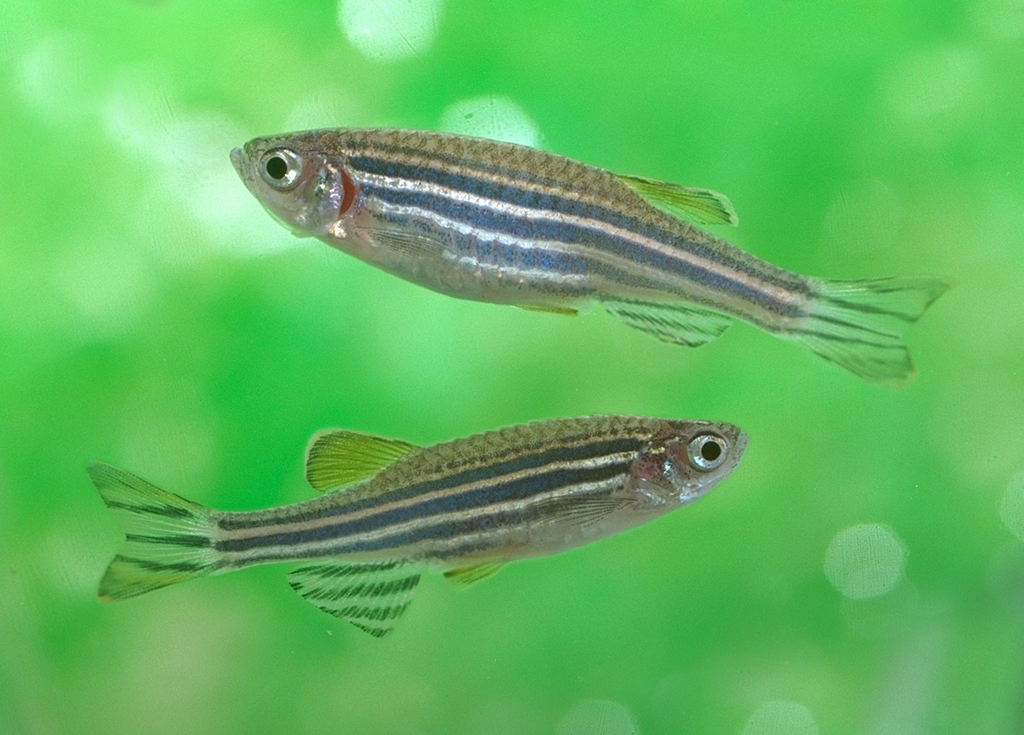
Zebrafish
Danio rerio
Also calledZebra danio · Poisson-zèbre (French)
A small striped minnow of South Asian paddies and streams that became one of biology's most important laboratory animals. Its transparent embryos develop in days, and it can regrow its heart, fins and retina.
The zebrafish is a species of danionin belonging to the genus Danio in the suborder Cyprinoidei. Native to South Asia, it is a popular, hardy aquarium fish, frequently sold under the trade name zebra danio. Wikipedia
What it can do
- iRegrows damaged heart muscle, fins, spinal cord and retina
- iiEmbryos are transparent and develop from egg to swimming larva in about 3 days
- iiiAbout 70% of human genes have a zebrafish counterpart, making it a model for disease research
In the field
Field marks
- aSlender, small minnow body with 5–7 horizontal blue-black stripes running to the tail tip
- bSilvery-gold to yellow stripes between the dark ones
- cTwo pairs of barbels
- dStriped anal fin
- Not to be confused with
- Pearl danio (Devario/Danio albolineatus) has no stripes but a pinkish iridescent sheen. Giant danio (Devario aequipinnatus) is bigger, with broken stripes and a yellow ground colour.
- Where to see it
- Paddy fields and streams of West Bengal and Bangladesh during the monsoon; research labs worldwide
- When
- Resident; breeds mostly in the monsoon
Life & habits
- Diet
- Omnivore: zooplankton, insects and larvae, algae
- Habitat
- Shallow, still or slow-flowing vegetated water, including rice paddies
- Size
- Up to about 4 cm
- Lifespan
- Usually 2–3 years; up to 5
Forms shoals and spawns at dawn, with females scattering eggs over vegetation and gravel.
Where it lives
Recorded sightings
—
geo-referenced records in GBIF, from museums, herbaria and field observers.
Native range
India, Bangladesh, Nepal and Bhutan (Ganges and Brahmaputra basins), possibly Pakistan and Myanmar
Drag the globe to turn it. Dots are where records exist, not a range map; darker means more records.
In the stacks
Searching the stacks…
Every page naming Danio rerio in the Biodiversity Heritage Library →
Marginalia
Buchanan-Hamilton described it from the Ganges in 1822. George Streisinger at the University of Oregon developed it as a lab model in the 1970s, and his 1981 Nature paper on producing clonal, homozygous zebrafish launched zebrafish genetics.
Curiosity
The zebrafish's stripes self-organise through interactions between three kinds of pigment cells, a textbook living example of the pattern-forming mechanism proposed by Alan Turing.
Kinship



Photographs: iNaturalist contributors under the licences shown. Records: GBIF.org. Historical plates: Source Library (CC BY-SA 4.0; originals public domain). Summary text: Nature Library editors and Wikipedia (CC BY-SA). Medicinal and edibility notes are historical and educational, not advice. iNaturalist taxon 49977.